-20260623-121211-800x450.webp)
Global online gambling revenue reached an estimated €72 billion in 2024, with projections placing the market above €92 billion by 2029 - a 28% increase over five years, driven by mobile growth, market expansion and rising player numbers across nearly every region.
Rapid expansion attracts investment, innovation and new players into the market. It also attracts bad actors who see opportunity in the gap between what a platform appears to offer and what it actually delivers. The bigger the market, the larger that opportunity becomes.
The data on fake games and unlicensed online casino operators is now substantial enough to draw clear conclusions. The cost of not checking is financial, measurable, and growing.
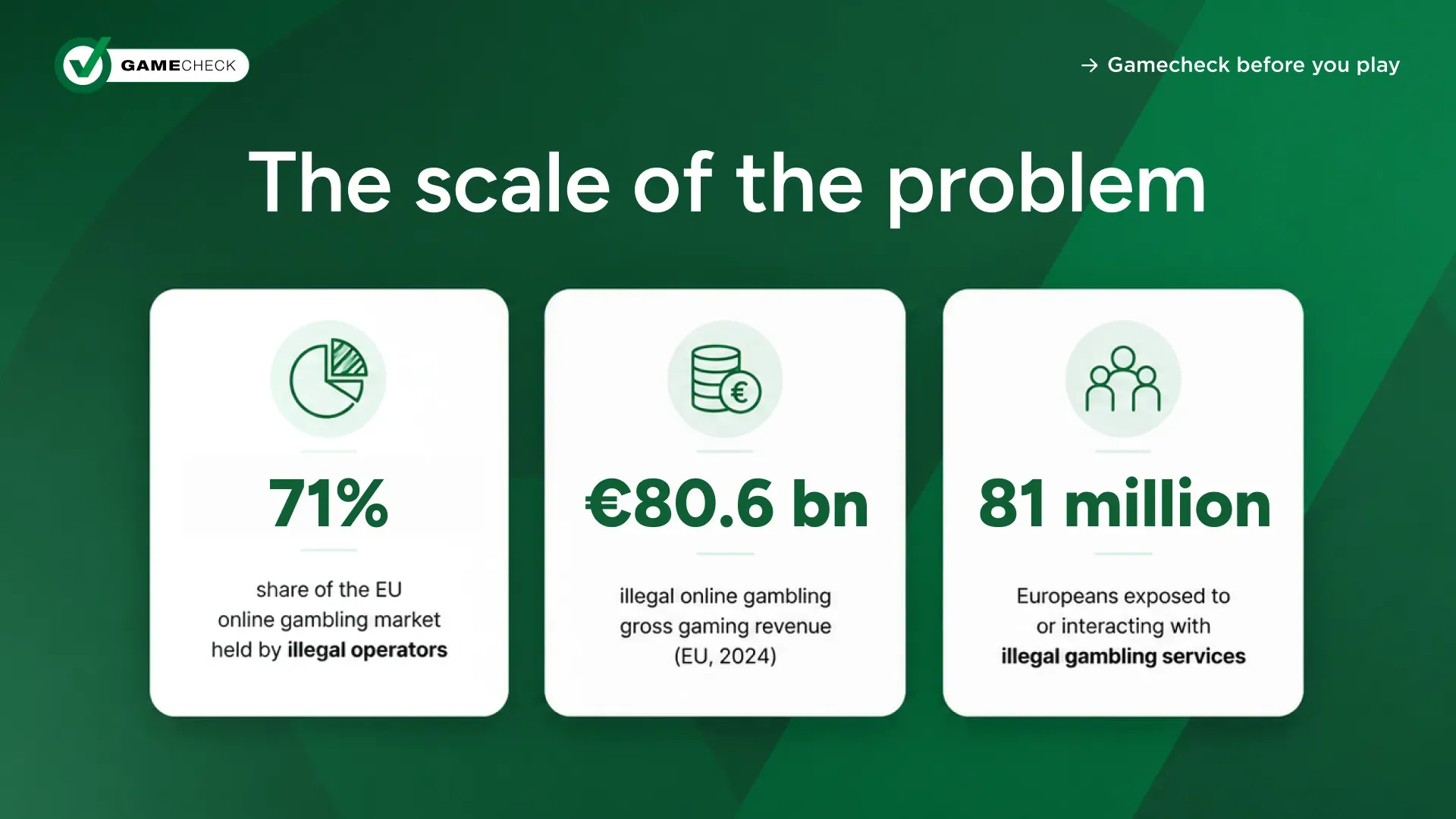
A study commissioned by the European Casino Association and conducted by global intelligence platform Yield Sec reveals that illegal online gambling operators now account for 71% of the European Union's online gambling market, representing an estimated €80.6 billion in gross gaming revenue, more than double the legal market's €33.6 billion. The study identifies over 6,200 illegal gambling operators actively targeting EU consumers online, with 81 million Europeans exposed to or interacting with illegal gambling services.
The tax dimension illustrates the scale of the problem. Illegal operators diverted more than €20 billion in tax revenue from European economies in 2024, the annual cost to public finances of a market operating outside the framework meant to protect the people using it.
The number of illegal operators increased by 26% in 2024 compared to 2023, and illegal gross gaming revenue jumped by 53% year-on-year. The market is not stable. It is accelerating.
The market includes operators running fake games, platforms impersonating brands and networks designed to extract deposits with no intention of processing withdrawals. Between 2022 and 2024, fraud in online gaming rose 64% year-on-year on average, driven by increasingly sophisticated fraud networks and AI-driven attacks. Losses for mobile casinos and betting platforms reached $1 billion a year. Fake games are a particularly damaging category, since players have no way to spot the problem from the game itself.
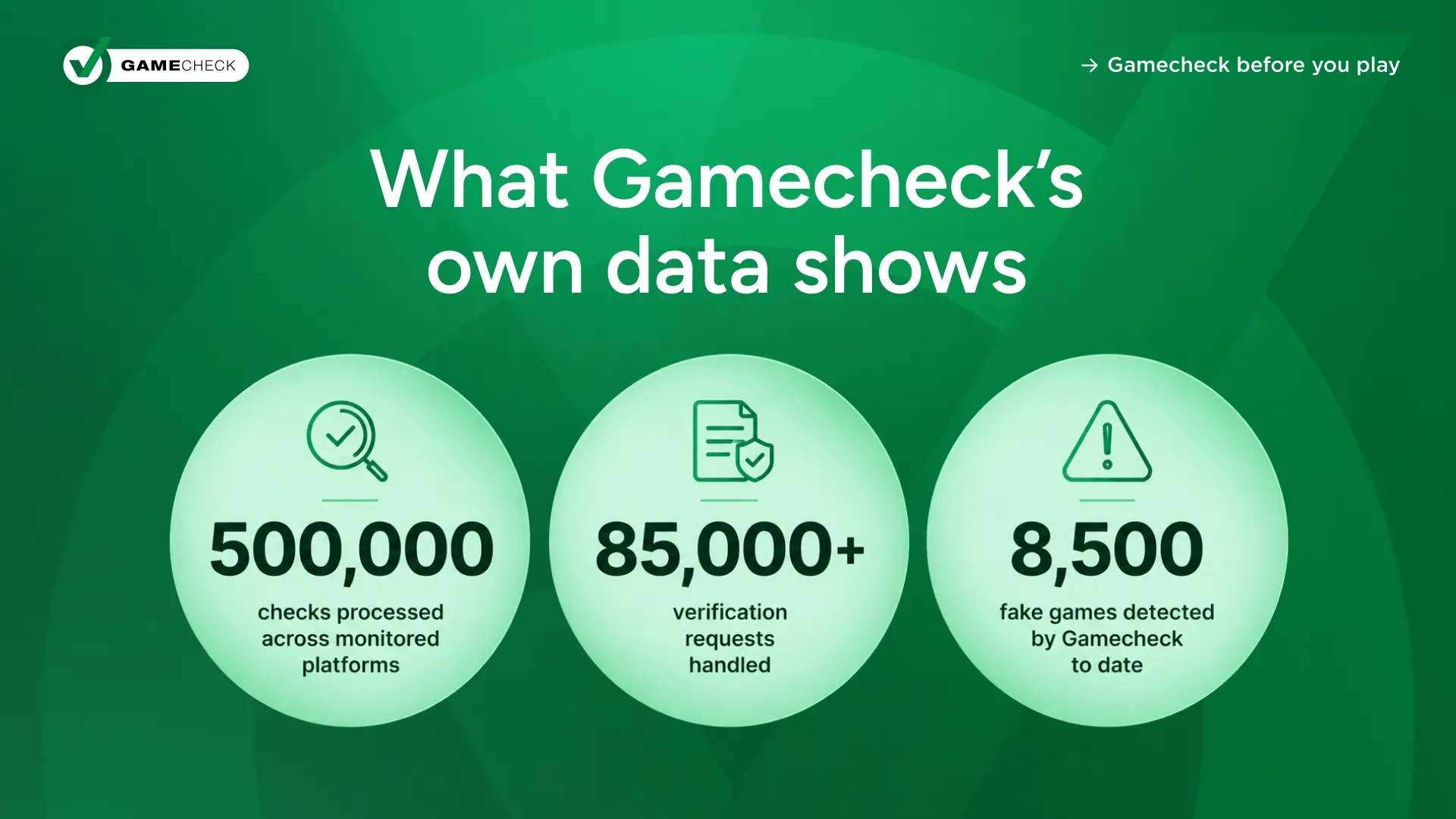
Gamecheck has processed close to half a million checks across the platforms it monitors. More than 85,000 verification requests have been handled, and nearly 70,000 brands have been checked. Within that body of work, Gamecheck has detected 8,500 fake games.
Each of those 8,500 fake games represents a title available to players on a live platform - a game that looks like a real product but has been confirmed by the original game providers as not being their work. Each one represents a player who, without checking, would have no way of knowing what they were playing.
Fake games are widespread, targeting players in multiple markets and languages.
Gamecheck's data shows that players who encounter fake games are significantly less likely to return to online casino gaming at all. The damage is not only financial, it erodes the confidence that makes players willing to engage with the industry in the first place. A player who walks away after a bad experience is not just a single lost customer. They represent a wider pattern of players leaving the market altogether.
Regulators across Europe have invested significantly in reducing the visibility of illegal gambling operators. Website blocking, advertising restrictions and cooperation with digital platforms have all produced measurable results in specific channels. Paid advertising visibility for unlicensed operators has declined in several markets. These are genuine achievements.
The difficulty is that visibility cannot be assessed solely through the channels that are easiest to regulate. Modern consumers rarely discover gambling products through a single source. Search engines, affiliate websites, comparison portals, social media platforms, video content, messaging groups and direct recommendations all play a role in how players navigate the online gambling market. Reducing visibility within one channel does not necessarily mean reducing visibility across the broader consumer journey.
Germany illustrates this well. The country's gambling regulator identified 858 illegal gambling websites run by 212 operators in 2024 - up from 205 operators in 2023, with the illegal market estimated at €500 million. Those figures have been challenged by the industry. Tipico's Director of iGaming publicly argued the illegal market is likely worth at least €2 billion - far above the regulator's estimate - based on online traffic data showing black-market sites receive up to 50% more visitors than licensed ones.
An analysis by H2 Gambling Capital suggests that between Q1 2022 and Q1 2023, Germany saw a 63% increase in illegal operators, with around 9.3 million people engaging with illegal gambling products monthly.
The core issue is that channelisation and visibility are not the same thing. A market can experience reduced visibility in paid advertising while channelisation rates remain largely unchanged, because consumers who actively seek gambling products adapt when one channel closes. Search terms change. Discovery methods evolve. Affiliate websites, comparison platforms and referral routes continue to shape the consumer journey even where direct advertising has been curtailed.
An operator that loses access to paid advertising may continue reaching players through affiliate rankings and social media recommendations. From the player's perspective, the operator remains discoverable. If that operator is running fake games, the player's exposure to financial loss remains unchanged.
The financial cost to an individual player who encounters fake games is difficult to quantify precisely, because the mechanism of loss varies. Real cases, however, make the scale tangible.
In France, Eurojust coordinated a cross-border investigation into a network of fake online casinos that generated nearly €1 billion in turnover over five years. Authorities were alerted after victims came forward complaining they were unable to withdraw their winnings. Fund transfers of more than €100 million were traced before two suspects were charged.
The sums involved can be substantial. Investigate Europe found that customers of several unlicensed casino websites were left unable to redeem thousands of pounds from their accounts, with those websites collectively attracting an average of 2.3 million unique monthly visitors from the UK alone between November 2025 and January 2026. In one documented case, a player's withdrawal of $327,340 was blocked after an operator cited a bonus restriction that had never been clearly disclosed prior to play.
A UK player registered with GamStop reported losing approximately £15,000 after falling into the trap of platforms that accepted deposits without question despite the player's self-exclusion status. The pattern across these cases is consistent: deposits are processed without difficulty, and the problem only surfaces when the player attempts to withdraw. At that point, the options for recovery are limited.
Nearly one in five adults globally had gambled online in 2025, representing approximately 882 million people worldwide. Online platforms now account for approximately 40% of all gambling activity. As more players move online, the pool of potential targets for operators running fake games expands.
Mobile access is accelerating that exposure. Smartphones account for 80% of all online gambling users. A player accessing an online casino on a mobile device has less ability to check what they are playing than a desktop user. Screen size and the speed of mobile sessions reduce the window for spotting inconsistencies.
The combination of a rapidly growing player base and increasingly sophisticated operator tactics means the environment facing players today is meaningfully more complex than it was even three years ago. And the evidence from markets where enforcement has been most active suggests that reducing the visibility of unlicensed operators in one channel does not reliably reduce the number of players who find and use them.
Gamecheck's free search tool is designed to address exactly this gap.
A player who checks an online casino before depositing receives a result based on evidence gathered directly from the original game providers. That result is an evidence-based classification - real games in operation, fake games detected, or pending checks, based on testing and provider confirmation.
Close to half a million checks have been processed. Each one represents a player who sought information before playing. The value of that decision is clearest when the result returned is 'fake games detected'. The check has done its job. The player has the information they need before any money changes hands.
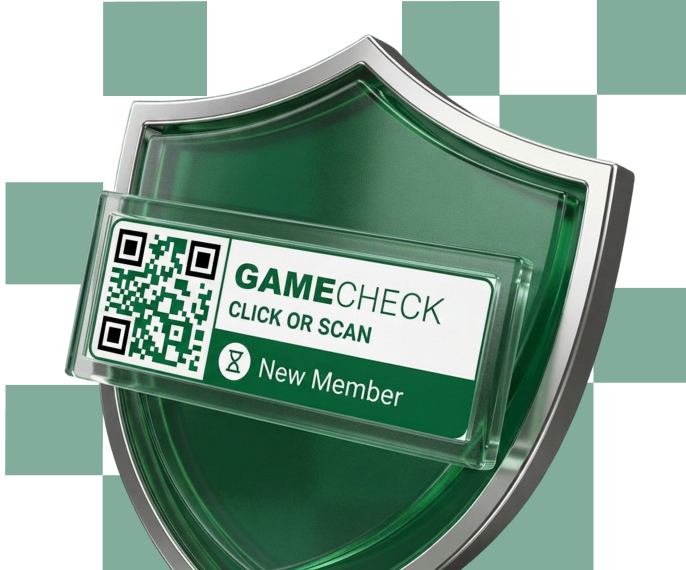
For operators playing fair, the Gamecheck SEAL provides a publicly verifiable signal of game integrity. The Gamecheck SEAL is domain-linked, blockchain-logged and can be checked in real time using the Gamecheck App. An operator displaying the Gamecheck SEAL is one that has submitted to ongoing monitoring, with the understanding that the Gamecheck SEAL is removed immediately if fake games are subsequently detected.
Players can access the free search tool to check any online casino before they play.
For operators interested in the SEAL, more information is available at SEAL Pricing | Gamecheck.
The numbers are consistent across every dataset. The unlicensed online casino market is large, growing and operating at players' direct expense. The European Casino Association puts the EU tax revenue loss at €20 billion annually. Gamecheck's own data puts fake games detected at 8,500 and rising.
Enforcement efforts have produced real results, but reduced visibility in paid advertising has not reduced player exposure to rogue operators. Consumers adapt, and discovery routes evolve. A player who lands on a fake casino through an affiliate link, a comparison site or a social media recommendation faces the same outcome as one who found it through paid advertising. For players, the practical implication stays the same regardless of where a rogue operator surfaces: the check has to happen before the deposit, not after.
Checking costs nothing. Not checking could cost everything. Players can access the free Gamecheck Search Tool and Chrome Extension. The alternative costs considerably more.
The direct cost varies by case, but documented examples show the scale can be significant. A cross-border investigation coordinated by Eurojust found a network of fake online casinos generated close to €1 billion in turnover over five years, with victims unable to withdraw their winnings. At the individual level, players have reported losses of thousands of pounds on unlicensed platforms with no viable route to recovery.
Research commissioned by the European Casino Association and conducted by Yield Sec found that illegal online gambling operators now account for 71% of the EU's online gambling market, representing an estimated €80.6 billion in gross gaming revenue. That is more than double the legal market's €33.6 billion. The number of illegal operators increased by 26% in 2024 compared to 2023, and illegal gross gaming revenue rose 53% year-on-year. The data shows it is accelerating.
Recovery options are slim. Many operators running fake games process deposits through cryptocurrency, which removes standard banking protections. Because of this, the most effective action players can take is to check a site before depositing, rather than trying to recover funds after. The Gamecheck Search Tool returns a result in seconds, to help players avoid fraudulent platforms entirely.