Les joueurs de casinos en ligne évoluent aujourd'hui dans un environnement plus complexe que jamais. La croissance de l'industrie s'accompagne d'une tendance parallèle : une forte augmentation des jeux contrefaits, des plateformes clonées et des tactiques de fraude coordonnées.
La fraude dans le secteur des casinos en ligne a augmenté de plus de 60 % ces dernières années, et les pertes liées aux arnaques aux jeux d'argent en ligne se chiffrent désormais en milliards chaque année. Ce n'est pas seulement une question d'ampleur, mais aussi de sophistication. Les tactiques des faux casinos ont grandement évolué, bien au-delà des simples copies. Aujourd'hui, ils fonctionnent comme des systèmes structurés, conçus pour évoluer et s'adapter.
Lorsqu'on examine les faux casinos, les exemples isolés ne donnent qu'un aperçu partiel du problème. C'est en analysant les données sur plusieurs cas qu'on obtient une compréhension véritablement pertinente.
Les enquêtes de Gamecheck révèlent un modèle d'activité récurrent. Il ne s'agit pas d'incidents isolés, mais d'un comportement qui se répète sur différentes plateformes et dans différentes régions. Rien qu'en 2025, des milliers de casinos en ligne ont été examinés, et des jeux frauduleux y font leur apparition chaque mois à un rythme constant.
Un petit nombre de sites démasqués illustre l'ampleur du problème. À eux seuls, quatre casinos ont généré plus de 6,9 millions de visites en douze mois. Ce niveau de trafic démontre que les faux casinos touchent un nombre important de joueurs avant d'être identifiés.
En y regardant de plus près, le schéma se complexifie. Parallèlement à ces plateformes à fort trafic, un deuxième niveau de sites continue de fonctionner, moins visible mais avec un flux d'utilisateurs constant. Certains affichent une croissance initiale, d'autres ciblent des créneaux spécifiques. Plusieurs font l'objet de contrôles continus, ce qui indique que l'activité ne s'arrête pas une fois l'exposition amorcée. Ce qui se dégage n'est pas un problème unique, mais un système distribué.

Le fonctionnement des faux casinos est aujourd'hui fondamentalement différent de celui d'il y a quelques années. Les versions précédentes reposaient sur une simple imitation. Aujourd'hui, elles sont structurées.
Plusieurs enquêtes ont révélé des schémas récurrents : des mises en page similaires, des bibliothèques de jeux identiques et des comportements techniques similaires laissent croire que plusieurs de ces sites ne sont pas construits individuellement, mais déployés à l’aide de cadres partagés.
Cela permet aux opérateurs de s'adapter rapidement. Un site peut être remplacé sans effort. Si un domaine est signalé, un autre peut prendre sa place. Le trafic ne disparaît pas ; il est simplement déplacé.
Dans certains cas, les sites semblent fonctionner en parallèle. Une plateforme à forte visibilité attire l'attention, tandis que des domaines plus modestes continuent de fonctionner discrètement. Cette approche par couches renforce la résilience. Du point de vue des données, c'est là que le changement devient évident. Les faux casinos ne sont plus des entités isolées ; ils font partie d'une infrastructure plus vaste.
Les particularités régionales ajoutent une autre dimension au tableau.
Dans les marchés plus matures, les faux casinos privilégient généralement la familiarité. Leurs plateformes sont conçues pour ressembler trait pour trait aux casinos en ligne établis, avec une navigation, un design et un parcours utilisateur similaires. Le but est de dissiper les doutes. Si l'expérience est familière, elle sera moins susceptible d'être remise en question.
C'est pourquoi, même sur des marchés comme le Royaume-Uni, de faux casinos continuent d'apparaître malgré une meilleure sensibilisation des joueurs. Les recommandations du secteur soulignent systématiquement le même problème : ces sites sont convaincants au premier abord.
Sur les marchés émergents, les données révèlent un rythme différent. Le renouvellement des noms de domaine est plus rapide et les cycles de déploiement plus courts. Le cycle de vie des sites est plus court : ils apparaissent, gagnent en popularité et évoluent rapidement.
Malgré ces différences, le comportement sous-jacent reste le même. Les faux casinos sont conçus pour évoluer, s'adapter et demeurer difficiles à suivre dans le temps.
Pour comprendre ce système, il faut dépasser ce que les joueurs voient en surface.
Dans bien des cas, les premiers signes sont subtils. Un site peut sembler légèrement défaillant. Les pages se chargent plus lentement que prévu. Les jeux peuvent présenter des ralentissements, des blocages ou un comportement erratique. Les boutons pourraient ne pas répondre correctement. Pris isolément, ces problèmes peuvent être faciles à ignorer, mais ils constituent souvent le premier indice d'un dysfonctionnement sous-jacent.
Un autre point commun est la familiarité. Certaines plateformes ressemblent beaucoup à des casinos en ligne réputés. L'interface est reconnaissable, la structure semble familière. Cependant, de petites incohérences apparaissent, comme du contenu répétitif ou générique, et des sections dysfonctionnelles. Ce sont souvent des signes de plagiat. À première vue, les jeux peuvent sembler authentiques. Mais l'apparence à elle seule ne garantit ni leur authenticité ni leur bon fonctionnement. La différence réside dans ce qui se cache derrière le jeu : sa diffusion, son comportement et les tests effectués.
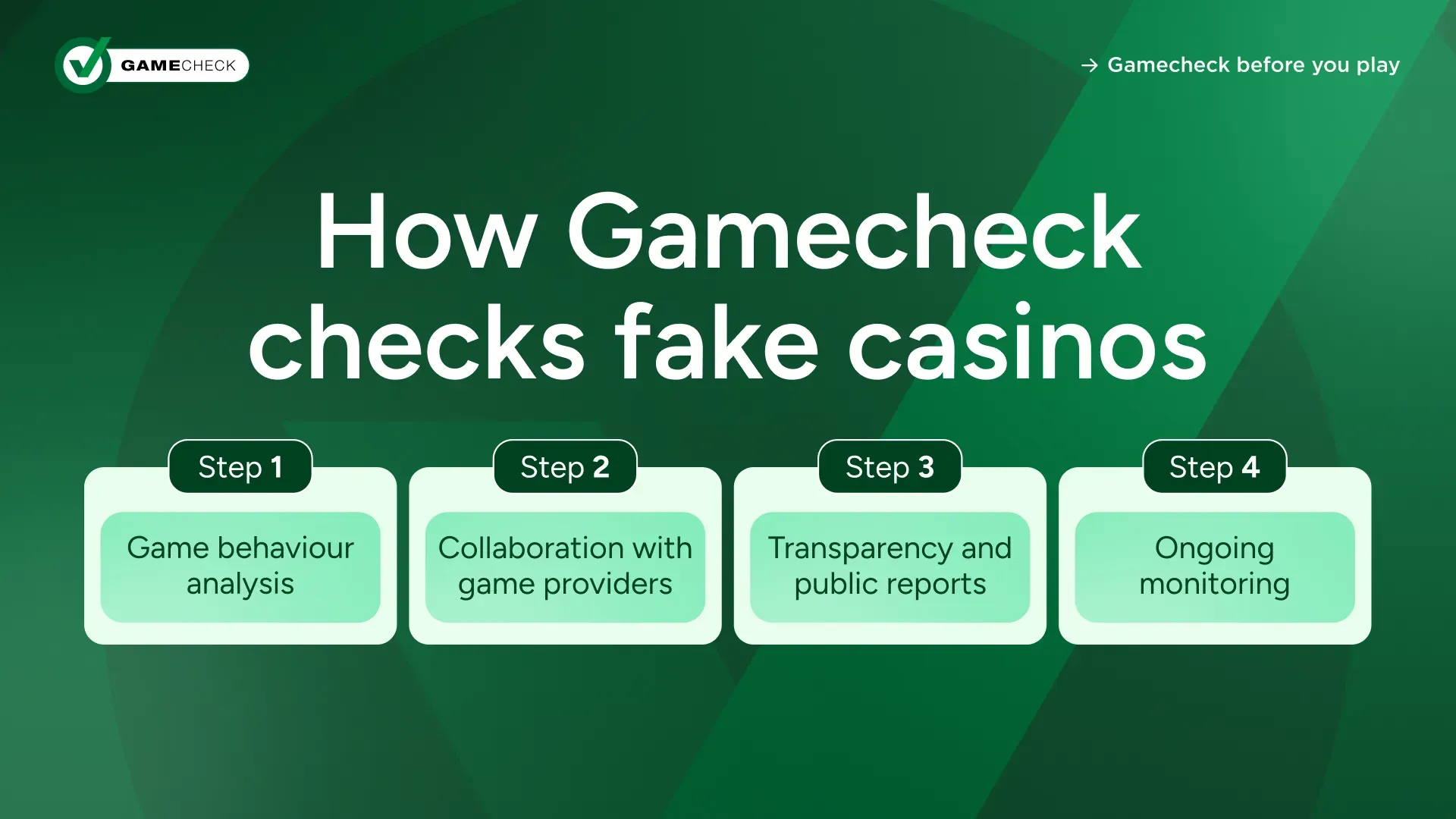
Le processus d'enquête de Gamecheck débute souvent par des indicateurs subtils. Parmi les premiers indices, on retrouve les problèmes de performance : des jeux présentant des délais inhabituels, des ralentissements ou des temps de chargement irréguliers. Pris isolément, ces signaux ne permettent pas de tirer de conclusions, mais ils aident à identifier les points nécessitant une analyse plus approfondie. Dès lors, le processus dépasse le cadre d'une simple observation.
Les parties sont lancées, enregistrées et analysées en temps réel, l'accent étant mis sur leur comportement plutôt que sur leur apparence. Cela inclut leur temps de chargement, leur réactivité et leur diffusion sur la plateforme. L'objectif est de recueillir des preuves tangibles.
Au lieu d'évaluer chaque jeu individuellement, une sélection représentative de jeux est vérifiée auprès de différents fournisseurs sur un site. L'étape suivante consiste en une collaboration : les résultats de ces jeux sélectionnés sont partagés avec les fournisseurs originaux, qui déterminent leur authenticité à l'aide de leurs propres systèmes.
Cette étape associe l'enquête externe à la validation par le fournisseur. Elle permet de clarifier les cas où l'inspection visuelle seule ne suffit pas. Elle révèle également un problème plus vaste : bien souvent, les fournisseurs ne sont pas immédiatement informés de l'utilisation de versions copiées de leurs jeux. Le processus d'enquête contribue à mettre en lumière ces pratiques, soutenant ainsi les efforts déployés pour protéger leur innovation.
La dernière étape consiste en une surveillance continue. Les faux casinos évoluent constamment : leurs ludothèques changent, leurs noms de domaine changent et leurs comportements s’adaptent. Un simple contrôle ne permet de saisir qu'un instant. Seule une surveillance continue révèle les tendances. C'est cette combinaison de signaux précoces, de collaboration entre les fournisseurs et de suivi continu qui permet de dégager des schémas récurrents.
L'analyse conjointe de ces tendances permet de tirer plusieurs conclusions.
Les casinos frauduleux s'appuient rarement sur une seule plateforme. Ils opèrent à plusieurs niveaux, combinant des sites à fort trafic avec des domaines plus petits et moins visibles. Cela crée un système à la fois évolutif et résilient. Le trafic, à lui seul, n'est pas un indicateur fiable d'équité.
Certains des sites les plus visités présentent aussi des signes manifestes d'activité irrégulière. La visibilité peut inspirer confiance, mais elle ne reflète pas toujours la réalité.
Parallèlement, la transparence a un impact concret. Dans plusieurs cas, des casinos ont abandonné les jeux truqués à la suite d'enquêtes et d'un suivi. Cela démontre que la transparence ne se contente pas d'informer ; elle influence les comportements.
Les faux casinos ne sont plus de simples sites Web isolés. Ce sont des systèmes structurés, et en les mettant en lumière, nous contribuons à protéger à la fois les joueurs et les opérateurs légitimes.
Le rôle d'une enquête n'est pas seulement d'identifier les problèmes, mais aussi de les rendre visibles. En mettant en lumière les faux casinos, l'objectif est de clarifier la situation dans un contexte où les apparences peuvent être trompeuses.
Cela permet aux joueurs de prendre des décisions plus éclairées et soutient les opérateurs légitimes qui s'engagent à respecter l'équité. Cela renforce également la collaboration au sein du secteur. Lorsque les tendances sont partagées et comprises, il devient plus facile de réagir collectivement. Il ne s'agit pas de réagir à des cas individuels, mais de comprendre le fonctionnement du système.
Dans l'ensemble du secteur des casinos en ligne, une tendance se dessine clairement. Les tactiques des casinos frauduleux deviennent plus structurées, plus évolutives et plus adaptables. Parallèlement, les méthodes utilisées pour les détecter et les analyser s'appuient de plus en plus sur les données. Il en résulte un cercle vicieux : l'un évolue, l'autre aussi. La différence entre le vrai et le faux ne se joue plus sur l'apparence, mais sur ce qui se cache derrière.
L'évolution des tactiques des faux casinos reflète une transformation plus profonde au sein de l'industrie des casinos en ligne. La croissance engendre la complexité. La complexité crée des opportunités. Et ces occasions, lorsqu'elles ne sont pas contrôlées, donnent lieu à des abus. Mais ces abus peuvent être détectés.
En mettant en lumière les faux casinos, l'objectif n'est pas seulement de révéler leur mode de fonctionnement, mais aussi de protéger les joueurs et de soutenir les opérateurs légitimes qui s'engagent à garantir un jeu équitable.
Le rôle de Gamecheck est de relier les données et les résultats, d'apporter de la clarté sur ce qui se passe en coulisses dans les casinos en ligne du monde entier et d'aider l'industrie à évoluer vers des normes plus élevées au fil du temps.
Consultez votre casino en ligne avec Gamecheck avant de jouer.
Publié le : Apr 21, 2026
Mis à jour le : Oct 06, 2026
Rejoignez les opérateurs qui utilisent le SEAL Gamecheck pour protéger les joueurs et renforcer leur crédibilité.