From a player’s perspective, the process looks simple.
You open the Gamecheck Search Tool.
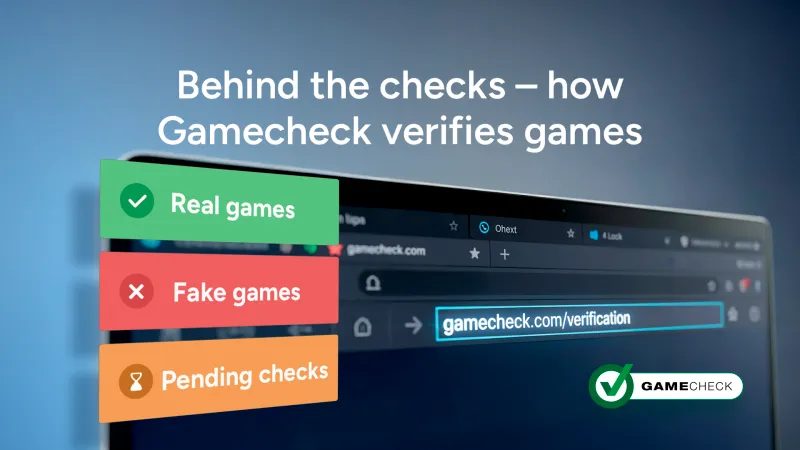
You paste an online casino URL into the search bar. Within seconds, a result appears:
The results are instant. But that result is not generated by a simple keyword lookup. It is the visible endpoint of a structured verification system designed to assess evidence, check findings with original game providers, and monitor changes over time.
Understanding what happens behind that search bar matters, because it means the result you see is backed by real checks confirmed by the original game providers. So you can rest assured and play with greater confidence.
When a player is ready to verify the legitimacy of an online casino, they start by entering the casino’s URL into the Gamecheck Search Bar.
The process that follows is designed to ensure that the games being offered are legitimate and fair. Here's how it works:
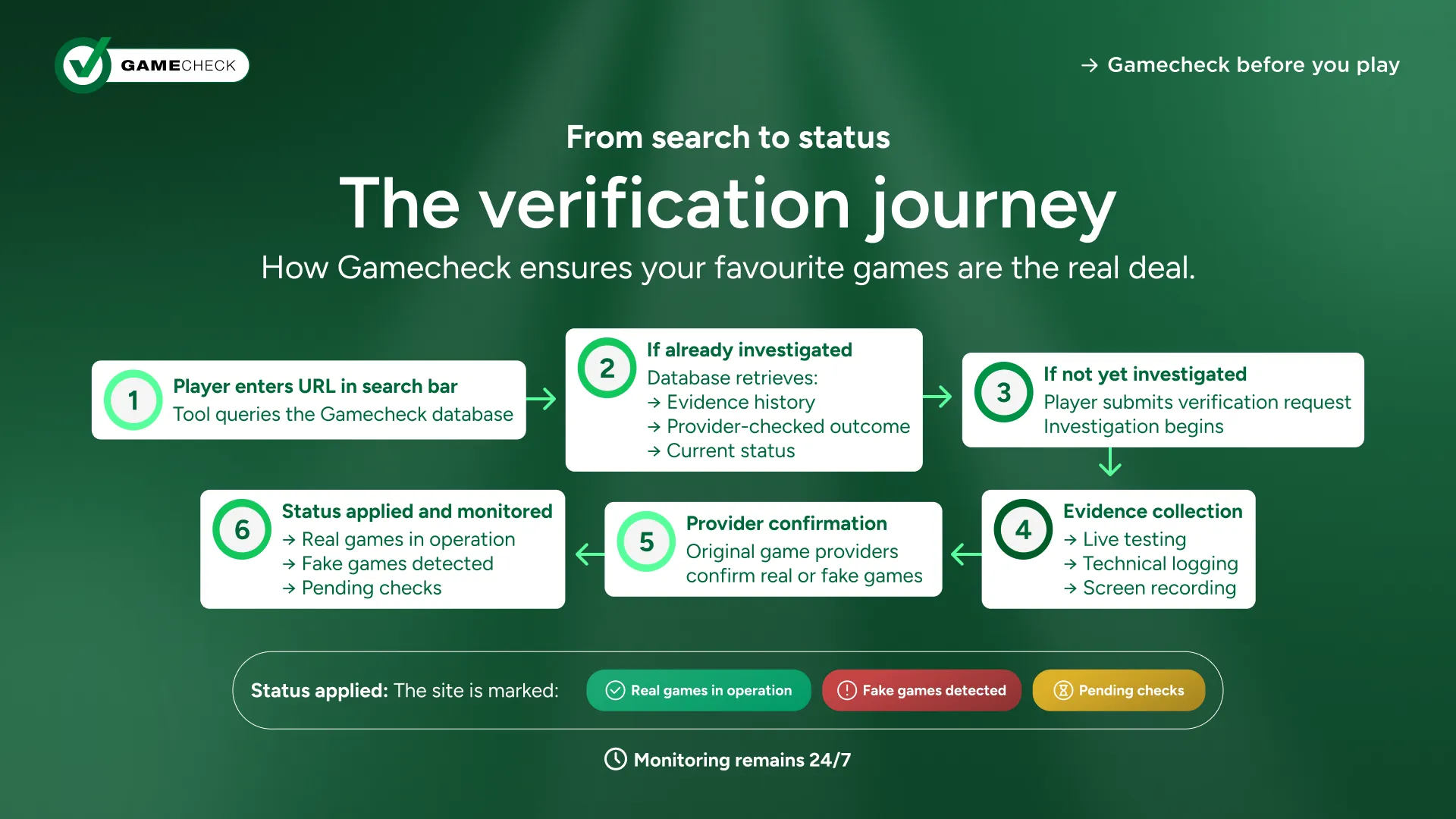
The process begins when the player types or pastes the URL of an online casino into the Gamecheck tool’s search bar. This triggers an immediate query to the database, allowing the tool to check the online casino’s verification status.
If the online casino has already been investigated by Gamecheck, the database will retrieve detailed information about the site. This includes:
If the online casino has not been investigated before, the player will be prompted to submit a verification request. Once submitted:
During the investigation, Gamecheck’s team gathers evidence to determine whether the games on the casino’s site are real or fake. This evidence collection involves:
After evidence is gathered, Gamecheck works directly with the original game providers to confirm whether the games are legitimate or fake. The game providers provide the final confirmation on whether the games being offered on the casino site are real games.
Once the verification process is complete, Gamecheck assigns a status to the casino:
Gamecheck continuously monitors the online casino to ensure that any changes or updates to the online casino’s status are reflected in real-time. This helps protect players from fake casinos, and ensures that they have the most up-to-date information available.
When a player submits a URL, the Gamecheck search bar does not “scan” the site live in that moment. Instead, it queries the Gamecheck database. That database contains:
If the domain has been reviewed, the tool retrieves the most recent verified status.
If the domain has not yet been investigated, the player is given the option to submit a verification request. That request triggers the research process.
The Gamecheck search tool functions as an access point to an evidence-backed database, not a one-click surface scan. This ensures that every displayed result is based on documented testing and provider confirmation, not automated guesswork.
Once a verification request is triggered, the investigative phase begins. Fake casino games often replicate the visual appearance of real ones with striking precision. Logos can look correct. Animations can feel familiar. Even sound design can be copied. Visual similarity is not proof of authenticity. Evidence gathering typically includes:
This creates a structured and documented evidence package.
Gamecheck does not simply declare a game to be real or fake. Once evidence is gathered, findings are checked directly with the original game providers.
Only the provider can determine whether:
This provider validation stage introduces an important layer of accountability. It ensures:
Gamecheck gathers and documents the evidence. The original game providers then review that evidence and confirm whether the tested games are real or fake. This two-stage process ensures that findings are thorough and independently confirmed.
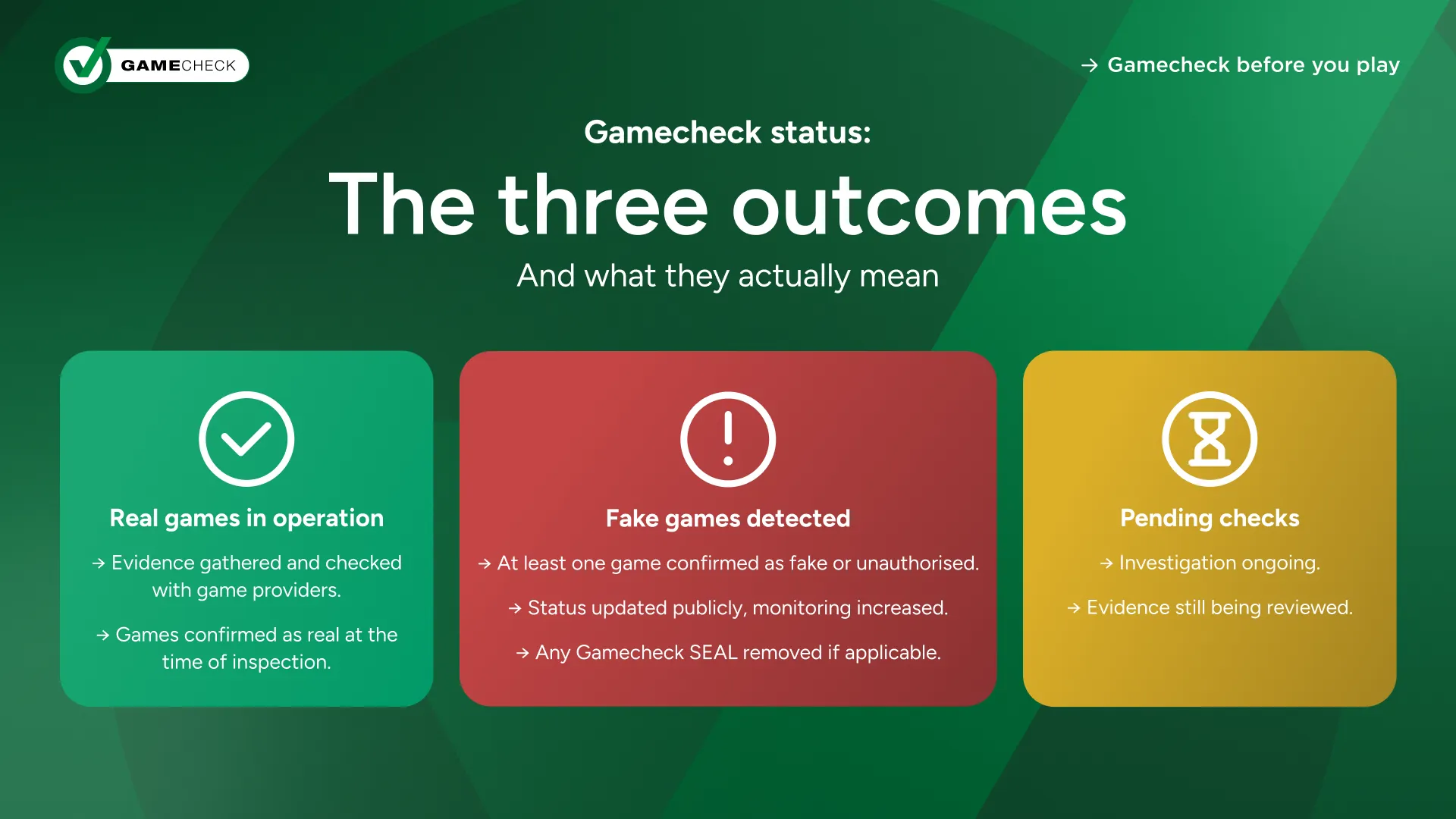
Each online casino in the database receives one of three structured outcomes.
Evidence was gathered. Findings were checked with the original game providers. Tested games were confirmed to be real games at the time of inspection. This does not mean every game on the platform has been individually tested. It means tested samples from multiple providers were confirmed to be real games, and no fake games were found.
At least one tested game was confirmed by the provider as fake or unauthorised.
Initial or further checks pending. Evidence is still being gathered and reviewed.
A verification process that only checks once creates a vulnerability window. Online casino libraries evolve. Game environments change. Domains migrate. Gamecheck therefore monitors online casinos consistently. Monitoring includes:
If fake games are detected at a later stage, the status changes. Verification is not permanent approval. It is a time-based assessment supported by continued observation.
One isolated fake game is a problem. But when thousands of online casinos are operating across different countries, the risk becomes much bigger.
In recent monitoring cycles, Gamecheck has processed thousands of verification requests and added thousands of online casinos to its database.
At this scale, verification cannot depend on one-off audits. It requires:
This is where technology supports investigation.
The Chrome Extension, for example, automatically parses the URL of the site a player is browsing and queries the Gamecheck database in real time. It does not independently judge the site, it retrieves the most recent verified status from the central system.
Consistency across tools is key. The same database powers:
The Gamecheck SEAL builds on this infrastructure.
It is a live, domain-linked trust badge. Each Gamecheck SEAL contains a QR code that must be validated through the official Gamecheck app.
Important characteristics:
The Gamecheck SEAL does not assess licensing. It confirms that a random selection of games were checked and validated by the original game providers and found to be real games at the time of inspection. That clarity protects both players and operators.
As the online casino market grows, so does technical complexity. Fake games are not always crude copies. Some are sophisticated replicas designed to blend in. The Gamecheck search tool may feel simple. The process behind it is not. And that complexity is precisely what makes reliable online casino verification possible.
Fair play becomes easier when online casinos are continuously monitored. Before you play, take a moment to make sure your online casino offers real games.