Fake casinos are not accidental discoveries. They are engineered to be found.
In 2026, many fake online casinos look polished, modern, and professionally built. They appear in search results. They run paid adverts. They use multilingual pages to target players across Europe, North America, Latin America, Asia, and Africa. The question is how they continue to reach players, and what can be done to stop them.
Fake casinos reach players through visibility, familiarity and speed.
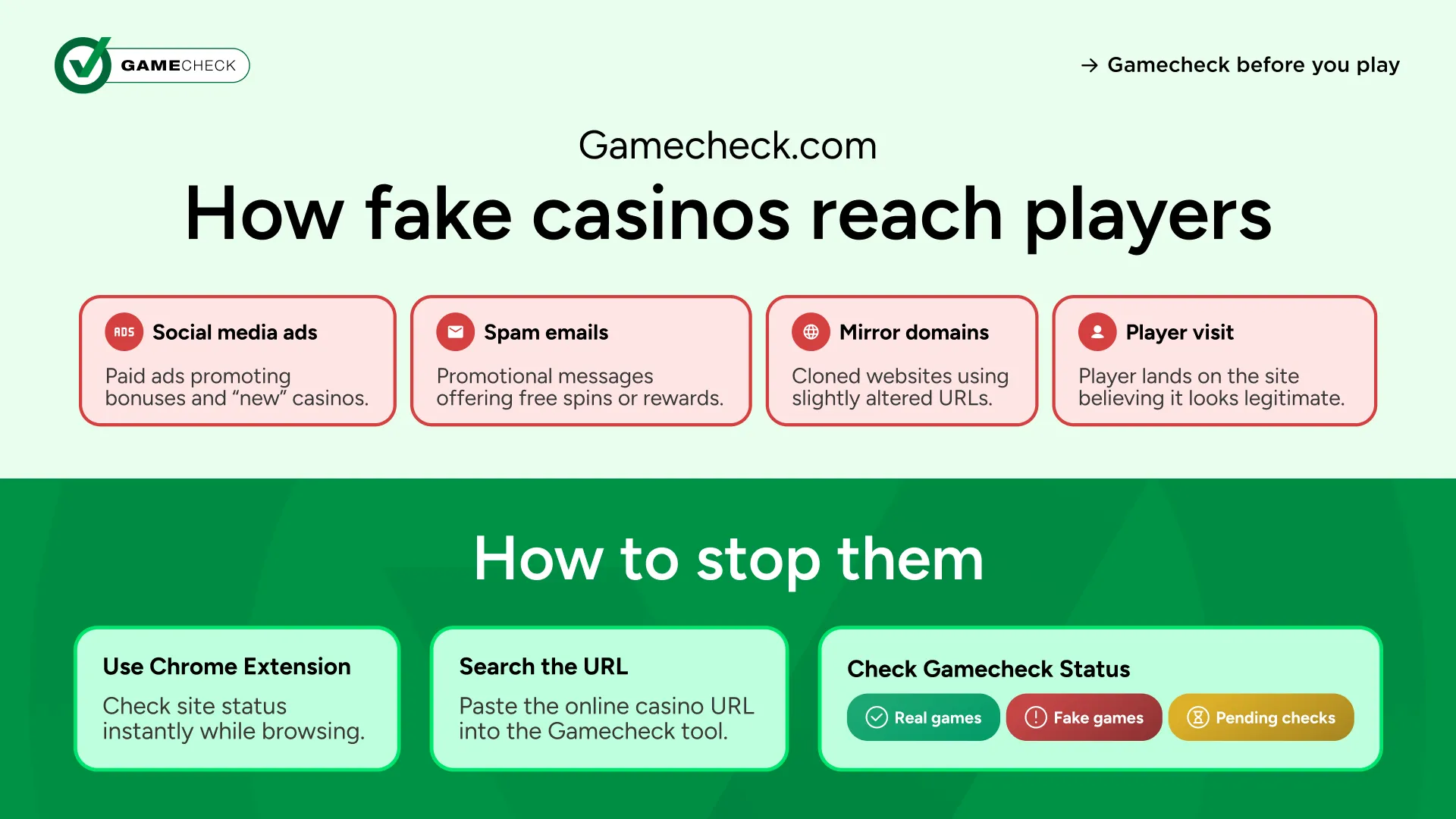
Some rogue operators invest heavily in paid search placements and aggressive advertising. When players search for bonuses, free spins, or new online casinos, these sites can appear alongside legitimate operators. The difference is not always visible on the surface. A well-designed homepage does not confirm real games in operation.
As a player you might see social media ads - paid ads promoting bonuses and "new" casinos or receive spam emails - promotional messages offering free spins or rewards.
Fake casinos often copy the structure of legitimate online casino sites:
Visual quality has improved significantly. Design alone is no longer a reliable indicator.
Monitoring patterns show fake casinos targeting players in Europe, Asia, Africa, North America and Latin America through multilingual deployment and paid search visibility. Geographic boundaries matter less than they once did. A site hosted in one region can target players globally within days.
Large bonuses remain one of the most effective acquisition tools. Urgency phrases such as “limited time only,” “claim now,” and “exclusive VIP access” are designed to create momentum before a player has time to pause and question the site. Scammers deliberately use these tactics to reduce hesitation and push quick decisions.
Even experienced online casino players can struggle to distinguish between real and fake platforms at first glance. Three factors explain why:
Speed – Rogue operators can launch quickly and replicate domains just as quickly.
Surface credibility – Professional design and familiar branding create instant reassurance.
Limited transparency – Without backend checks, players have no direct way to determine whether games are real.
Before 2025, checks were largely occasional and reactive. Today, monitoring is provider-backed, structured, and ongoing. The design sophistication of fake games may have evolved, but so has verification. When a random sample of games are checked with the game providers, the results are clear and easy to understand: real games in operation, fake games detected, or pending checks. Presentation and design do not alter the outcome.
Human decision-making relies heavily on recognition. When something looks familiar, the brain categorises it as lower risk. Fake casinos exploit this instinct.
They mirror common online casino structures. Navigation feels standard. Promotional banners look typical. Game lobbies resemble those players have seen before.
The design does not need to be original. It only needs to feel normal. That normality creates comfort. Comfort reduces the instinct to verify. The first shift for players is simple but powerful: separate familiarity from legitimacy. A site that looks like other online casinos is not proof that it operates real games.
Fake casinos also rely on psychological pressure. Urgency messaging is common. Limited-time bonuses. Countdown timers. Repeated claims of exclusivity. These techniques are not accidental. They are designed to shorten decision time. When urgency increases, verification decreases. The brain shifts from evaluation to action. The most effective countermeasure is slowing down. Taking even one minute to pause before registering interrupts that pressure cycle. That pause creates space for a check.
In previous years, fake casinos often revealed themselves through glitchy graphics and overall poor presentation. In 2026, that gap has narrowed significantly.
AI-powered tools now allow rogue operators to:
The surface can look polished and convincing. But appearance doesn’t mean fair play. What matters is simple: are the games real, and have they been checked?
Gamecheck helps players check whether tested games are real at the time of inspection. It does not assess payment systems, bonuses or licences. Its focus is specific: identifying whether fake games are present. When design becomes easy to replicate, verification becomes more important.
The online casino gambling industry continues to expand. But detection systems have evolved too.
Gamecheck now operates with:
This means rogue operators face shorter operational windows and higher exposure risk.
In 2026, fake casinos remain visible for shorter periods of time once identified.

The scale of imitation is no longer limited by geography. Monitoring patterns show fake casinos targeting players in Europe, Asia, Africa, North America and Latin America through multilingual deployment and paid search visibility. Cross-border accessibility makes geographic boundaries less relevant than they once were.
A site hosted in one jurisdiction can target players in another within minutes. Search engines and advertising platforms allow rapid expansion across languages and regions. For players, this means location is no longer a reliable indicator of legitimacy. The digital environment is global. Verification must expand to encompass all geographical locations.
In many cases, experience increases confidence, and confidence reduces perceived risk. If a site looks similar to others you have used before, your brain categorises it as familiar territory. The goal is to build checking your online casino platform into your routine.
If your usual flow is: See site → Register → Deposit.
Change it to: See site → Check → Decide before you deposit.
That single adjustment transforms perception into verification.
Stopping fake casinos does not require technical expertise. It requires one simple behavioural shift: verify before you play.
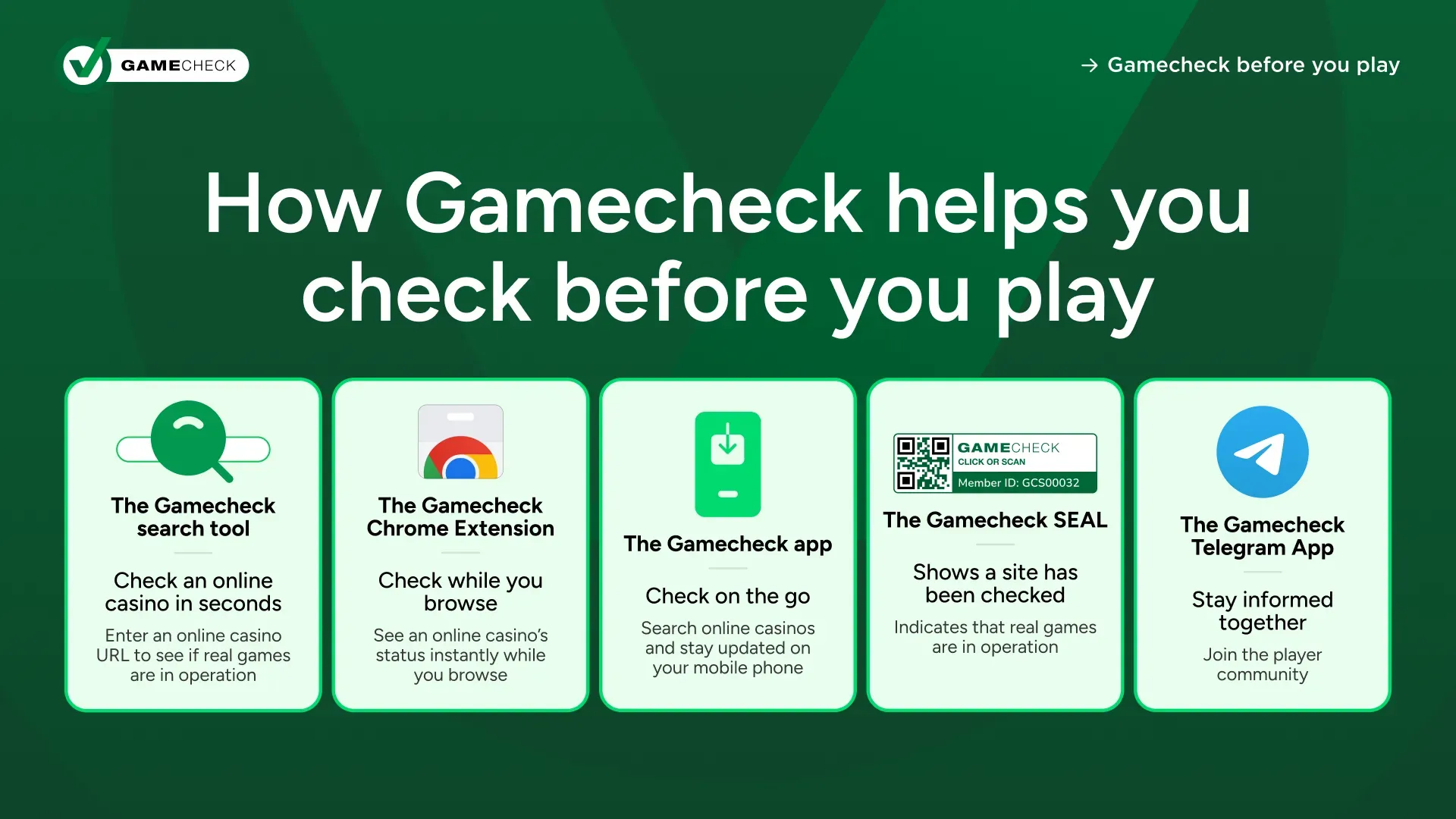
Paste the online casino URL into the Gamecheck tool before registering or depositing. If the site has already been checked, you will see its current status. If it has not been checked, you can submit a verification request.
The Gamecheck app allows you to:
Simply scan the Gamecheck SEAL, with the Gamecheck app to ensure it is authentic.
The Gamecheck Chrome Extension parses the URL of the site you are visiting and retrieves its current database status. You do not need to leave the page to check.
The Gamecheck SEAL offers a visible trust signal on an online casino’s website. The Gamecheck SEAL displayed on an online casino, shows that a selection of games on the site has been checked, with findings confirmed by the original game providers.
Gamecheck also brings players together through its growing Telegram community, where players use the Gamecheck Telegram App to share experiences, exchange insights, and build real-time awareness across the online casino space.
This collaborative approach reflects what Gamecheck stands for - connecting players, and making it easier to navigate the online casino landscape with greater clarity. When these tools and community insights are used together, they provide a clearer and more reliable way to check a slot casino before you play.
Fake casinos reach players because they are built to be visible. They succeed when players rely on design, bonuses, or branding alone. They struggle when players verify first. This is not about fear. It is about transparency. Rogue operators will continue to replicate legitimate platforms. But the balance shifts when players adopt one protective habit:
Check first. Play second.
In a world where perception can be engineered, verification is your strongest protection.
Protection does not require technical expertise. It requires consistency.
Before creating an account, build one small routine into your process:
To make this even easier, download the Gamecheck app. It allows you to verify an active Gamecheck SEAL and confirm it is linked to the domain.
You can also install the Gamecheck Chrome Extension. When activated while browsing, it retrieves site information directly from the Gamecheck database without leaving the page you are on.
That removes guesswork. You are no longer relying on how professional a website looks, how persuasive the copy sounds, or how urgent the promotion feels. You are checking before you play. These tools are not complicated, they are free and easy to use. They exist to protect you from fake games.
In 2026, appearance is easier to manufacture than ever. Professional design, persuasive language, and familiar layouts can all be replicated in minutes. But evidence cannot.
Gamecheck does not assess whether an online casino is trustworthy or licensed. It helps players determine whether tested games are real at the time of inspection. Fake casinos succeed when appearance replaces evidence. They lose when players take one deliberate step before they play.
Before you register. Before you spin. Pause. Check the domain. Use Gamecheck. In a world where perception can be engineered, verification is your strongest protection.