-800x450.webp)
Online casino players today have more choice than ever. New platforms appear daily, offering familiar games, polished designs, and seamless experiences. On the surface, everything looks legitimate. But beneath that surface, fake games have not gone away. In many cases, they are designed to blend in. The interface looks right, and the games appear identical to what players expect. The difference sits behind the scenes.
Reporting fake casinos is no longer just about protecting yourself. It plays a wider role in supporting fair play, and helping the industry move in the right direction. This is where a simple action - requesting verification - becomes more important than it may seem.
If you want to request verification of an online casino platform, the process is designed to be simple and accessible for any player.
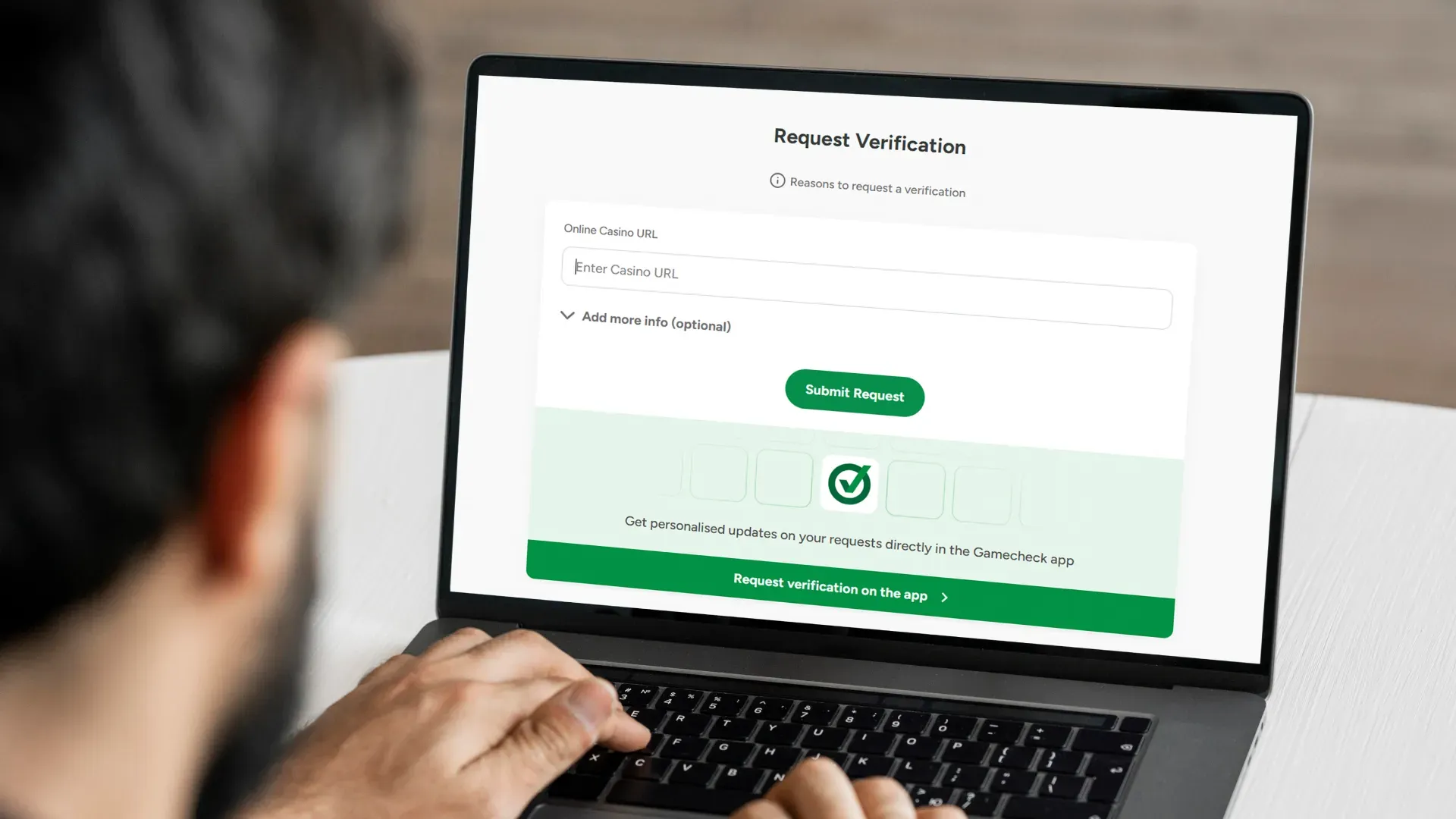
Start by visiting the Gamecheck website. From the homepage, navigate to the More section. As you scroll down, you will find Request verification, positioned just above the Articles section where you can read the latest blogs and insights. Clicking on this will open the verification request form.
From here, you can enter the online casino URL you want checked. This is the most important step, as it allows the investigation to begin. You can also include additional details about what you observed. This might be unusual gameplay behaviour, inconsistencies in how a game loads, or anything that did not feel quite right during your experience.
The process does not require personal information. You can submit a request anonymously. Even if you choose to include your name, your identity is not made public. The focus remains on the information provided and the site being reviewed.
Once submitted, your request becomes part of a wider investigative process. It helps highlight potential issues and contributes to a growing body of data used to identify patterns across different online casinos.
A verification request does not sit in isolation. It feeds into a wider investigative process.
Once an online casino is submitted for review, Gamecheck begins by testing a selection of games to gather evidence. This is not about surface-level checks. It focuses on how the games behave, how they load, and how they connect to their underlying systems.
That evidence is then shared with the original game providers. They are the only parties able to confirm whether what is being presented is a real version of their game or something that has been altered or copied.
From there, monitoring continues. If a site shows signs of irregular behaviour, it does not simply pass through a single review. It is observed over time, allowing patterns to emerge rather than relying on a single snapshot. This process matters because fake games rarely exist in isolation. They tend to appear in clusters, across multiple titles or providers, often following repeat patterns. A single request can uncover far more than the player initially suspected.
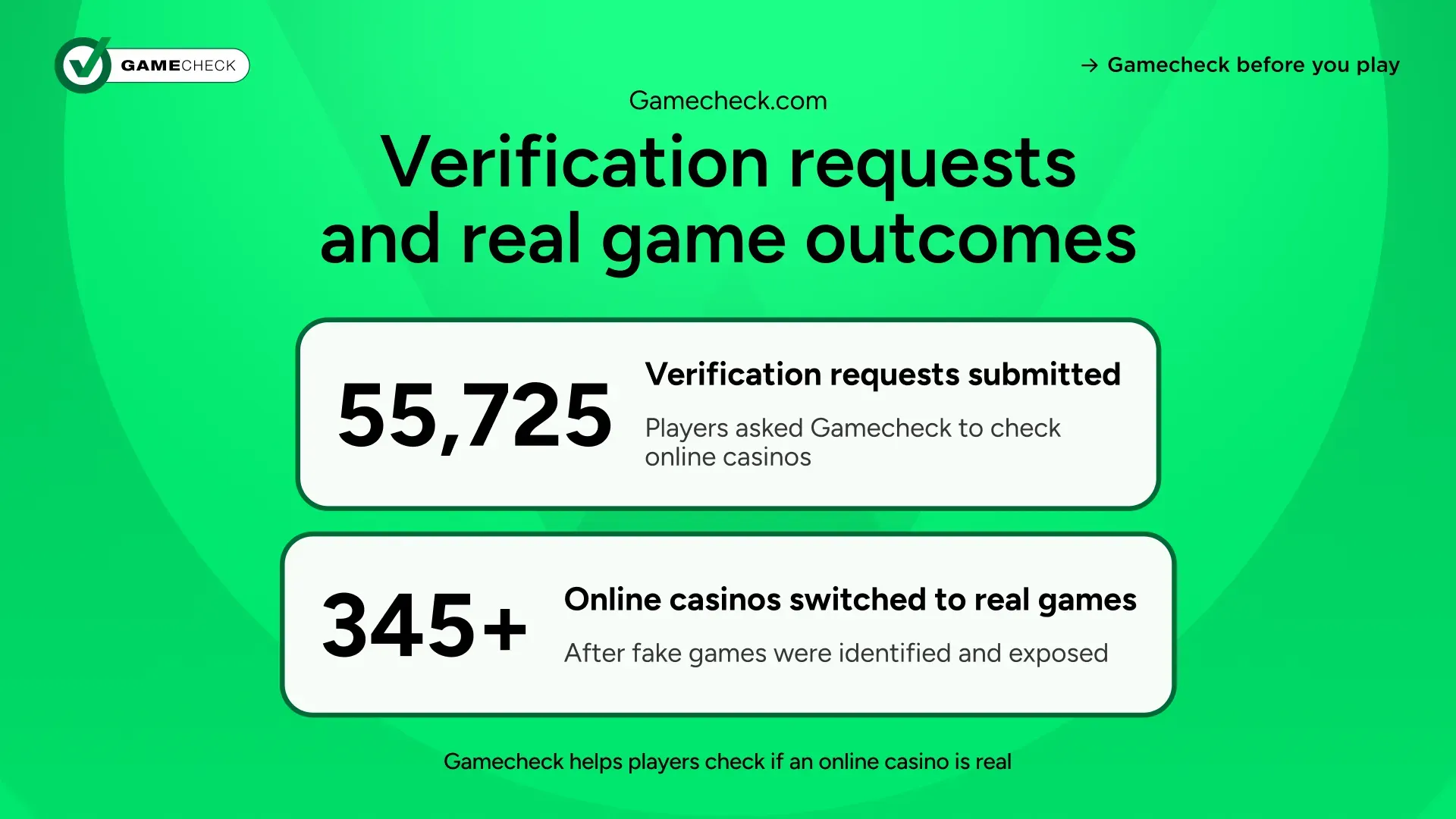
Over 55,725 verification requests were submitted in 2025. This reflects a shift in behaviour.
Players are no longer relying purely on instinct or appearance. They are taking small, deliberate steps to understand what sits behind an online casino before they commit time or money. Each request represents a moment where something did not feel quite right. A delay in gameplay. A feature that behaved differently. A site that looked correct, but lacked consistency beneath the surface. Individually, those moments may seem minor. Collectively, they form a pattern. And it is those patterns that make reporting valuable.
Most players report a site for personal reasons. Something does not feel right, and they want clarity before continuing. What is less visible is how that single action contributes to a broader system. When multiple reports point towards similar behaviour, they begin to form a data trail. That trail helps identify repeat activity across different platforms, regions, and timeframes. It allows investigations to move faster and with greater precision.
Over time, this builds a shared layer of knowledge. Instead of each player navigating uncertainty alone, information becomes collective. What one player flags can help prevent the same experience for thousands of others. This is one of the core principles behind Gamecheck. It exists to help players make informed decisions by turning individual signals into something more structured and useful.
The impact of reporting does not stop at the player level. Fake games affect multiple parts of the online casino gaming industry at the same time.
For game providers, it creates a direct problem. Their games can be copied and redistributed without their knowledge, which affects how players perceive the original versions.
For operators, it introduces a different challenge. When fake games circulate widely, it becomes harder for players to distinguish between platforms. Trust is no longer based on appearance, but on what can be proven beneath it. For the wider industry, the effect is cumulative. Confidence becomes harder to maintain when players are unsure whether the games they are interacting with are real.
Fake games undermine trust and reduce confidence in legitimate platforms. Reporting plays a quiet but important role in addressing this. It creates visibility. It introduces accountability. And over time, it helps separate what is real from what is fake.
One of the less obvious aspects of reporting is how it strengthens over time. The more verification requests are submitted, the clearer the picture becomes. Patterns that would otherwise go unnoticed start to stand out. Certain behaviours repeat. Certain structures reappear across different sites. This allows investigations to become more focused. It also supports ongoing monitoring. When a site shows signs of irregular activity, it can be tracked over time, rather than assessed once and forgotten.
This continuous approach is important. Fake games are not static. They evolve, adapt, and reappear in different forms. A system built on one-time checks would struggle to keep up. A system supported by ongoing reporting becomes far more responsive.
Requesting a verification is designed to be simple.
A player can submit an online casino URL directly through the Gamecheck platform, adding any additional context if needed. For those already browsing a site, the process can happen in real time. The Gamecheck Chrome Extension allows players to check a site instantly and submit a request without interrupting their session.
This is where reporting becomes part of normal behaviour rather than a separate task. It does not require deep technical knowledge. It does not require time-consuming research. It simply requires noticing when something feels off - and acting on it.
The volume of verification requests in early 2026, points to something broader than individual caution. It reflects a change in how players approach online casinos. There is less reliance on visual trust signals alone. More awareness that appearance does not always reflect reality. And a growing willingness to check before engaging further.
This shift matters because it changes the balance. Fake games rely on scale and speed. They depend on players moving quickly, without questioning what sits behind the experience. Reporting slows that down. It introduces friction where none existed before. And in doing so, it makes it harder for fake games to operate unnoticed.
Requesting a verification takes seconds. But its impact extends far beyond that moment. It contributes to investigations, supports game providers, helps other players avoid the same risks, and strengthens transparency across the industry. 345 online casinos have switched to real games after fake games were identified and exposed.
This is one of Gamecheck’s key success outcomes - showing that when fake games are detected and made visible, operators do take action and move towards fair play.
Taking a moment to check an online casino before you play gives you a clearer understanding of what sits behind the platform. It clarifies whether you are dealing with real or fake games. If something does not feel right, request a verification. Be part of the community that supports fair play. Check your online casino with Gamecheck.