At first glance, 101Game looks like a global online casino brand attracting players worldwide. Bright branding, a familiar games lobby, and the promise of real cash wins. But a closer look by Gamecheck told a different story. A selection of games from multiple original game providers was checked against the versions running on 101Game, and fake games were found.
Players can confirm this directly on the 101Game Gamecheck profile, where the fake games status is recorded and updated as monitoring continues. That is the reason this site deserves a proper look.
Most established online casino operators are easy to research. They publish a company name, a registration number, and a licence reference somewhere on their site. 101Game does not offer any of this in a form that can be checked. What does exist is a sprawl of platforms carrying the 101Game name or close variants, spread across unrelated products. The name has been used for an Indian real-cash gaming app, a card game, a live dealer casino site, and several gambling portals with little in common beyond the branding.
A single operator building one platform does not usually end up with its name attached to this many unrelated products. It is a pattern more often seen when a brand name is reused as a template, applied wherever convenient, with no single company standing behind it in a way a player could trace.
That pattern shows up in the domain records too. A related site in the same naming cluster, 1015game.in, has its WHOIS registration fully redacted, disclosing nothing beyond a registrant location in Guangxi, China. No operator name, no organisation, no contact details. This is consistent across much of the cluster: names that repeat, ownership that does not.
This matters because it makes basic due diligence almost impossible for a player. There is no single "101Game" to research. There is a name attached to an unknown number of sites, each one able to disappear the moment it draws too much attention. Rogue operators who rely on this kind of anonymity are not playing fair with the players who deposit real money expecting a real game behind the reels.
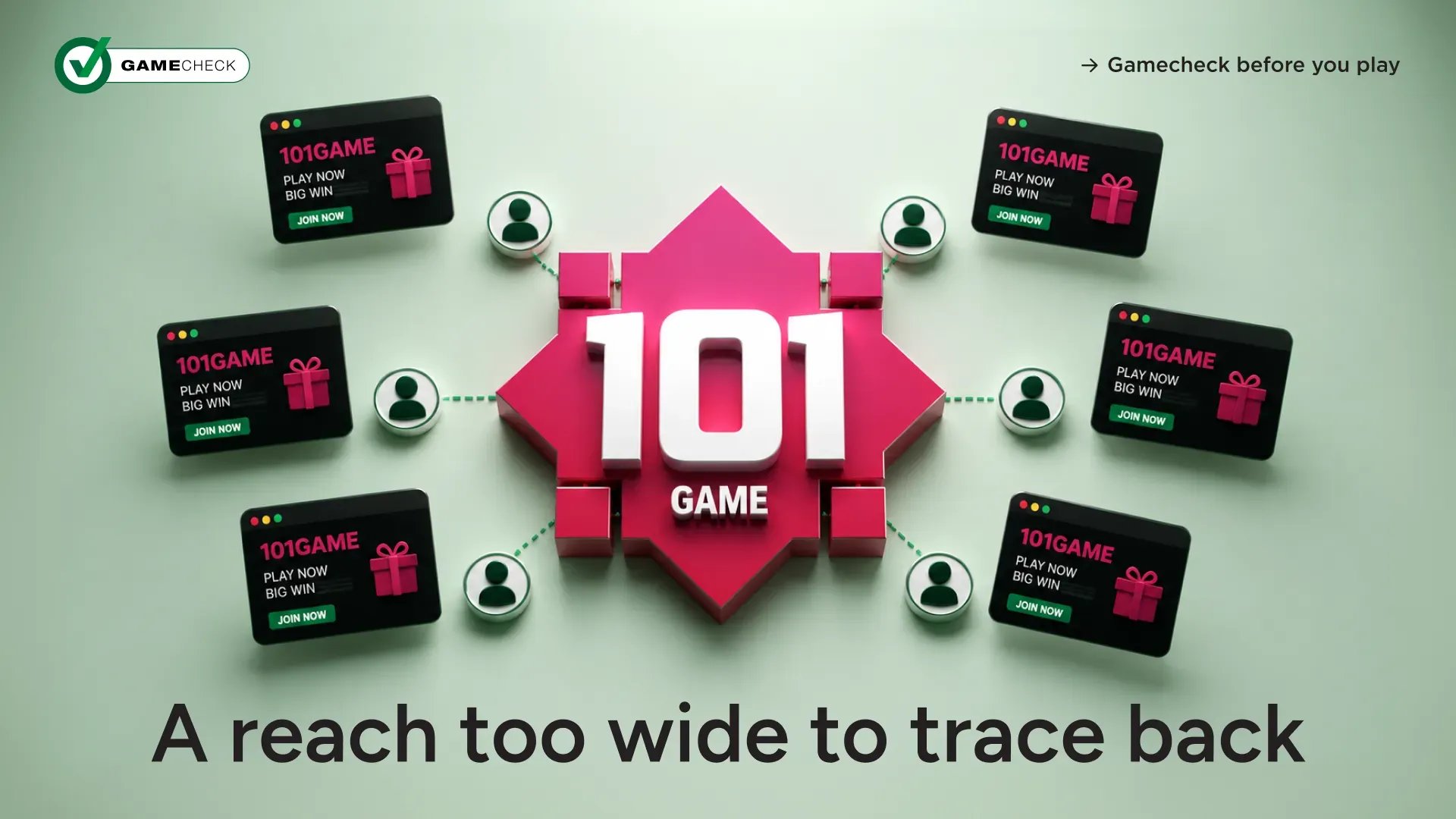
Gamecheck looked for a verified social media presence tied specifically to the 101game.cc domain and could not confirm one. The wider 101Game name does appear across marketing pages built around affiliate-style promotion and referral bonuses, a common route rogue operators use to expand reach quickly without spending on conventional advertising. Referral and affiliate models let a network of sites grow through word of mouth and commission, which helps explain how a brand attached to so little verifiable ownership can still reach a wide international player base.
No player complaints could be confirmed against the 101game.cc domain at the time of writing. Sites that share a name across this many domains make it structurally difficult for any single complaint trail to build up in one place. A player who loses money on one version of "101Game" and searches for it afterwards may find reviews, forum posts, and reports scattered across products that are not the one they used. That fragmentation is not evidence of a clean record. It is a feature of how these networks are built.
Gamecheck checks games against the providers who built them, and reports what those providers confirm. In the case of 101Game, that check returned a fake games result. Fake games often carry manipulated outcomes and altered pay-out rates, meaning the odds displayed on screen may bear no relation to the odds actually running underneath. A player spinning a fake slot has no way of knowing this from the interface alone. The graphics and the game rules can all look identical to the real thing.
This is precisely the gap the Gamecheck SEAL was built to close. Operators who carry the Gamecheck SEAL have had their games checked against the original providers and confirmed as real, with the result linked to their own domain, logged, and authenticated through the Gamecheck app. A player can scan the QR code or check the SEAL directly and see, in seconds, whether the games in front of them are the real thing. For a brand as fragmented and hard to trace as 101Game, that thirty-second check is the difference between playing a real game and feeding money into a system with no verifiable game integrity behind it.
The wider reach a reused brand name can achieve, spread across unrelated apps and domains, is exactly why a visible, checkable standard matters more as these networks grow. A single fake casino is a problem. A name copied across a card game and a live casino site, each one reaching new players before the last one is flagged, is a pattern that needs a scalable answer. The Gamecheck SEAL gives operators a way to stand apart from that pattern in a way players can check for themselves, rather than take on trust.
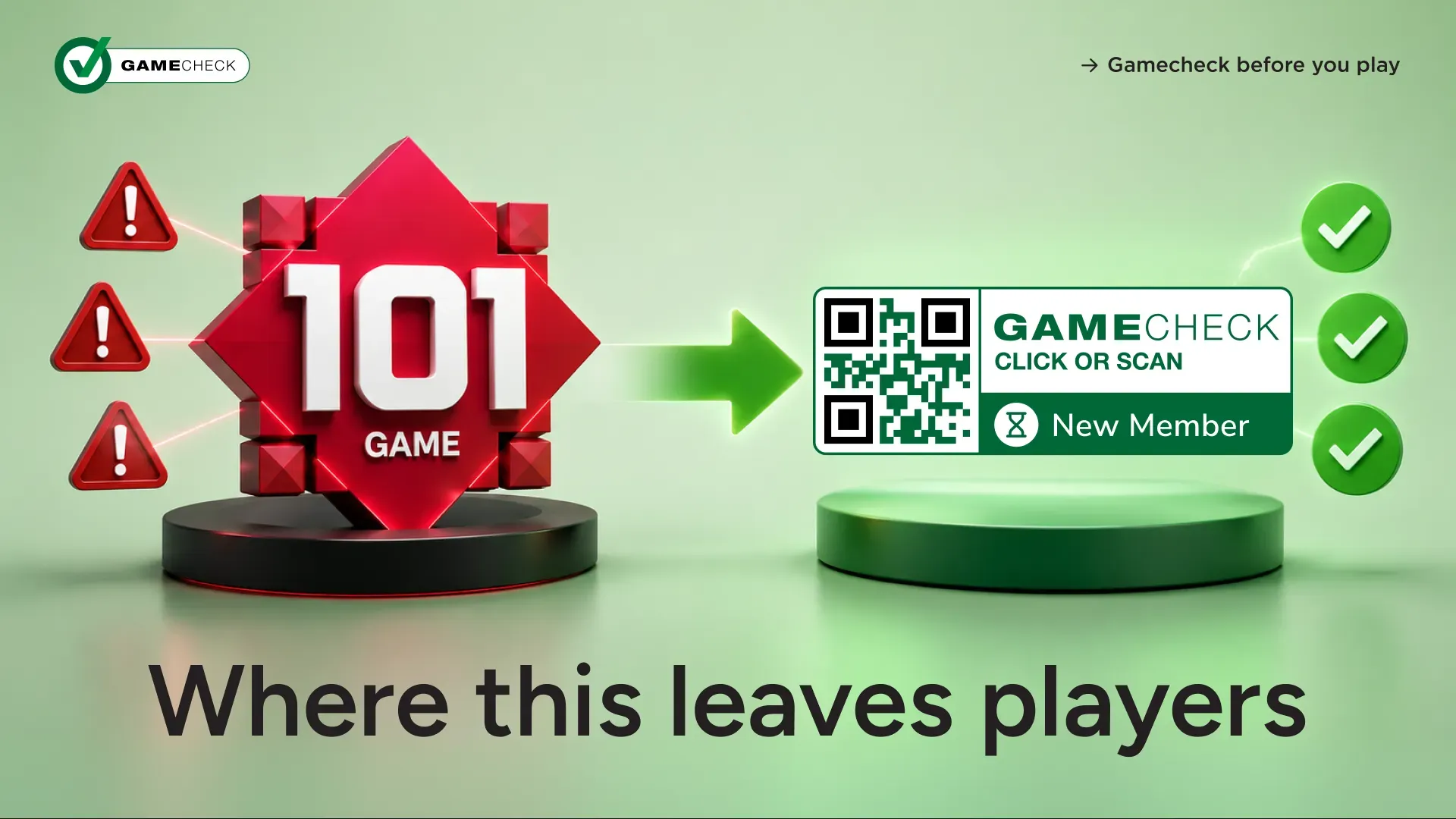
101Game presents itself as a global online casino brand. Behind that presentation sits a name reused across unrelated products and domains, ownership details that are redacted where they exist at all, and games that did not check out against the providers who made them.
Gamecheck encourages players to avoid any online casino they come across using the 101Game brand, in any of its forms. The 101Game profile remains under monitoring on Gamecheck, and any change to its status will be reflected there. Anyone who has played on a site carrying the 101Game name is encouraged to move their activity to an operator that carries the Gamecheck SEAL instead.
It means a selection of games were checked against the originals in collaboration with the providers, and they did not match the originals. This can include altered pay-out rates or manipulated game behaviour.
The 101Game name appears across multiple unrelated products, including a live casino site, and several gambling portals, with no clear ownership information published. This makes it difficult to trace who is behind the operator. What is confirmed is that fake games were found on 101game.cc.
Search the operator's domain on Gamecheck: Protecting Players from Fake Online Games , or look for the Gamecheck SEAL on the operator's site and scan its QR code using the Gamecheck app.
Check the site's current status on its Gamecheck profile, and report any suspicious activity or losses at Request Casino Verification | Gamecheck.