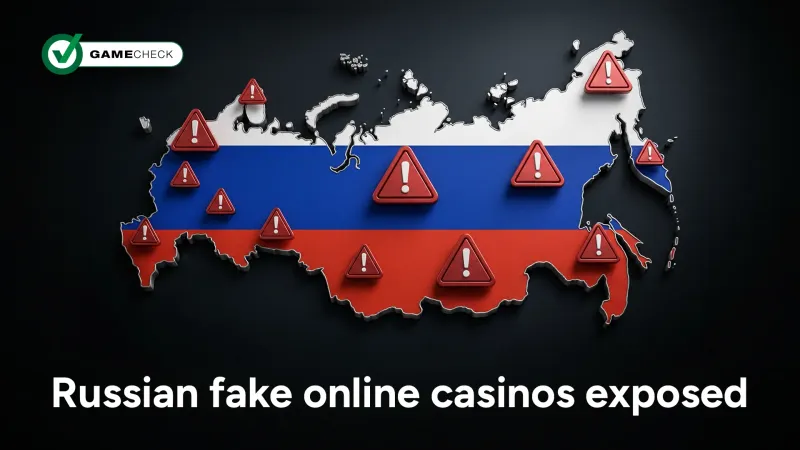
Gamecheck has identified several online casinos operating under Russian-language branding, all of which have returned a status of ‘Fake Games Detected’. The operators span a range of styles, from imitation slots to VIP-branded platforms, yet each shares the same critical finding. A selection of the games on offer are fake.
This report sets out what Gamecheck found, explains the landscape Russian online casino players are navigating, and outlines what players can do to protect themselves.
Watch the Segaslot14 exposé video
Online casino gaming occupies an unusual position in Russia.
Online casino gaming is outlawed under federal law, while online and retail sports betting remain legal. Land-based casino gaming is permitted exclusively within five officially designated zones: Krasnaya Polyana in Sochi, Siberian Coin in Altai Krai, Primorye near Vladivostok, Yantarnaya in Kaliningrad Oblast, and Crimea. Online casino gaming on the other hand is illegal everywhere in the country, even within these five zones.
Despite this, demand for online casino gaming among Russian players is growing. Russia's Ministry of Finance estimates that the legal online betting market - sports betting through licensed bookmakers - generated around 1.7 trillion roubles in turnover in 2024. By contrast, the illegal online casino segment is believed to exceed 3 trillion roubles annually, operating through roughly 100 unlicensed platforms.
The gambling ban passed in 2006 and came into full effect in 2009. It applied to both land-based and online gambling, confining casinos and slot halls to designated zones while banning online gambling outright. It was a direct response to years of largely unregulated growth in casinos and slot halls, which had become closely associated with organised crime and tax evasion.
According to iGamingToday rather than eliminating demand, the ban pushed it online, creating the conditions for a vast and largely unmonitored market to develop. Underground gambling networks moved their operations to the internet, where they were far harder to trace and shut down.
The scale of what followed is significant. Russian players looking for online casino gaming have few officially sanctioned options. What they find instead is a large volume of platforms operating without any form of independent oversight, many of which present fake games as real ones.
Gamecheck tests games by gathering evidence and checking findings directly with partner game providers. When a provider confirms that games on a site do not match their original titles, those games are classified as fake. Every operator listed in this report has received that classification.
The rogue operators are:
Each Gamecheck profile contains the full findings for that operator, including the status classification and the evidence gathered during testing. Fake games have been detected on all of these sites.
The Russian Civic Chamber has stepped up efforts to shut down online casino websites and target crypto payment providers that support the unlicensed market. Enforcement remains difficult given the scale of what authorities are dealing with. Authorities plan to block access to unlicensed websites and curb financial transactions, particularly those involving cryptocurrency, which is often used to evade detection.
Cryptocurrency has become central to how many of these rogue operators process payments. Transactions are harder to trace and easier to deny. Players who deposit via crypto have limited recourse if something goes wrong, and the operator has little incentive to resolve disputes.
The picture is further complicated by the sheer volume of operators targeting Russian-speaking players. Russia's population of almost 146 million represents a significant audience. That audience is being targeted aggressively by operators who have no interest in offering real games.
Advertising unlicensed online casinos is subject to heavy fines in Russia, with new proposals aiming to increase penalties up to 7 million roubles. Even so, enforcement against operators based outside of Russia is limited, and many continue to reach Russian players through affiliate networks and social media.
Russia's Ministry of Finance has proposed lifting the existing ban on online casinos as part of a broader effort to curb the large unlicensed gambling market. Under the proposal, a unified online casino regulator would be designated by presidential order, and all betting transactions would be processed through the country's Unified Betting Transfer Accounting Centre, mirroring the existing system used by licensed bookmakers.
The proposal projects that legalising online casinos with a monthly tax of at least 30% on gross revenue would generate approximately 100 billion roubles annually for the federal budget. Proponents argue that bringing the market above board would give authorities meaningful tools to protect players and reduce the dominance of unlicensed platforms. The proposal also includes consumer protection measures, with access to online casinos limited to users aged 21 and older.
Whether that proposal becomes legislation remains to be seen. In the meantime, Russian players have no official online casino options and remain heavily exposed to operators offering fake games.
Several operators in this group share naming conventions that are worth examining.
V2 V Vulkan Slots and Vlk Fast 09 both draw on Vulkan-adjacent naming, a common pattern in Russian-market online casino fraud. The Vulkan brand, long associated with slots-style gaming across Russian-speaking markets, has been replicated across different domains many times over. The persistence of Vulkan-style branding across fake online casinos speaks to how effective it has been at attracting players who recognise the name from years of exposure across Russian-language gaming platforms.
Segaslot14 borrows from the Sega name, a brand that carries significant recognition. Using a trusted name from a completely different sector is a deliberate tactic. Players who recognise the brand may apply a degree of trust that has no basis in the actual operator behind the site. Slot Million Play gestures at scale and reward, a framing designed to attract players seeking high-volume slot entertainment.
J Jac and Vulpin Casino use less transparent naming that gives little indication of the games offered inside, while Playbit Casino rounds out the group with a name that gestures towards play and digital currency, a combination increasingly used by operators targeting younger or tech-adjacent audiences who may be newer to online casino gaming and less familiar with the red flags.
What unites all of these operators is not their branding but their Gamecheck status. Every one of them has been checked. Each of these sites has returned ‘Fake Games Detected'.
A fake game is not simply a poor-quality game. It is a copy of an original title, stripped of the mathematics and mechanics that the original developer built and certified. When a player sits down at what appears to be a well-known slot, they may be playing something that looks identical but behaves entirely differently.
The original game provider has confirmed no involvement with the operator. The game has not been tested or certified by that provider. The outcomes it produces are not governed by the same logic as the real version. Everything the player sees on screen, from the symbols to the animations to the apparent win frequency, has been constructed independently of the original title it resembles.
This matters most in a market like Russia, where players already have limited access to officially sanctioned platforms. A player who cannot compare what they are seeing against a known reference point is more exposed. The visual presentation of a fake game is often indistinguishable from the real thing. That is precisely what makes independent checking tools essential.
Gamecheck provides that check for free. It does not require an account, a subscription, or any personal information. A player submits an online casino, Gamecheck tests it, and the result is returned. If the result is 'Fake Games Detected', the player has the information they need before any money changes hands.
Gamecheck operates as an independent platform. When a player submits an online casino for checking, Gamecheck tests games on that site and takes that evidence to the original game providers. If those providers confirm the games are not their titles, the operator receives a status of 'Fake Games Detected'. That status is publicly accessible and updated continuously.
Players can check any operator using the free Gamecheck Search Tool. Results are displayed in seconds. If an operator holds a Gamecheck SEAL, that status can be checked by scanning the QR code using the Gamecheck app, which retrieves a live, blockchain-logged result connected to the operator's specific domain. None of the operators in this report hold a Gamecheck SEAL.
Russian online casino players searching for online casino gaming face a market where the vast majority of platforms operate without oversight. That makes checking tools even more important.
Gamecheck operates as a free platform available to any player, anywhere. When a player submits an online casino for checking, Gamecheck tests games on that site and takes its findings to the original game providers. If those providers confirm the games are not their titles, the operator receives a status of 'Fake Games Detected'. That status is publicly accessible and updated continuously.
Gamecheck follows the Russian online casino market closely and publishes regular updates for Russian-speaking players. Online casino players in Russia can follow Gamecheck Russia on Instagram for the latest findings, fake online casino alerts, and player protection guidance.
Russian-speaking players can connect with the Gamecheck community on Telegram via the the Gamecheck CIS super group, Gamecheck Russia channel, and the Gamecheck Russia🇷🇺 chat group.
Any player who suspects they have encountered a fake online casino can submit a report directly at
Request Casino Verification | Gamecheck.
If an online casino is listed in this report, the advice is straightforward: do not play at that operator. The evidence gathered by Gamecheck and checked with the original game providers has returned a clear result. The games are not real.
For any online casino not listed here, checking before playing takes less than a minute. Players can access the free Gamecheck Search Tool to check any online casino before they play. If something on a site does not feel right, that is reason enough to check.
Russian-speaking players can stay informed by following Gamecheck Russia on Instagram and joining the conversation on Telegram via the Gamecheck CIS super group, the Gamecheck Russia channel, or the Gamecheck Russia🇷🇺 chat group. The operators identified in this report will continue to be monitored. Any change in status will be reflected in their Gamecheck profiles.
Online casino gaming is not legal in Russia. Online sports betting operates under a regulated system through licensed bookmakers, but online casino games fall outside that framework. Russia's Ministry of Finance has proposed legalising online casinos, though no legislation has been passed to date.
A status of 'Fake Games Detected' means that Gamecheck has tested a selection of games on that operator's site and taken its findings to the original game providers. Those providers have confirmed the games are not their titles. The games checked are copies of original titles and have not been tested or certified by the original game providers.
Any player can access the free Gamecheck Search Tool to check an online casino before they play. Results are returned quickly and updated continuously. Russian-speaking players can also follow Gamecheck Russia on Instagram and connect with the community on Telegram via the Gamecheck CIS super group, the Gamecheck Russia channel, or the Gamecheck Russia🇷🇺 chat group.