Across Latin America, online casino activity continues to grow at pace. New platforms appear daily, many of them well-designed, mobile-friendly, and easy to access. For players, this growth creates choice. It also creates uncertainty.
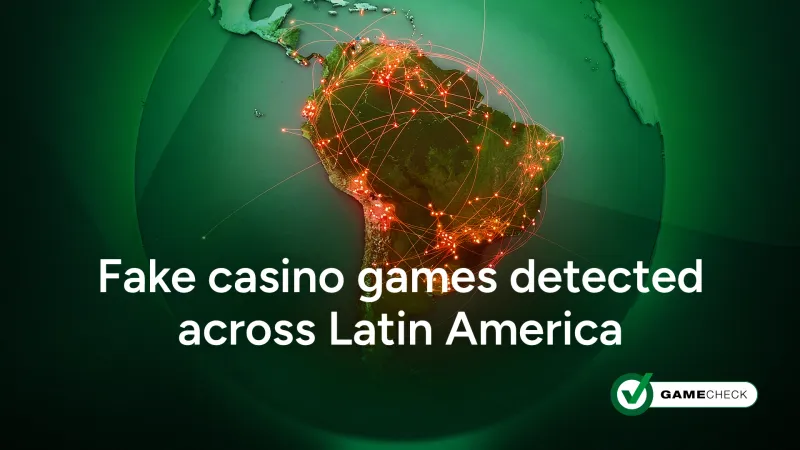
In recent weeks, Gamecheck has identified a large group of online casino domains operating across Latin America that were found to be offering fake games. This article explains what Gamecheck found, and what players should take away from the findings.
When fake casino games are detected, they rarely appear in isolation. More often, they are part of a wider structure designed to scale quickly. The sites reviewed followed a recognisable formula: similar domain names with slight brand variations.
To a player, these small differences can feel reassuring at first. Choice implies competition. In reality, the variation is often cosmetic. Once gameplay evidence was collected and reviewed across the group, all of these sites had one noticeable thing in common: all of them offer fake games.
The domains in these clusters follow a structured naming system. Core brand terms are reused, while interchangeable suffixes create the illusion of legitimacy. Gamecheck has exposed WIN MACHANCE and WIN UNIQUE CASINO as clusters of fake casinos.
.webp)
This level of repetition is not accidental. It is a distribution strategy for fake games.
Gamecheck does not assess an online casino’s licensing, payment systems, or customer service. We also do not rely solely on player complaints, reviews, or testimonials.
Our focus is specific and evidence-based:
Across this network, the evidence collected showed repeated indicators consistent with fake games. Based on this process, the sites reviewed were labelled:

Red Status – Fake Games Detected
This status reflects the games found during inspection.
What makes this case particularly important is scale.
Rather than operating one or two questionable platforms, the operators behind this activity appear to rely on volume. Dozens of closely related domains are used to distribute the same underlying systems across different market entry points.
Common characteristics included:
This approach allows new sites to replace flagged ones quickly, by changing their names.
Latin America is not unique, but it currently sits at the centre of several trends that favour this kind of operation. These include:
Together, these conditions make it easier for fake games to gain traction before scrutiny catches up.
Fake games are not designed to fail visibly. They are designed to blend in. They load smoothly. They look polished. They closely resemble real titles. For most players, nothing immediately feels wrong during casual play. That is precisely why checks matter.
The key lesson from this investigation is not about individual domain names. It is about recognising patterns. If an online casino:
There is a strong chance it is part of a wider network.
Checking the specific site you are using can save you from fake games and financial loss.
.webp)
Gamecheck gives players a way to pause and verify before committing time or money. Using the Gamecheck tool, players can see whether a site offers real or fake games. Sites offering fake games remain under ongoing monitoring, because patterns like these rarely disappear overnight. Additionally, players should look out for the Gamecheck SEAL on a site, if they want reassurance that the online casino platform offers real games.
Fake casino games persist because they are designed to look legitimate. The platforms exposed in this investigation appeared convincing at first glance. They failed only when their games were examined properly. That is why checking before you play matters more than ever. When platforms feel familiar but not quite the same, it’s worth checking why.
Published On: Feb 23, 2026
Updated On: Sep 21, 2026
Join operators using Gamecheck SEAL to protect players and grow credibility.