Fake games detected on Seven Casino
5 min read
Gamecheck has identified fake games across multiple game providers on Seven Casino, an online casino currently accessible to players in the UK. The findings are straightforward. Games appearing under the names of established original game providers do not match the software those providers produce. They carry the branding. They don't carry the substance.
Fake games are unauthorised copies of original titles, altered to perform differently from the real thing. They can be configured to pay out less than advertised or not at all. Without an independent check, there is no way for a player to know whether the outcome of a spin is determined by a certified random number generator or something else entirely.
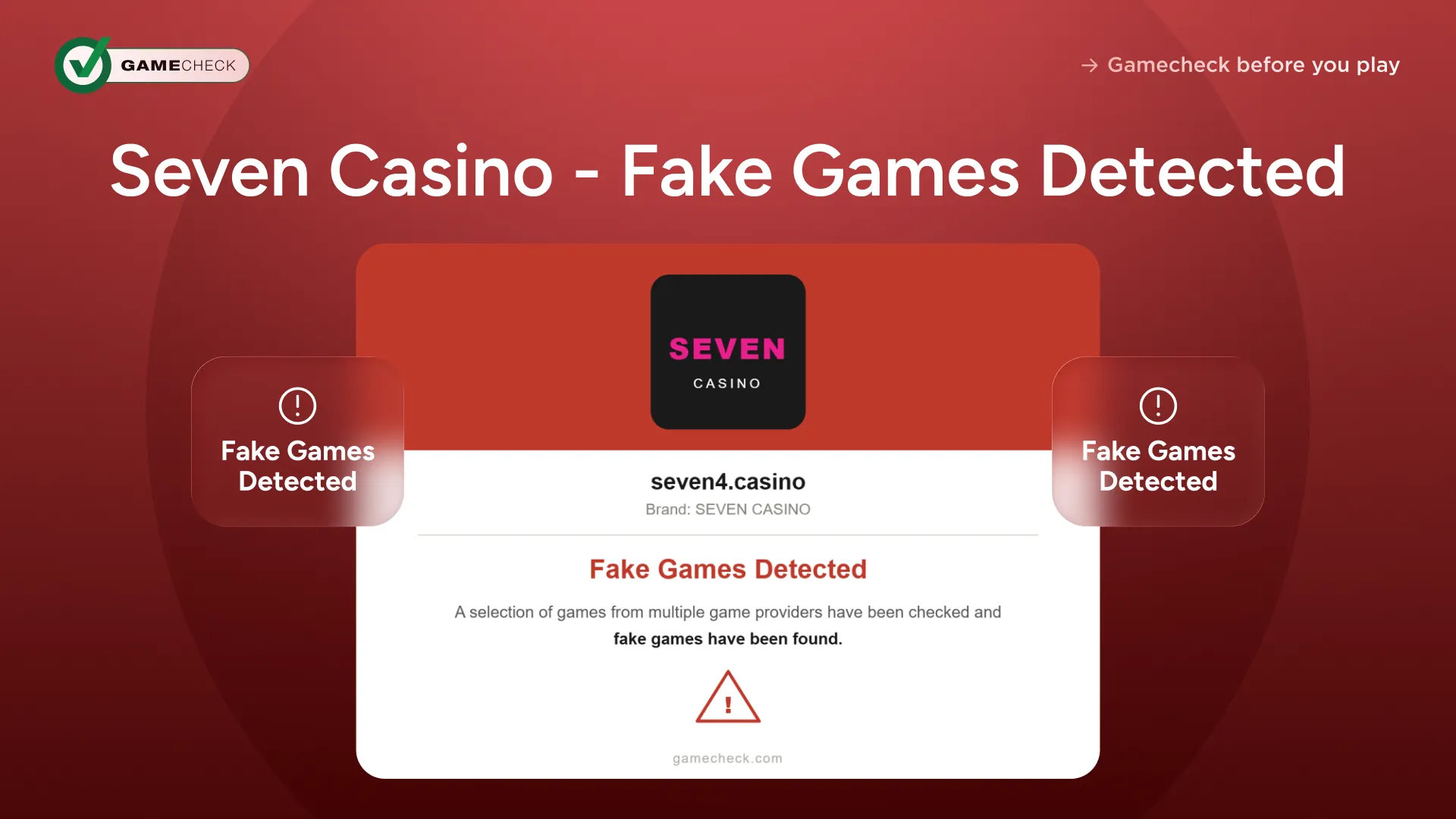
Gamecheck has identified fake games on SEVEN CASINO - Gamecheck.
Who is behind Seven Casino?
Seven Casino operates under Group Gaem B.V. and holds a Curaçao licence, not a UK Gambling Commission (UKGC) licence. This matters. A Curaçao licence means the operator sits outside UK jurisdiction. UK players who deposit and encounter problems cannot access UKGC dispute resolution. There is no access to the Alternative Dispute Resolution (ADR) schemes that licensed UK operators are required to provide. Deposits are not protected by segregated funds requirements. The site targets UK players directly and it accepts GBP, markets a £7,500 welcome bonus, and promotes itself as accessible to British players. Yet it operates outside the framework that exists to protect those same players.
What Gamecheck has found
Gamecheck's checks of Seven Casino, with the URL seven4.casino, identified fake games across multiple game providers. The games in question are are copies taken from original game providers without authorisation and altered. The outcomes of those games are not governed by certified random number generators. They can be configured to return less than advertised, or nothing at all.
This is the core of the problem. A player visiting seven4.casino sees a game that looks very similar to one they might find on a legitimate platform. Same brand. Same layout. But the game underneath is not the same one provided by the real game provider.
Gamecheck's check covered games across several providers. Fake games were identified. The Gamecheck profile for Seven Casino is now publicly accessible and shows the results of those checks in full. Players can view it at SEVEN CASINO - Gamecheck.
What players are reporting
On Trustpilot, UK players have left reviews describing experiences consistent with a rogue operator. One reviewer described being spammed by SMS offering a £7,500 sign-up bonus, calling the site "unregulated and part of a larger network of scam casinos."
Another player described turning a bonus into £200, only for the withdrawal to be rejected. The email correspondence came from seven.casino, a domain that does not exist, directing the player back to seven4.casino. Attempts to withdraw were blocked at every turn.
A second URL associated with the brand - seven7.casino, has also appeared on Gamecheck's records. Fake games were previously detected on this domain. Gamecheck's checks indicate it has since switched to real games, but it carries a history worth noting. These are not isolated incidents. The pattern - unsolicited contact, inflated bonus offers, withdrawal refusals, and shifting domain names, is consistent with how rogue operators work.
Seven Casino is not alone
Seven Casino is one of a number of online casinos currently flagged on Gamecheck with fake games detected. Another example is maxispin.best, operating under the brand Maxi Spin, where Gamecheck's checks across multiple game providers have also found fake games. The Gamecheck profile is MAXI SPIN - Gamecheck.
These sites do not operate in isolation. The presence of multiple domains using similar brand names, similar bonus structures, and similar evasion tactics suggests a network of connected operators, not a series of unrelated bad actors.
The bigger picture: the UK's illegal gambling market
This is not a fringe problem. According to data from anti-fraud platform Yield Sec, the illegal gambling market in the UK accounts for around 9% of the total online gambling sector. While 9% may appear low, it is equivalent to approximately £379 million in the first half of 2025 alone. That figure has risen from just 0.43% of the market in 2020, effectively doubling year on year since the pandemic.
A significant driver is the targeting of self-excluded gamblers. Yield Sec's analysis estimates that self-excluded players may contribute as much as £426 million in losses to illegal operators. Many of these operators actively market themselves as "not on GamStop" sites, a deliberate strategy to reach people who have already asked to be excluded from gambling.
The methods these operators use to reach UK players are brazen. A recent report commissioned by Flutter UK & Ireland, published in April 2026 ahead of discussions on gambling policy reform, found that social media influencers and tipster accounts were directing users to offshore sites openly. Researchers were able to register accounts using obviously false identities, and in some cases, the names of well-known public figures.
What is being done
The UK Gambling Commission is not standing still.
In 2026, it received an additional £26 million in government funding to strengthen enforcement against illegal offshore operators. This includes blocking illegal domains so UK users cannot access them, working with payment providers to disrupt transactions to unlicensed platforms, and expanded use of payment blocking orders requiring financial institutions to stop processing payments to blacklisted sites.
These are meaningful steps. But enforcement is reactive by nature, and it targets sites that have already reached players. The gap between a site going live and regulatory action can be months or years. In that window, players lose money.
How to check before you play
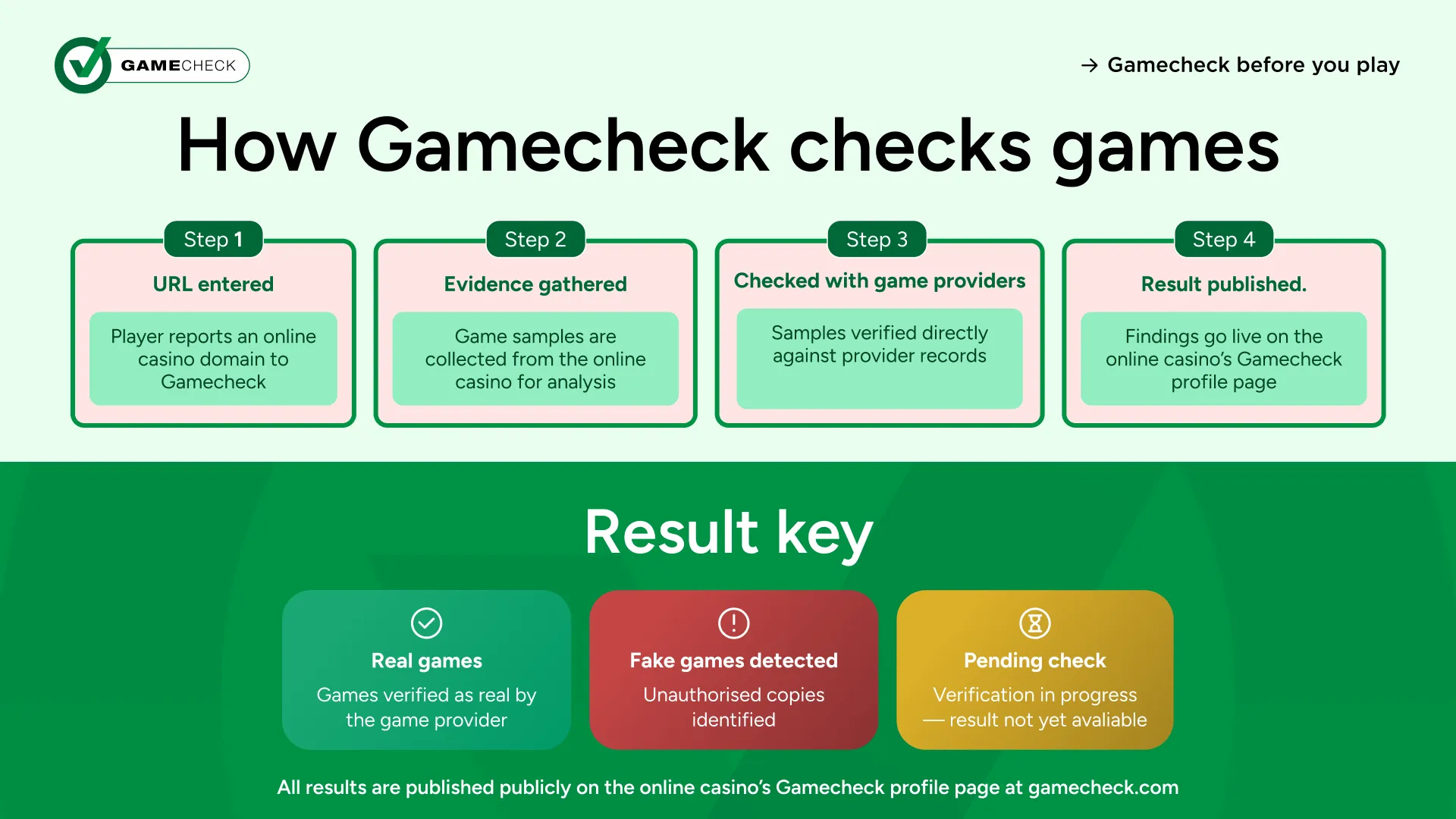
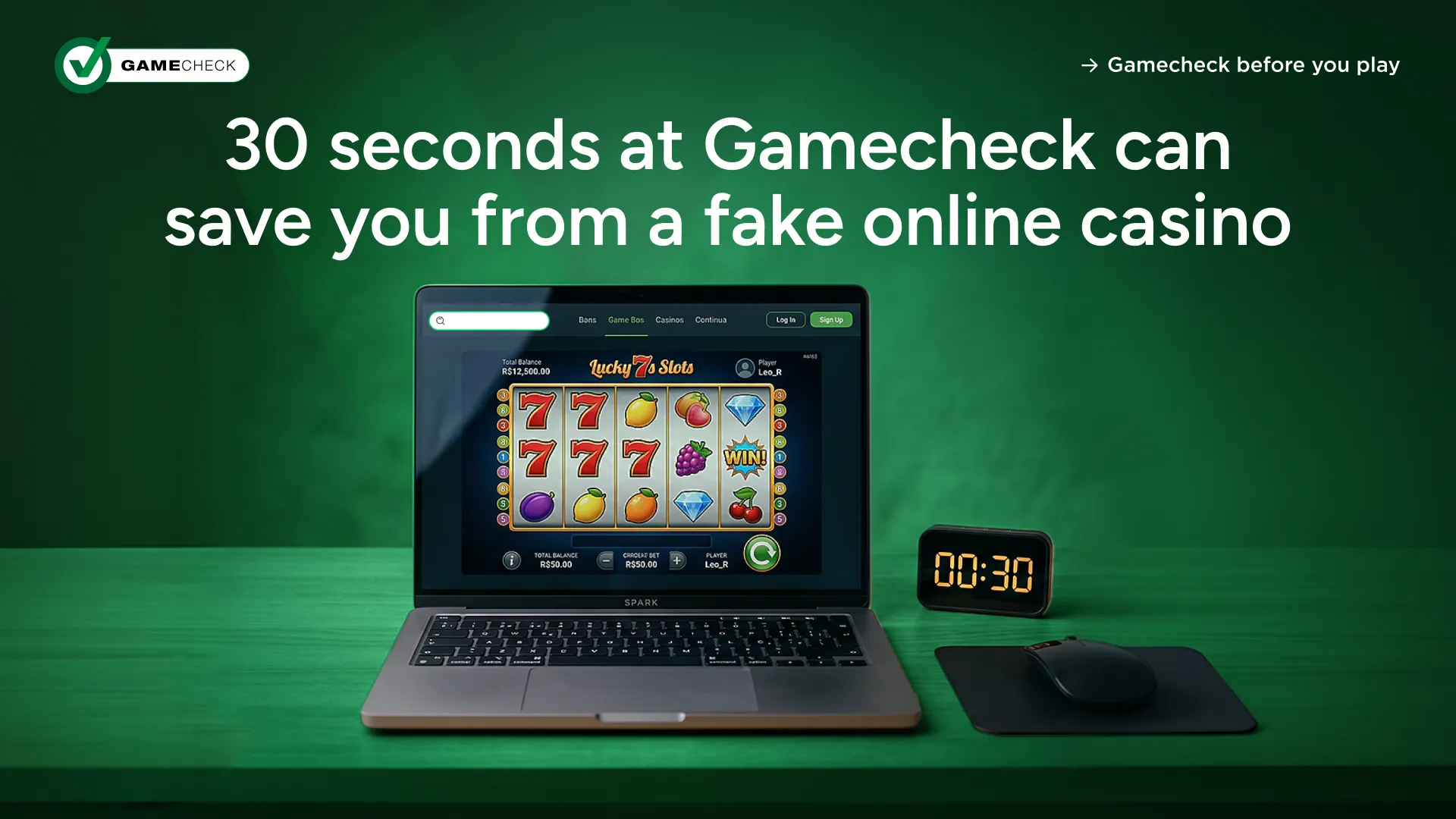
The Gamecheck app allows players to run a check on any online casino before depositing. Thirty seconds on gamecheck.com can save you hours of hassle later. If a site has been checked and fake games have been found, that information is visible immediately. If a site has not yet been checked, players can request a verification.
For UK players, there is also a straightforward first step: check whether the operator holds a UKGC licence. The UKGC's public register is searchable. If an online casino is not on it, and is actively accepting UK players, that is a problem in itself.
Seven Casino does not hold a UKGC licence. Any UK-based players who choose to play at Seven Casino do so at their own risk. Gamecheck has found fake games on the site. Players who have already deposited and are experiencing problems with withdrawals should contact their bank or card provider and consider reporting the site to Report Fraud.
If you are unsure about a site, check it at Gamecheck before you play.