Fake online casino games are one of the most damaging problems facing online casino operators today. They look identical to the originals - same branding, same sound effects, same visual polish. But beneath the surface, they run on untested random number generators (RNGs) that a third party can manipulate without the player's knowledge.
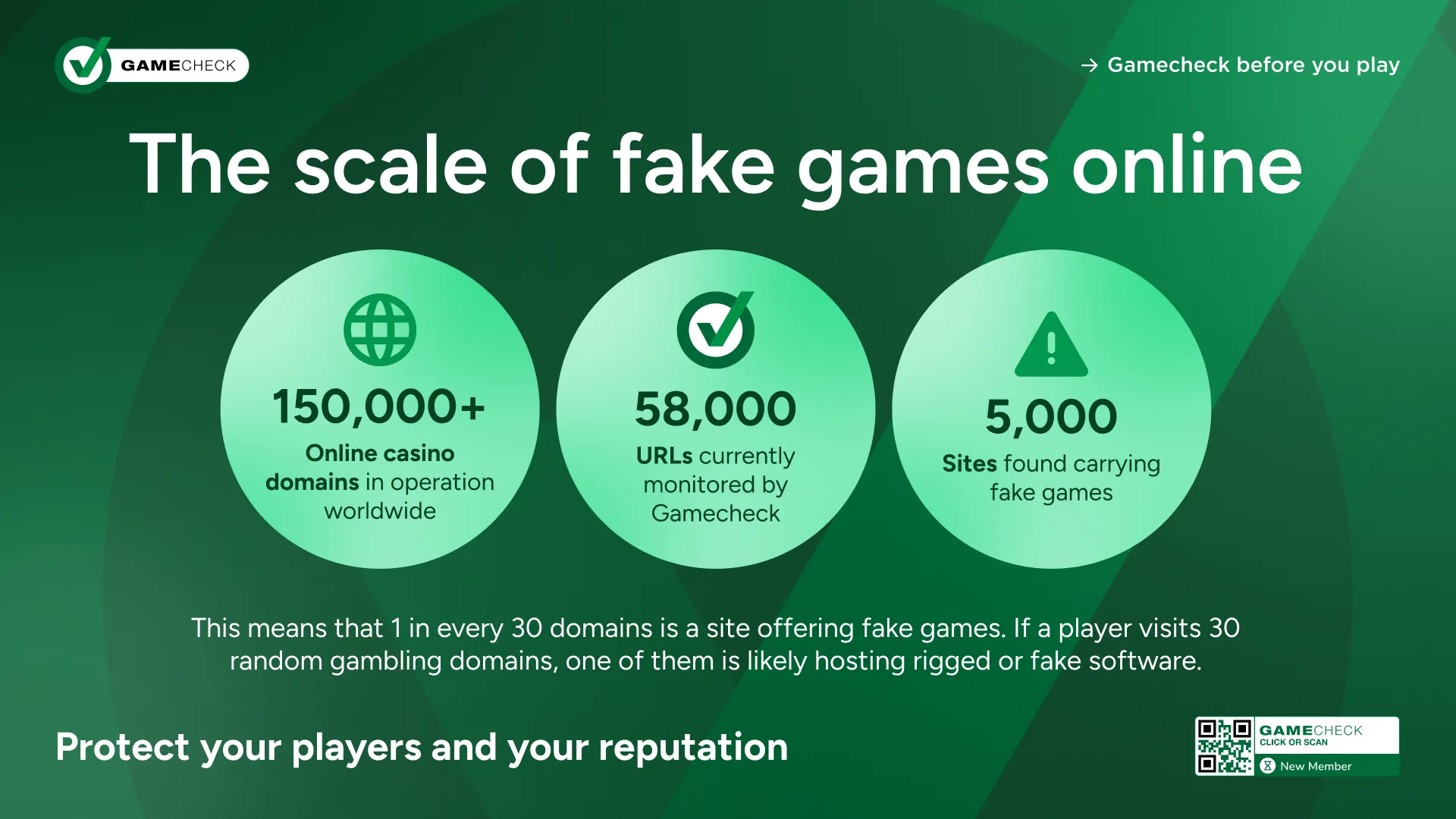
There are more than 150,000 online casino domains in operation worldwide, and a meaningful number of them are running games like this. The industry has a word for them: fake. A fake game can mean several different things, and the differences matter.
Gamecheck is currently monitoring 58,000 URLs across its database, adding to that figure every month. Of those, 5,000 sites have been found to carry fake games. That sits directly in the path of operators who have invested years building a reputation for fair play.
Understanding how fake games damage reputations and how operators can protect themselves has become essential knowledge for everyone in the iGaming industry.
The term "fake games" covers several distinct categories, each with different characteristics and different consequences for players.
To understand why fake games are a problem, it helps to understand how a real game reaches a player's screen.
When an online casino integrates a game from a legitimate provider, the game loads directly from the provider's own servers. Every spin sends a request to those servers, where an independently tested random number generator (RNG) produces the result. That result is recorded automatically. The operator has no way to influence it.
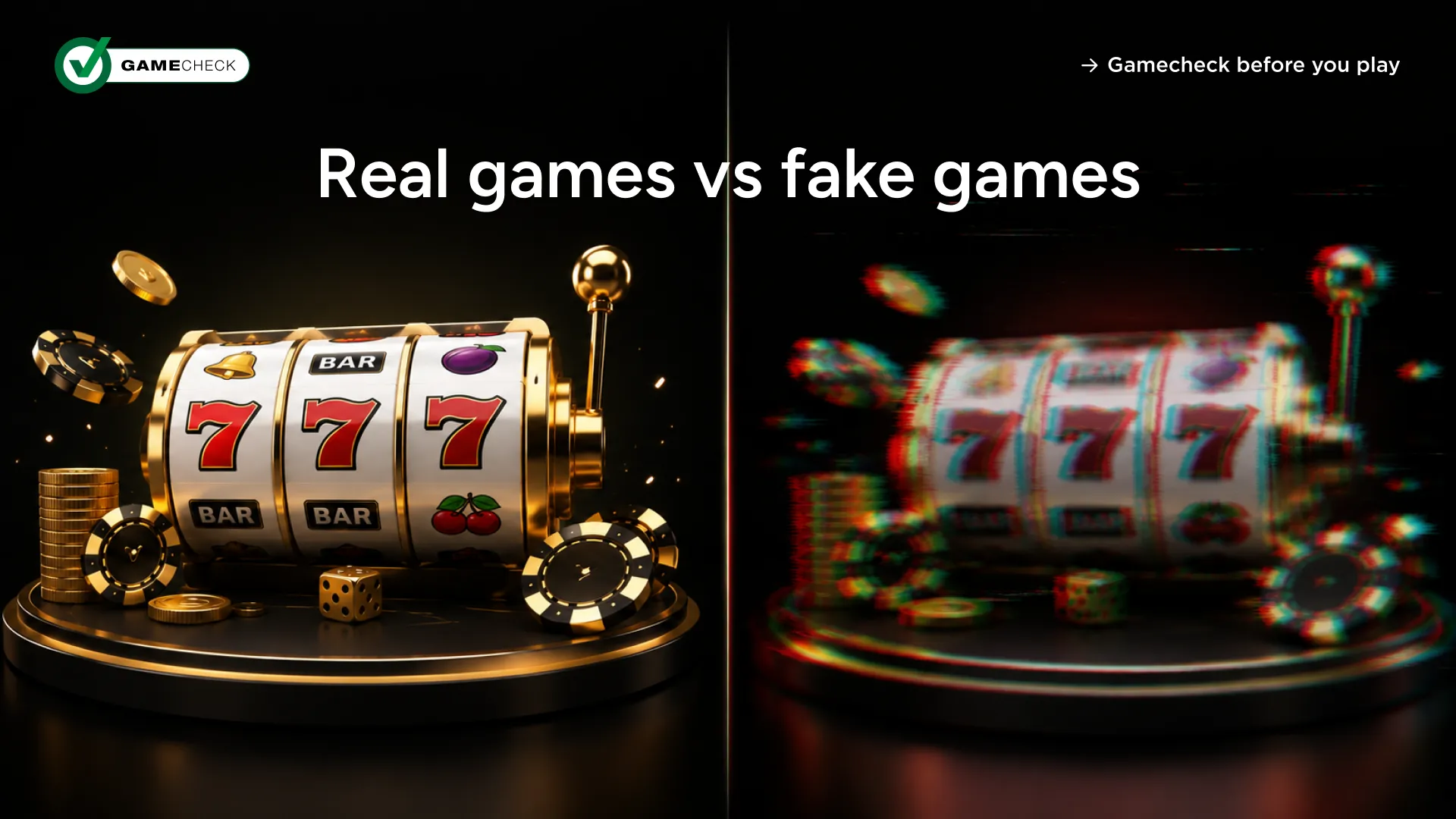
A fake game works differently. The game is routed through servers controlled by an unauthorised third party. The RNG has not been independently tested. There is no connection to the original provider's systems, and none of the automatic record-keeping that legitimate games carry. In practice, the outcome of each spin becomes something the rogue operator can adjust, and nothing on the player's screen would indicate that.
One of the easiest things to check is the progressive jackpot counter. On a real game, every online casino running that title shows the same live jackpot figure, updating in real time as players across the network contribute to the pool. On a fake installation, that counter is static or moves independently, because there is no connection to the real network. It is a small detail, but it is visible to anyone who knows to look for it.
The problem rarely stops at the games themselves. Rogue operators do not always build their own websites from scratch. Instead, they identify legitimate websites with security vulnerabilities and plant hidden code known as a backdoor, that creates a secret entry point into the site, bypassing all normal login and security processes.
Through that hidden access, rogue operators quietly install unauthorised gambling pages alongside the real content, and embedded scripts on those pages have been found collecting players' registration details and payment information in the background.
Wherever a game has been replaced, other things tend to be replaced too.
Documented cases across the iGaming industry reveal a consistent pattern. Online casinos move from the first forum-thread suspicion to permanent watchdog blacklisting in roughly 60 to 90 days. The timeline is predictable, and the damage is almost always irreversible.
The pattern typically begins when a player or independent tester notices something unusual: a game behaving differently from the same title on other sites, a jackpot counter that does not match the provider's network, or asset domains loading from unfamiliar servers. These observations are posted to player communities, where experienced members quickly organise technical inspections.
Within two to four weeks, the review sites and watchdogs publish their findings, which are rarely flattering. Within three months, the blacklists cascade. Affiliates pull their links. Comparison tables remove the listing. Programmatic advertising platforms freeze the accounts. Search rankings collapse, because flagged domains do not rank, and organic traffic, which is usually the largest source of new players, dries up overnight.
Operators caught hosting fake games almost always rebrand under a new entity rather than attempt to rehabilitate the original property. Successful recoveries are rare.
The financial damage from a fake game discovery does not stop at the initial blow to reputation. Several things happen in quick succession that make recovery extremely difficult.
The timeline from suspicion to permanent brand damage is typically three months. For an industry where player acquisition costs run into the hundreds of pounds per depositing customer, the mathematics are devastating.
The most common entry point is the game aggregator layer. Major aggregators connect hundreds of game providers and distribute tens of thousands of titles. At that volume, anomalies can hide easily. Distribution chains obscure provenance, and white-label platforms can embed fake content deep in the stack before the operator is even aware.
Operators who go directly to providers have less exposure but are not entirely safe. The supply chain is getting more complex every year, and the financial pressure to cut costs nudges decisions in directions that turn out, later, to have been mistakes.
Spotting a fake game does not require technical expertise, but it does require attention.
Lower-quality fake games often give themselves away through visible problems. Missing bonus features, buttons that do not respond, simplified pay tables, broken bonus rounds, and sound effects that do not match the game you know, are all signs worth taking seriously. Real games built and maintained by the original game providers behave consistently. When something feels different from how a game normally plays, that instinct is worth following up.
The most reliable check is Gamecheck. Paste the online casino's URL into the Gamecheck tool and the result comes back in seconds: real games in operation, fake games detected, or pending checks. It is the only check you need and requires no technical knowledge.
Where visible red flags raise a question, Gamecheck answers it.
Every game that appears in an online casino lobby should be traceable back to a signed agreement with the company that supplied it. Responsible operations teams regularly cross-check their full list of live games against the official records provided by their game suppliers. If a game is live in the lobby but cannot be matched to an approved supplier record, that is an immediate red flag and should trigger an investigation without delay.
This process is straightforward in principle: if you cannot confirm where a game came from and who authorised it, it should not be in your lobby.
Independent testing agencies such as eCOGRA, GLI, and iTech Labs play an essential role in certifying the integrity of a game before it reaches players. Their audits establish that the original build is fair, that the RNG performs as it should, and that the mathematics match what the provider has declared. That certification is the foundation the industry is built on.
What Gamecheck addresses is a separate and distinct question: whether the certified game is the one being served to players on a specific platform on any given day. Lab certification and live deployment monitoring work at different points in the chain. The Gamecheck SEAL was designed to cover the live deployment end, giving operators a way to demonstrate in real time that the games in their lobby are the real, certified titles, not unauthorised copies.
That gap between lab testing and live deployment is where fake games hide, and it is the gap the Gamecheck SEAL was designed to close.
Gamecheck is an independent provider of tools, research and education that helps online casino players determine whether online casinos offer real casino games. The company was founded in 2024 by a former general counsel with extensive experience at a major game provider and operator group. The Gamecheck SEAL operates across three layers:
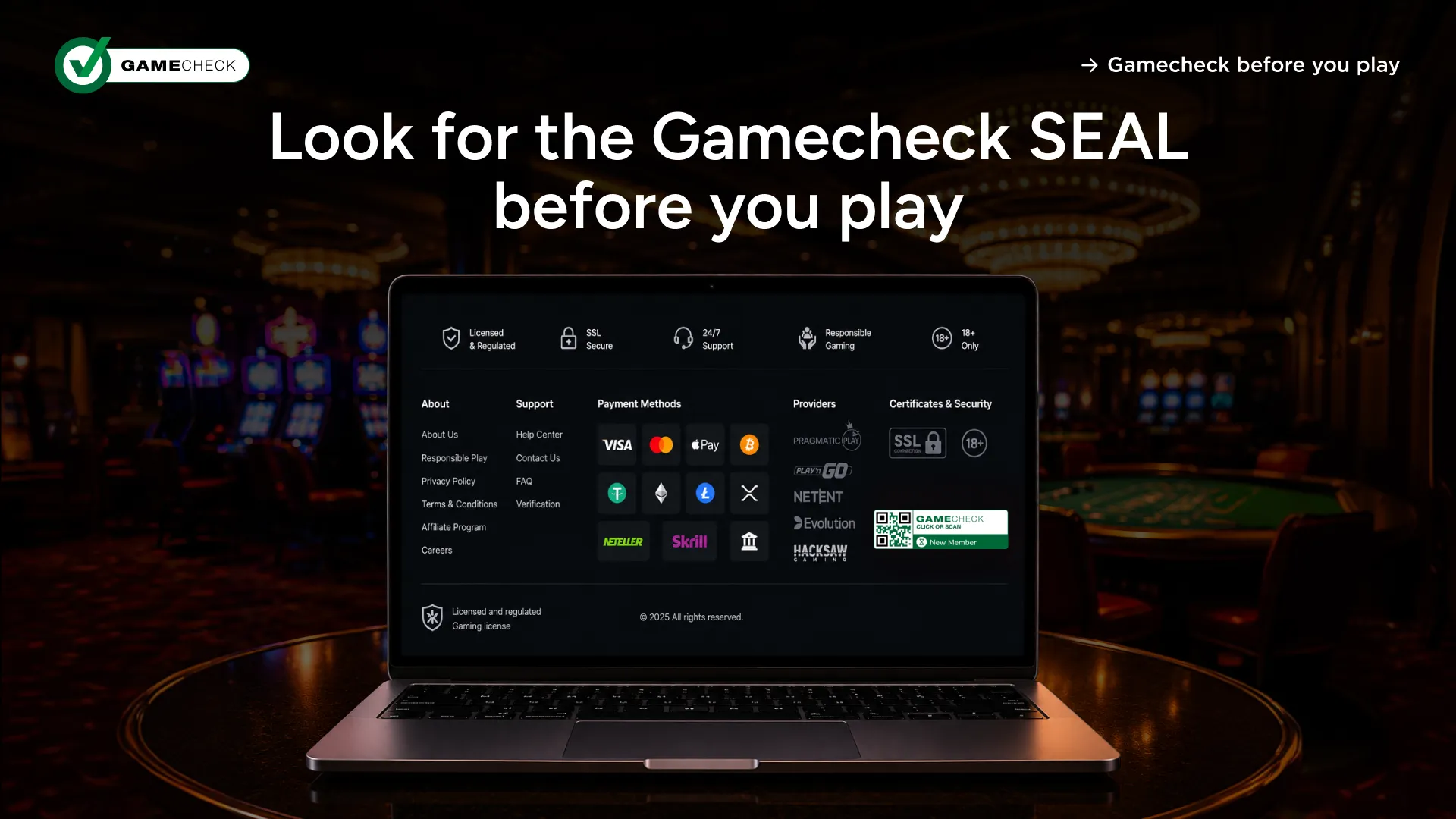
Each Gamecheck SEAL is connected to a specific domain and contains a unique QR code that can only be scanned using the Gamecheck app. Third-party QR scanners return invalid results. Verification records are stored on the blockchain for time-stamped immutability. Players can follow up to six online casinos through the app and receive push notifications on every retest.
The Gamecheck SEAL does not replace independent testing lab certifications. It complements them by addressing the specific blind spot that lab testing cannot cover.
An independent testing lab checks a game build in a controlled environment. It does not check that the same build is what players encounter in production. The Gamecheck SEAL is a live, dynamic trust badge displayed on an operator's site, showing players that a selection of games has been checked and identified as real by the original game providers. If fake games are later detected, the Gamecheck SEAL is removed immediately.
Casino Guru integrated the Gamecheck SEAL into its online casino database in February 2026, becoming the first major affiliate platform to embed third-party game verification at the listing level. Gamecheck was named headline sponsor of the Sustainable Gambling Zone at ICE Barcelona 2026. The Gamecheck app has surpassed 30,000 downloads, and the company's database now contains more than 5,000 identified fake casinos.
The iGaming industry's supply chain is growing more complex every year. Aggregators are connecting more providers, white-label platforms are multiplying and the volume of games in circulation continues to increase. Each additional layer creates new opportunities for fake games to enter the ecosystem undetected.
For operators building reputational capital that compounds over the years, the question is no longer whether game verification matters. The question is whether an operator can afford to be without it when the next forum thread, the next watchdog review or the next affiliate audit asks a straightforward question: are your games real?
Continuous checking provides a clear answer. The Gamecheck SEAL exists because the gap between a lab test and a live player session is exactly where trust is won or lost.
For operators interested in applying for the Gamecheck SEAL: SEAL Pricing | Gamecheck.
For players, the Gamecheck app is free on iOS and Android: Gamecheck App.