In the iGaming industry, trust is everything - not just for players, but also for operators and providers. As the sector continues to grow, driven by new markets, mobile-first platforms, and real-time betting, there are more access points where risks can emerge.
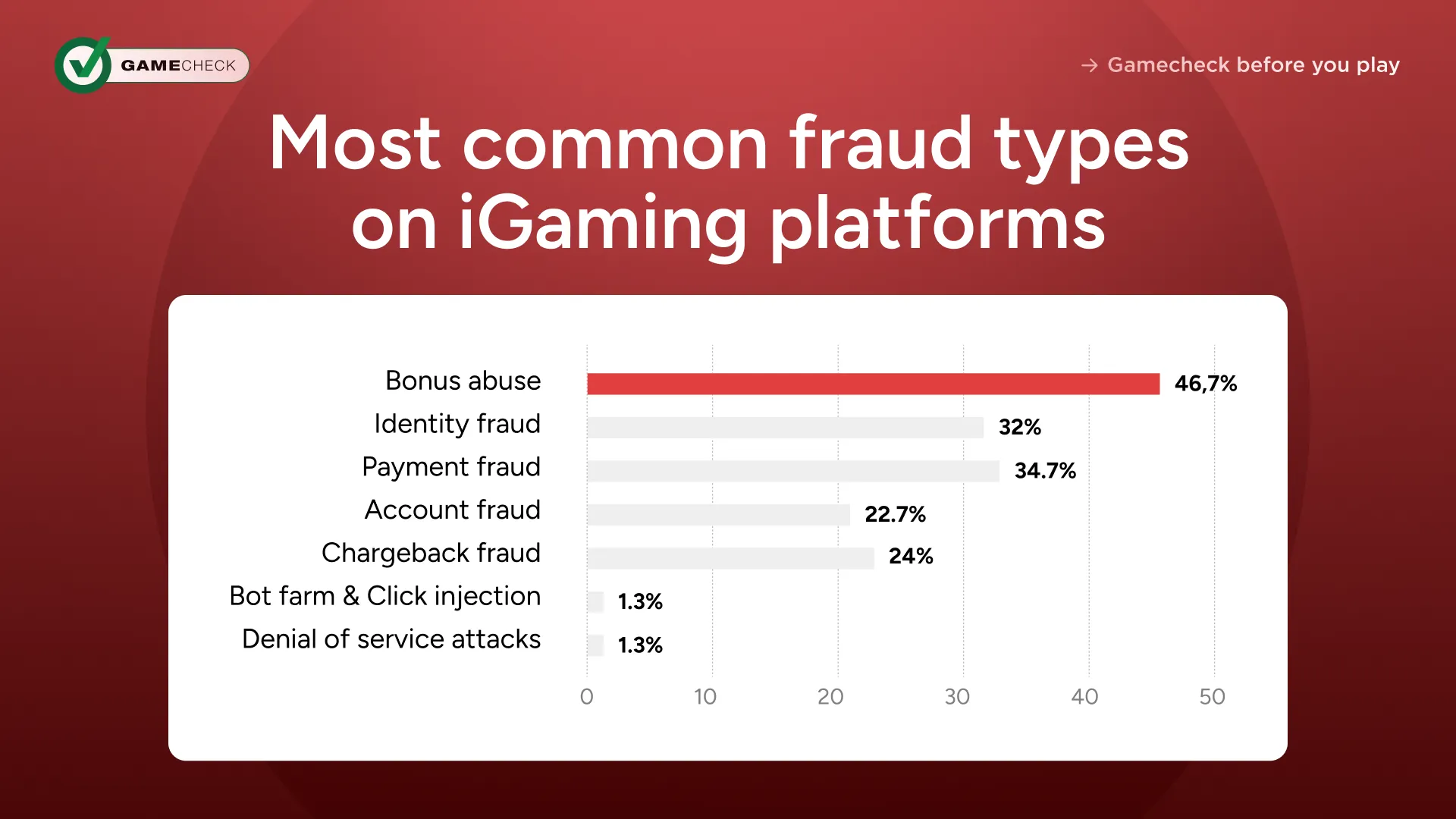
According to Sumsub's latest findings, online gambling fraud has doubled in the last two years – from 0.70% in 2023 to 1.39% in early 2025. This surge translates into $1 billion in annual losses across the sector. At the same time, AI-driven fraud is becoming harder to detect. For players, the stakes have never been higher.
Online casino players are facing more fraud risks than ever before. This article breaks down the biggest threats right now, and what you can do to protect yourself.
The most direct threat to players is still fake and unlicensed online casinos.
The most direct risk to players today comes from fake online casinos. These operations have evolved far beyond amateur-looking websites. Many are well-designed, fast, and convincing, making them difficult to distinguish from legitimate platforms.
Gamecheck recently reported a network of fake online casinos where investigators uncovered more than 1,200 connected domains operating on shared backend infrastructure. These sites used familiar branding styles, including fake celebrity endorsements and promotion across social platforms, offering high sign-up bonuses to attract attention quickly.
Once players deposited funds, a different pattern emerged. Reported winnings were often locked behind repeated "verification deposits" that were never returned. Instead of allowing withdrawals, the process continued in cycles, extracting more funds over time.
What makes these operations effective is the level of detail behind them. Some are built using fully customised systems designed to mirror real online casino environments closely. Everything is structured to feel familiar and credible, even to experienced players.
These networks rarely stay visible for long. When concerns build, they tend to disappear and reappear under new names, often using the same infrastructure behind the scenes. Patterns such as identical site designs, and repeated messaging styles, can link multiple sites together.
At a surface level, many of these platforms look professional. The challenge for players is that appearance alone does not reflect how games actually operate behind the scenes. Fake games can still be present even when everything else looks convincing.
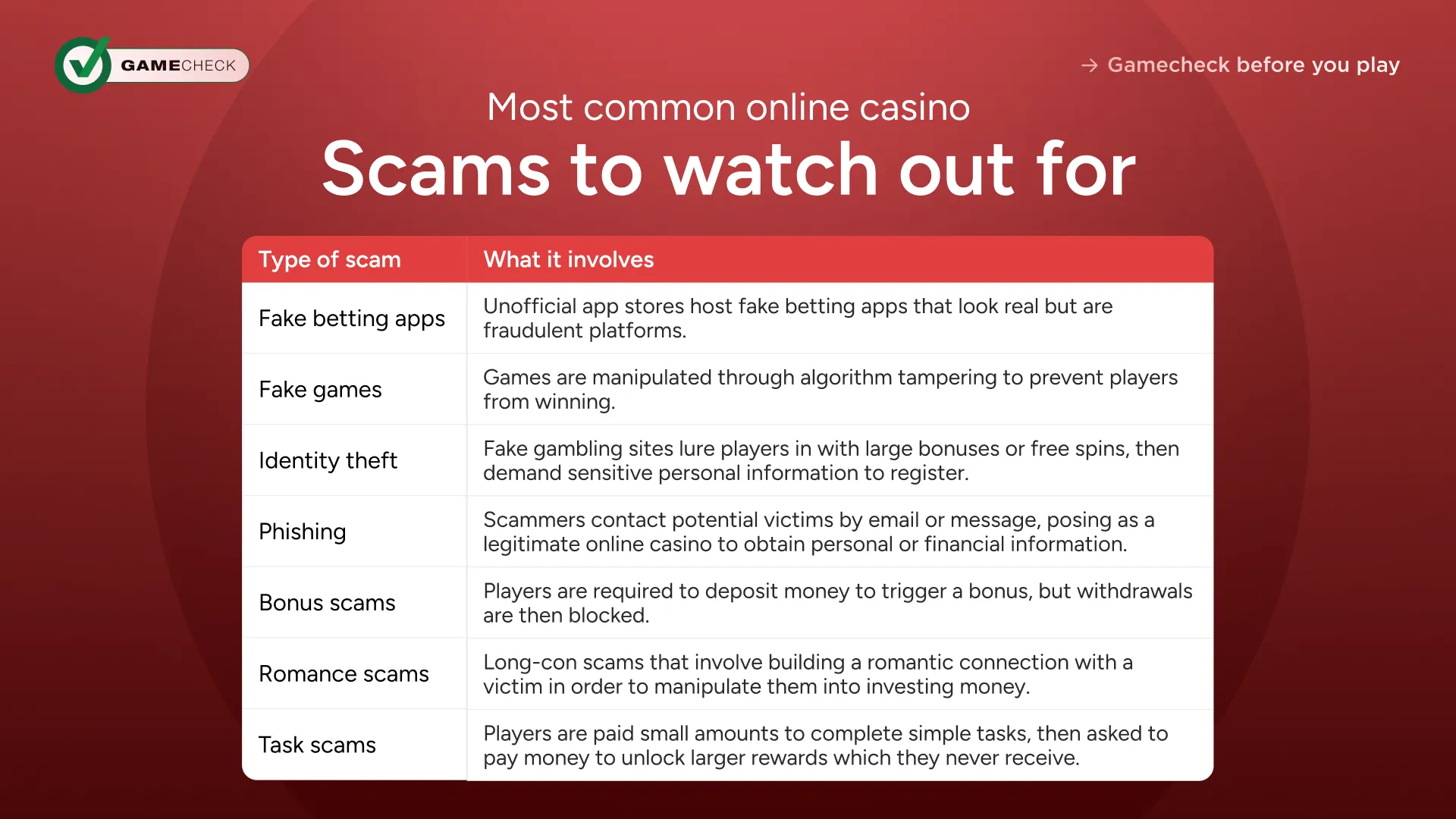
According to Techopedia, the most common tactics used by rogue online casinos include missing licence information, impossibly generous bonuses, crypto-only payment options, and customer support that is either non-existent or designed to stall you. The red flags remain consistent, even as fake online casinos become more sophisticated.
Gamecheck helps players check whether an online casino is offering real games. By combining evidence-based research with input from original game providers, it gives players a clearer view of what sits behind the screen.
In a space where design and presentation can be replicated easily, having access to independent checks helps you move beyond appearances and make more informed decisions.
Player tip: Always verify an online casino's licence directly on the regulator's website. The UKGC Public Register, MGA Licensee Register, and state gaming commission websites let you confirm legitimacy in seconds. Don't rely on logos in the footer; they can be faked.
Most gambling operators place information about their licenses in the footer on their websites. Still, seasoned gamblers already know that they should not accept everything that is written there as such. It is always a good idea to check the online casino's license to ensure the platform is trustworthy and is controlled by a gambling authority.
Read more here: How to Check an Online Casino License | Legal Pilot
The biggest shift in 2025 and 2026 is the role of artificial intelligence.
SEON's research reveals that 77.4% of senior fraud leaders agree AI-driven fraud is evolving faster than their current systems can detect and prevent. This growing gap between threat and defence is corroding industry confidence.
INTERPOL's 2026 Global Financial Fraud Threat Assessment describes fraud as having become "industrialised" through AI, with criminal groups leveraging deepfakes, large language models, and automation tools to launch convincing scams at minimal cost.
This new INTERPOL report has raised the alarm over the rapid evolution of global financial fraud, warning that increasingly sophisticated scams, powered by artificial intelligence, cryptocurrencies and organised crime networks, are expanding in scale, reach and impact.
AI and digital tools have changed social engineering and victim profiling, making schemes more convincing and easier to deploy. Advanced AI systems (LLMs), cryptocurrencies and Fraud-as-a-service (FaaS) platforms are supporting the growth of fraud as a global industry. According to Bitdefender's reporting, global fraud losses have now climbed to an estimated $442 billion. AI is accelerating global fraud: Scammers are using AI, deepfakes and automation to scale attacks and make them more convincing than ever.
For players, this shows up in several ways. Deepfake videos featuring celebrities and public figures now promote fraudulent gambling platforms. In 2025, AI-generated videos of Elon Musk circulated on YouTube and X promoting fake crypto gambling giveaways.
The Hacker News reported that cybersecurity firm ESET blocked over 64,000 URLs linked to a single AI-powered scam operation - "Nomani" - which surged 62% in one year.
AI is also powering a new generation of phishing attacks. According to Sift's Q2 2025 Digital Trust Index, over 82% of phishing emails are now AI-generated, and 78% of recipients open them. Scammers impersonate casino VIP managers and customer support agents with unprecedented sophistication, to extract login credentials and financial details.
Sumsub's global iGaming report found that 78% of iGaming operators encountered growth in AI-generated fake documents over the past year. According to AU10TIX via GGRAsia, these AI tools now enable amateurs to launch fraud attacks against specific gambling companies.
Player tip: Legitimate online casinos will never ask for your password or wallet keys. If you receive an unsolicited message claiming to be from one, treat it with caution.
When you sign up at an online casino, you entrust that platform with sensitive personal data: government IDs, selfies, proof of address, and financial information.
That data has become a prime target.
In July 2025, Flutter Entertainment confirmed a data breach affecting up to 800,000 users, exposing personal data including IP addresses and betting activity. Merkur Group suffered a breach compromising over 70,000 identity document scans.
According to Continent 8's cybersecurity forecast for iGaming, these breaches are growing in both scale and frequency. When rogue casinos collect your KYC documents, that data can end up on dark web marketplaces, fuelling identity theft and fraud.
Account takeover (ATO) fraud, where criminals gain access to your existing casino account using stolen credentials, accounted for 27% of all reported global fraud incidents in 2025. GamblingIQ's threat analysis reported that ATO attacks surged 42% in Q1 2025 alone. One European betting platform lost €1.7 million in just 48 hours from account takeovers.
Player tip: Enable two-factor authentication on every gambling account. Use unique, strong passwords for each platform. Monitor your accounts regularly for unauthorised activity, and review your credit reports if you suspect your data has been compromised.
Even when an online casino looks legitimate, the games themselves may not be. Rogue operators create fake versions of popular games. These clones closely mimic the original graphics and sounds but run on tampered Random Number Generators with artificially reduced return-to-player rates. That means the house wins far more than advertised. CasinoBeats and Gambling Nerd have both investigated this issue extensively.
Gamecheck's own investigation which examined nearly 15,000 online casinos, found that approximately 6.5% (around 975 games) were fake. These fake games are distributed by fictional software providers, and their URLs do not match legitimate game server domains.
The distinction matters: licensed casinos running certified game builds cannot alter the software. But rogue operators running pirated or cloned versions can and do manipulate outcomes. If a game loads suspiciously fast, the graphics seem slightly off, or you experience unexplained "disconnections" during bonus rounds or big wins, those are warning signs.
Player tip: Stick to games from well-known providers and look for independent certification seals from bodies like eCOGRA, GLI, or BMM Testlabs.
Use Gamecheck to verify whether an online casino's games are confirmed as real.
Cryptocurrency casinos carry unique risks because blockchain transactions are pseudonymous and irreversible. "Rug-pull" casinos accept crypto deposits, display a functional interface, then vanish overnight with no recovery path for players. Others claim "provably fair" systems but provide no genuine way to verify outcomes. Webopedia's analysis of crypto casino scams catalogues the most common tactics.
The fake casino network uncovered in July 2025 specifically targeted crypto users via Discord, requiring Bitcoin and Ethereum "verification deposits" that were never returned. As iGaming Business reported, LeoVegas CEO Gustaf Hagman has identified the rise of offshore wallets, and disguised merchant codes as one of the most underestimated threats, enabling gambling flows that regulators cannot track or intercept.
Regulators are responding with heightened enforcement. The UK introduced new fraud prevention laws including a 'failure to prevent fraud' criminal offence, making gambling operators potentially liable for fraud committed by employees or affiliate partners.
The UK Gambling Commission (UKGC) implemented mandatory deposit limits for all new customers. The new rules launched in two stages: initial requirements took effect on 31 October 2025, with a full requirement that operators let customers set deposit-only limits from 30 June 2026. The aim is to make limits easy to set and hard to bypass, complementing other optional limit types and broader responsible-gambling reforms.
The Malta Gaming Authority (MGA) enhanced its supervisory framework and issues regular warnings on unauthorised gaming websites.
In the US, a sweepstakes casino crackdown saw enforcement actions across Connecticut, New York, Louisiana, Michigan, Tennessee, and California. And Meta removed 159 million fraudulent ads and deleted 10.9 million accounts connected to gambling scam networks.

Staying safe doesn't require technical expertise. It requires vigilance.
Here are the most important steps:
The iGaming fraud landscape in 2026 is defined by the convergence of AI-powered deception, and increasingly sophisticated criminal operations. AI scams have grown 456% in a year. Networks of over a thousand fake casino domains operate in coordinated ecosystems designed to steal your money and data.
The tools to protect yourself exist, and they are free. Regulatory enforcement is tightening, industry verification standards are improving, and platforms like Gamecheck provide direct, actionable ways to confirm an online casino's legitimacy before you deposit a single cent.
When in doubt, Gamecheck before you play.