-20260428-161311-800x450.webp)
The global online gambling market is on a trajectory that any analyst would find striking. Revenue reached an estimated €72 billion in 2024. Projections have the market exceeding €92 billion by 2029, a 28% increase over five years, driven by mobile growth, market expansion, and rising player numbers across nearly every region.
Where there is growth at this scale, there is also opportunity for those who prefer to take rather than build. As the industry grows, it becomes an attractive target for rogue operators who copy the surface of legitimate platforms without any of the infrastructure beneath.
The cost of this problem is real and distributed across three groups: the players who encounter fake games, the original game providers whose work is being copied, and the legitimate operators whose reputations suffer by proximity. Understanding where those costs fall is the starting point for understanding why verification matters.
Before examining the cost, it's worth being precise about what we mean.
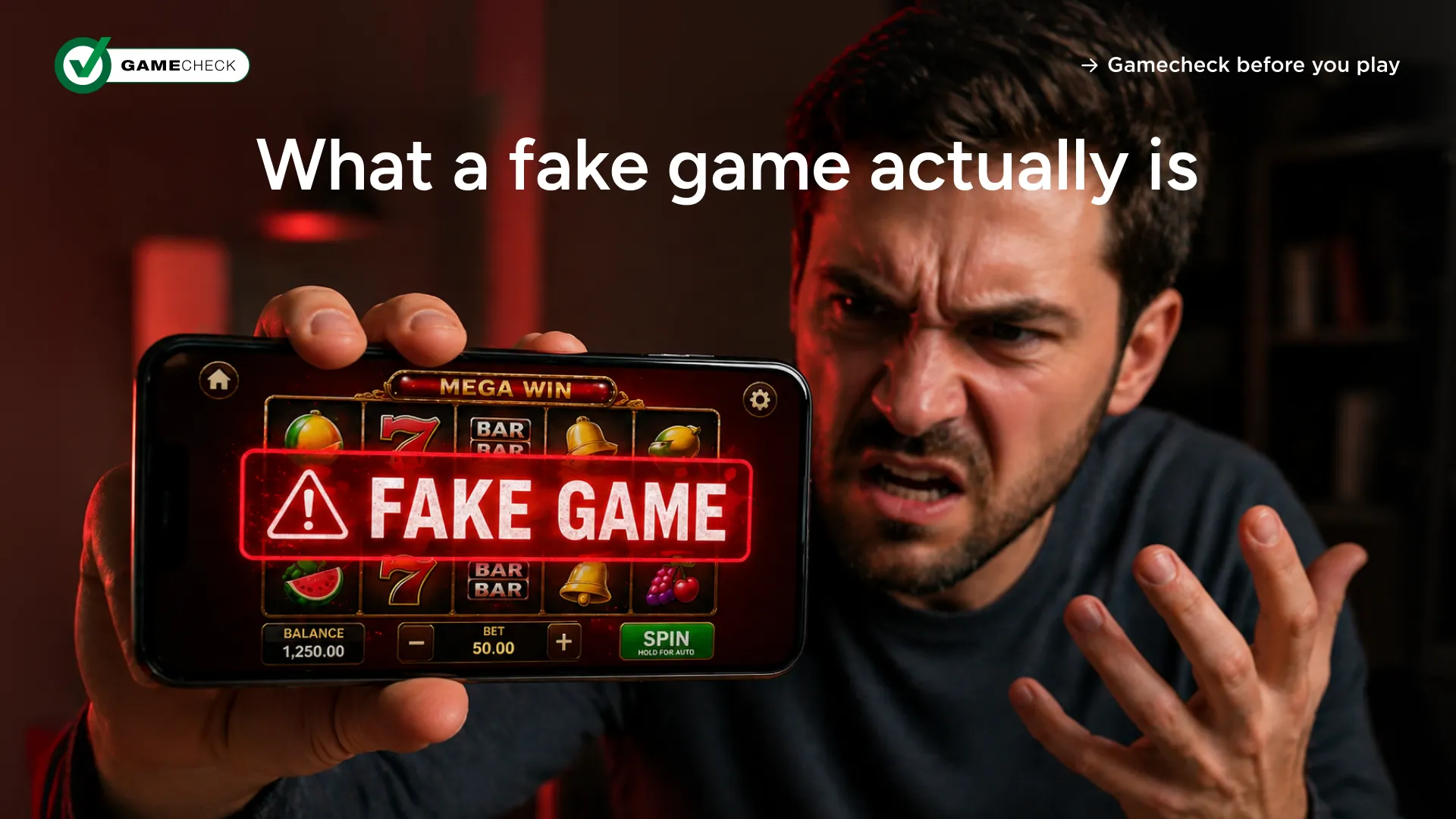
A fake game is not a poorly designed game or a low-quality platform. It is a copied version of a real game title - one that uses the visual identity, name, and interface of a game produced by a legitimate game provider, but runs on entirely different software.
The fake version may display the same name, the same graphics, and even the same stated return-to-player percentage as the real thing. But the underlying code has no connection to the original provider. The figures shown on screen don't reflect how the real game is designed to behave. Outcomes, pay-out patterns, and return rates are entirely unknown variables, controlled by whoever built the copy, not by the original provider's certified software.
Players are the most directly exposed group, and the financial impact is straightforward.
When a player deposits on a platform running fake games, they are not playing the game they believe they are playing. The return-to-player rates displayed may bear no relationship to actual outcomes. Wins may appear and then prove difficult or impossible to withdraw. Support channels on rogue platforms frequently offer limited response when problems arise.
What does this look like in practice? Gamecheck's own investigations into rogue platforms have found player reviews that read as follows: at Fountain Casino - a platform where fake games were detected - players reported "frequent game freezes and crashes" and described losing substantial amounts due to unexplained site errors. At Anglia Bet, another platform flagged by Gamecheck, a Trustpilot reviewer described the operator as "full of scammers," stating they would not deposit again. Play Regal Casino, also confirmed by Gamecheck to be hosting fake games, carries a Casino Guru Safety Index of just 1.5 - labelled a "very poor trust casino" with unfair rules and low withdrawal limits.
These aren't isolated incidents. They reflect a consistent pattern: players experiencing anomalous losses, unresponsive support, and withdrawal barriers on platforms that, beneath the surface, were never offering the games they claimed to.
That pattern is supported by wider industry data. A detailed analysis of complaints handled by Casinomeister during 2025, published by iGamingToday, found that across 690 formal complaints processed that year, almost every second complaint came down to withdrawals. Players were asking for money that already belonged to them. A recurring pattern emerged: everything worked smoothly until money needed to leave the platform. That's precisely the point where rogue operations, including those running fake games, reveal themselves.
The broader picture in Gamecheck's data shows that players who encounter fake games are significantly less likely to return to online casino gaming at all. The damage is not only financial - it erodes the confidence that makes players willing to engage with the industry in the first place. A player who walks away after a bad experience on a rogue platform is not just a single lost customer. They represent negative word of mouth, reduced trust in online casino gaming broadly, and in many cases, someone who might otherwise have continued playing on legitimate platforms for years.
"Players weren't shocked by losing money. They were shocked by being unable to get their own money back. That's the signature of a rogue operation." - iGamingToday
For the companies that develop and license real games, the problem operates on two levels.
The first is intellectual property theft. When a rogue operator copies a game title, they are using the provider's design work, mathematics, visual assets, and brand recognition without any agreement, licence, or payment. The provider receives nothing while their product generates revenue for someone else.
The second level is reputational. A player who has a poor experience on a fake version of a provider's game has no way of knowing the game was fake. From their perspective, they played a game bearing that provider's name and branding, and the experience was not what they expected. That perception, however unfairly formed, attaches to the provider.
Identifying when a game has been copied is not straightforward. The process of investigating unauthorised use, gathering evidence, and pursuing removal is time-consuming and expensive. Rogue operators frequently reappear under new domains after takedown, meaning the cycle begins again.
The financial model that sustains game development - licensing revenue, distribution agreements, ongoing provider relationships - depends on the market understanding that provider-backed games are worth paying for. Fake games devalue that proposition directly. When players can't tell the difference between a real and a copied game, the perceived value of the real thing is undermined.
The impact on legitimate online casino operators is less discussed but equally significant.
Rogue operators don't compete fairly. They can advertise bonuses and promotional offers that a legitimate platform simply cannot match - because a legitimate platform carries real costs: licensed software, verified infrastructure, genuine provider relationships, and ongoing compliance obligations. A rogue operator running fake games has none of those overheads. They can promise more, because they are delivering considerably less.
This creates a market distortion that puts legitimate operators at a structural disadvantage. Players who have no reliable way to distinguish between a legitimate platform and a rogue one may be drawn in by the more aggressive offers. When things go wrong, the broader category of online casino gaming absorbs the reputational damage, not just the specific rogue operator responsible.
Legitimate operators also face a trust deficit they did not create. Players who have encountered fake games, or who have heard of others doing so, approach the entire market with more caution. Building and maintaining player trust becomes harder and more expensive when bad actors are eroding it from within.
The data supports this. Platforms displaying a verified Gamecheck SEAL show measurable improvement in player confidence. The presence of a third-party, independently verified trust signal changes how players engage with a platform, because it gives them something concrete to check, rather than simply a set of claims to evaluate.
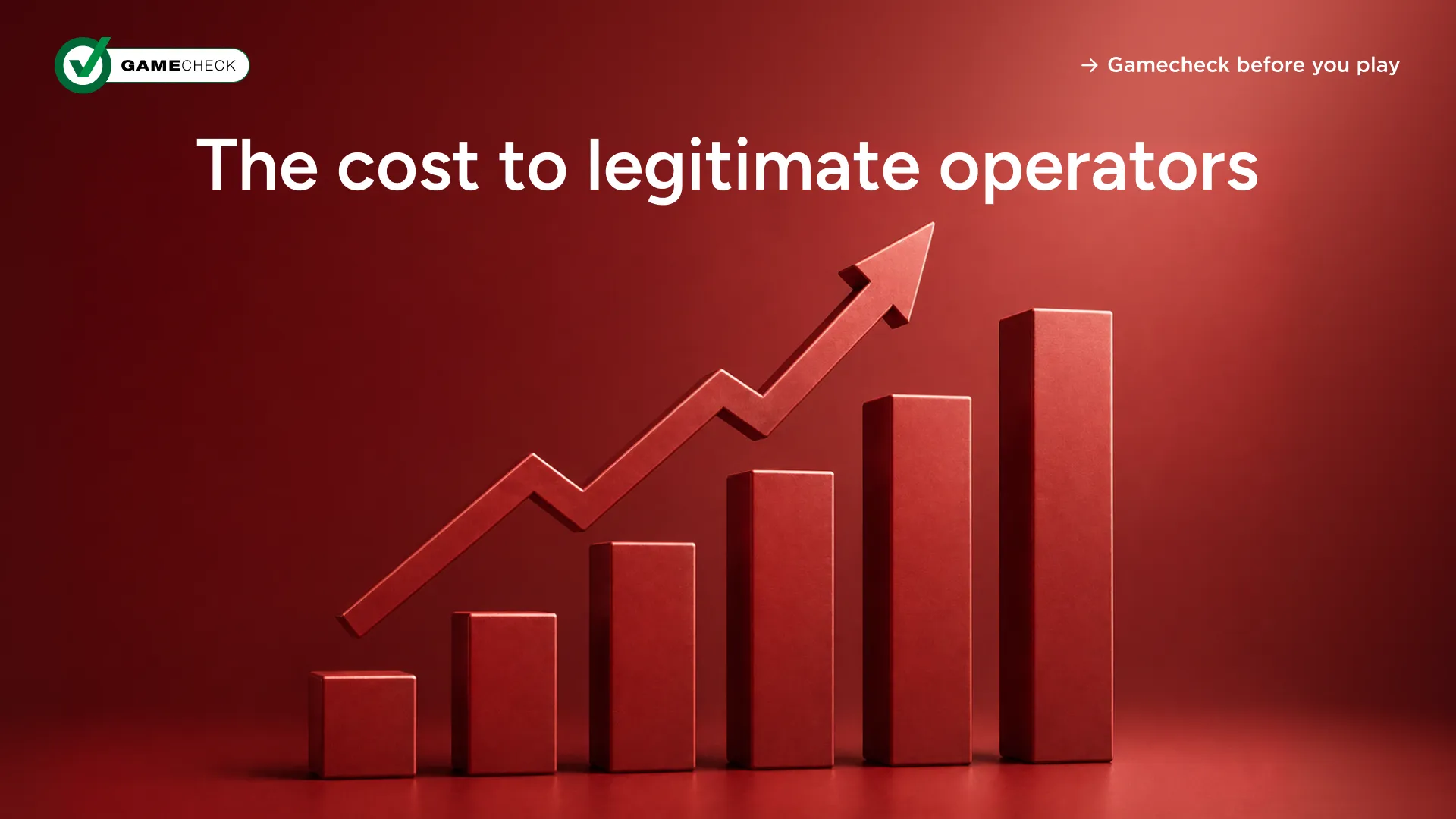
There is a compounding dynamic worth understanding here. As the online gambling market grows, the pool of players, including new ones less likely to know what to look for, gets larger. And the financial incentive for rogue operators to enter the market grows alongside it.
A market worth €72 billion attracts a different level of organised effort than one worth €20 billion. The fake game operations that Gamecheck identifies are not amateur efforts. They are platforms built to appear credible, and designed to process real deposits from real players. The investment in looking legitimate has increased in line with the returns available.
The Gamecheck SEAL represents a structural response to a structural problem.
An operator awarded the Gamecheck SEAL has passed a four-stage backend verification process. A selection of their games has been confirmed as real by the original providers. Their platform is subject to continuous monitoring. If fake games are detected after the SEAL has been issued, it is removed immediately and reapplication is blocked for 12 months. Every enforcement action is logged on the blockchain and made publicly accessible.
For players, this creates a verifiable signal - something that can be scanned, checked, and trusted because it carries real consequences for the operator who holds it.
For providers, it creates a visible market distinction between platforms running their licensed games and those that are not. It also provides an evidence trail that supports enforcement when copies are identified.
For legitimate operators, it gives them a means to demonstrate what they are, and to stand apart from platforms that merely look similar. In a market where trust is increasingly contested, that distinction has measurable commercial value.
The cost of fake games is not abstract. It sits across three groups, each absorbing a different dimension of the same problem:
Each of those costs compounds the others. A market with less player trust generates less revenue for providers. Providers with less revenue invest less in the game development that gives legitimate operators their product. The whole ecosystem weakens.
Verification doesn't eliminate the problem overnight. But it makes the problem visible at scale and a visible problem is one the industry can act on.
It is easy to get caught up in the excitement of a new online casino. But before placing a single bet, the most valuable thing a player can do is check what they are actually playing. Gamecheck's free tools make that straightforward - paste a link in our free search tool to see whether the games on offer are real. Knowing an online casino is offering real games is not a small thing. It is the foundation of a fair experience. And that peace of mind costs nothing.
Check any online casino at Gamecheck: Protecting Players From Fake Online Casino Games, or download the free Gamecheck app on iOS or Android to stay informed before you play.
Roger William J. Rivera is Gamecheck's data analytics expert. He analyses gambling trends and fraud patterns, to provide insights for the online casino gaming community.