Fake games are no longer a side issue in the online gambling industry. In 2026, they represent one of the most persistent and damaging threats facing players worldwide – quietly undermining trust, draining money, and exposing personal data at scale.
Gamecheck’s goal for 2026 is clear: to help drive a measurable global reduction in fake games. This means protecting players before harm occurs, reducing the reach of fake games, and supporting healthier market development across regions at very different stages of maturity.
A 2024–2025 study commissioned by the European Casino Association and conducted by Yield Sec - the ECA & Yield Sec report on illegal online gambling across the EU, found that illegal online gambling platforms now account for the majority of online gambling activity across the EU, generating €80.6 billion in revenue.
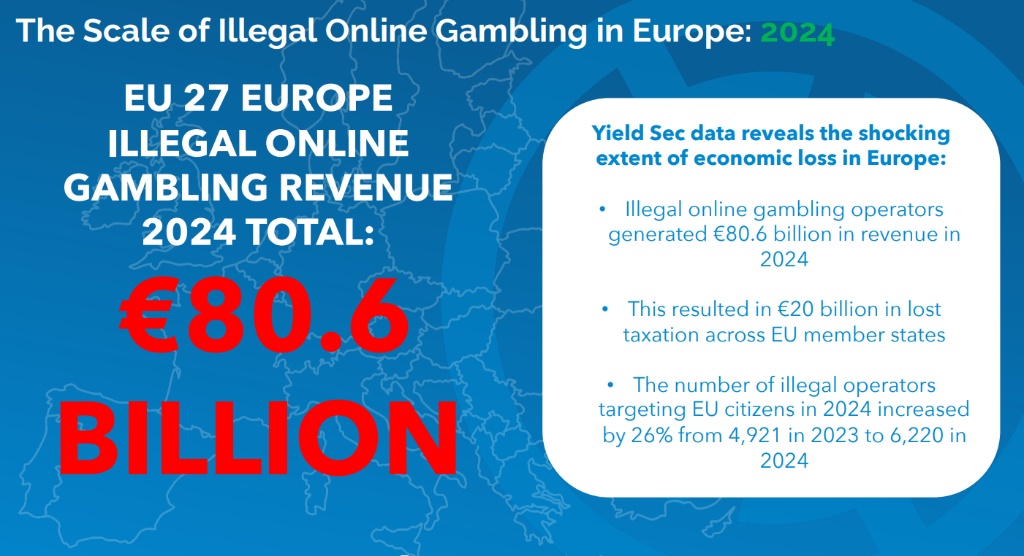
The report highlights that the issue is not limited to a small number of jurisdictions. Illegal platforms operate across borders, targeting players in both mature and emerging European markets alike. This aligns with player behaviour seen globally.
While reporting structures differ from region to region, the underlying problem remains the same: players are often unable to verify whether an online casino’s games are real. This lack of visibility continues to expose players to risk. These illegal platforms create the same conditions repeatedly seen in scam complaints worldwide:
2025 Outlook: Given the 2024 growth trajectory and the fact that 2025 saw continued expansion of illegal operators (estimated at over 6,200 active entities), industry experts suggest the figure likely exceeded the €80 billion mark in 2025, as the "black market" continues to outpace the regulated sector.
What makes this especially dangerous is the growing sophistication of fake games, and their ability to blend seamlessly into environments that appear legitimate. As online casino markets continue to expand both in long-established regions and fast-growing territories, players are being asked to make trust decisions more frequently.
In 2026, the greatest danger facing online casino players is not always obvious. It does not always look like a scam. In many cases, it looks like a normal game – familiar, polished, and easy to access. That is precisely the problem. Fake games are designed to feel safe long enough for damage to occur. Most players are not acting recklessly. They are making reasonable decisions based on what they can see, what they recognise, and what appears to be popular or trusted.
The consequences of fake games are not abstract. They follow a familiar pattern:
Most players only realise something is wrong when recovery of their funds is impossible.
The Better Business Bureau’s BBB Gambling and Gaming Scam Study reports nearly 200 scam reports and over 10,000 complaints related to online gambling between 2022 and 2025. Although the study focuses primarily on North America, the patterns it identifies are not region-specific.
The report highlights recurring issues such as fake or misleading gambling platforms, games that do not originate from the real game provider, disappearing balances or blocked withdrawals, and the impersonation of legitimate casinos or brands. These same behaviours are consistently reported across Europe, LATAM, and other emerging markets, where the key difference is often the level of visibility and reporting infrastructure rather than the prevalence of the problem itself.

Recent European research confirms that the scale of risk facing players is just as significant. A 2024–2025 study commissioned by the European Casino Association and conducted by Yield Sec - the ECA & Yield Sec report on illegal online gambling across the EU found that illegal online gambling platforms account for the majority of online gambling activity across the EU. According to the report, over 6,000 unlicensed operators are active across European markets, exposing millions of players to platforms operating outside of regulatory oversight.
Fake games succeed because they exploit uncertainty. Most players are not experts in licensing structures, game certification, or platform integrity. They rely on signals that feel trustworthy – a familiar game name, a polished interface, or a convincing promotion. In 2026, those signals are easier than ever to fake.
Criminal networks now copy everything players associate with legitimacy:
To the average player, the difference between a real game and a fake one can be almost invisible until something goes wrong at the withdrawal stage. This is no accident. Fake games are designed to look real long enough to extract deposits, data, or both.
Many players assume the worst-case scenario is losing a deposit. In reality, fake games often cause longer-term harm. Fake platforms commonly collect:
Once collected, this data can be reused or sold, exposing players to fraud long after they stop engaging with the site or app. In 2026, identity-based scams increasingly rely on recycled data rather than random outreach – which means one mistake can lead to multiple future risks.
Mobile-first play has transformed access to online casinos – and fake games have followed the same path. Players are now exposed to fake games through:
On smaller screens, it is even harder to spot inconsistencies. In fast-moving sessions, players rarely stop to question what looks familiar. However, a fake app or a fake mobile site can capture credentials, reroute payments, or manipulate outcomes while appearing to function normally.
One of the most damaging patterns in fake games is the illusion of success. Players may see repeated small “wins” and encouragement to deposit more to unlock withdrawals. The problem only appears when a player tries to withdraw. At that point, fake games introduce endless friction such as new verification requirements, unexplained processing fees, changing rules and support teams that delay, deflect, or disappear.
Fake games are not tied to one country. They are portable.
As soon as enforcement increases in one region, domains, branding, and distribution channels shift. Players are left navigating a changing landscape where familiarity no longer guarantees safety.
Emerging markets such as LATAM highlight the challenge facing players in 2026 better than almost any other region. The combination of rapid digital adoption, mobile-first behaviour, and expanding online casino interest creates enormous opportunity, but also significant exposure to fake games.
In many LATAM markets, players are entering online casino ecosystems faster than consumer education and verification awareness can keep up. This creates ideal conditions for fake games including uneven regulation and high reliance on social recommendation and messaging platforms. When something looks popular or widely shared, it is often assumed to be safe – even when it is not.
Regulatory action is essential, and several LATAM jurisdictions have taken visible steps to block illegal operators and unlicensed platforms. However, enforcement alone cannot give players clarity at the moment of decision. Fake games do not disappear when a domain is blocked. They reappear under new names, new links, and new promotions. For players, the challenge remains the same:
That question exists in every market, but it is especially urgent where growth is fastest.

Gamecheck exists to remove guesswork from one of the most important decisions a player makes: whether a game is real.
Gamecheck does not promote games. It verifies them. By checking whether games are real and operating as they should, in collaboration with the original game providers, Gamecheck gives players an independent reference point they can trust. Verification replaces assumption with evidence.
Players should not need to interpret complex language to understand risk. That is why Gamecheck uses clear verification statuses:

Real games in operation

Fake games detected

Pending checks
This clarity helps players make informed decisions quickly – especially on mobile, where attention is limited and mistakes are costly.
Fake games thrive on exposure. When they are identified and flagged, their ability to attract new players shrinks. By exposing fake casinos that offer fake games, Gamecheck helps reduce their reach, warn players before deposits happen, create friction for operators relying on deception. Over time, this contributes to a real reduction in harm.
Gamecheck’s exposure reports are now a major source of truth for players. By cross-referencing site activity, traffic patterns, and provider validation, we’ve publicly exposed multiple fake casinos in the UK, Turkey, and LATAM, through the Fake Casinos Exposed series. These exposures did more than name and shame rogue operators. They removed thousands of fake games from circulation – reducing player risk and creating positive ripple effects across the industry. Some operators, once exposed, switched to real games in operation to restore credibility. Others vanished altogether. This is data driving positive change through accountability.
Gamecheck’s work is not limited to one region. In mature markets, verification helps players distinguish between legitimate operations and increasingly sophisticated fakes. In emerging markets like LATAM, it provides something even more valuable: early clarity, before fake brands and misinformation become entrenched. This dual focus is essential for long-term impact.
Reducing fake games is not about headlines or short-term wins. It is about sustained pressure. A real reduction means:
It is not a single action. It is an ongoing process – one that requires verification, transparency, and consistency. When fake games are exposed through independent verification, operators who wish to retain credibility often clean up listings or remove misleading offerings, leading to a net reduction in fake game activity.
Undoubtedly, the online casino industry will continue to grow in 2026. That growth can either benefit players or expose them to greater harm.
Fake games rely on confusion, speed, and silence. Gamecheck’s role is to counter that with clarity, evidence, and visibility. By helping players identify real games in operation, exposing fake casinos and fake games detected, and applying consistent checks across markets, Gamecheck supports a practical and measurable outcome: a safer global environment where fake games have less room to operate and players have greater confidence in the choices they make.
As more operators choose to display the Gamecheck SEAL, verification becomes easier for players to recognise, and makes it harder for fake games to hide. Over time, this will reduce the viability of fake games, strengthening protection at scale rather than in isolated cases. That is our goal for 2026.