Player protection has always been central to what Gamecheck does. From the beginning, that has meant one specific thing: the integrity of the games themselves. While the wider industry is only now asking more specific questions about the tools players have access to and what it means to offer verified real games, this is the conversation Gamecheck was built for.
In 2026, two areas define what meaningful player protection looks like in practice: game integrity and verification. Understanding what each means in today's iGaming landscape, helps players make better decisions about where to play.
A decade ago, player protection in online casino gaming meant one thing to most operators: a self-exclusion link buried in the footer and a set of deposit limits that players could opt into if they knew where to look. The tools existed, but they required the player to already recognise a problem, seek out the option, and take action entirely on their own.
The years that followed brought meaningful progress. Regulators in the UK, Malta, and Sweden introduced requirements that moved player protection from optional to structural. Operators were required to monitor player behaviour, intervene when patterns suggested risk, and make protection tools more visible. The industry began to understand that waiting for players to ask for help was not sufficient. Proactive identification of harm became standard.
By the early 2020s, responsible gambling technology had matured considerably. Behavioural analytics, spend tracking, and early-warning systems became embedded in operator platforms. Organisations such as GamCare and tools like BetBlocker gave players independent routes to support. Player protection had moved from the margins of the business to its core, something operators competed on, not simply complied with.
Looking at the next ten years, the emerging challenge is not behavioural, it is structural. As the online gambling market expands and technology makes it easier to replicate and manipulate digital content at scale, the risk of fake games will grow. Players will increasingly need tools that help them verify not just how they are playing, but what they are playing. Transparency at the game level, knowing that the title on screen is the real version created by the original game provider, will become as fundamental as deposit limits are today.
The next wave of online casino players has grown up with greater digital literacy and higher expectations of transparency. They will ask harder questions about the products they are being offered. Operators who can demonstrate that their games are real will be better positioned to earn and keep that trust. Player protection in the next decade will be more about building transparent environments where fair play is demonstrable, not just claimed.

For a long time, player protection focused primarily on behaviour: tools to limit spending, self-exclusion options, support for those experiencing harm. Those tools remain important. But there is a more fundamental question that has not always received the attention it deserves: are the games players are betting on real?
Fake online casino games do not operate the way real games do. A player cannot win fairly on a game that has been altered to work against them. That is not a responsible gambling problem. It is a game integrity problem, and it requires a different kind of solution.
Gamecheck exists to address this. By testing games and checking the findings with the game providers, Gamecheck helps players determine whether the games on an online casino are real before they play. It is a practical step that no other tool currently offers in the same way.
Game integrity and player protection are not separate concerns. They are the same concern, looked at from different angles. A player who has no way to know whether a game is real has no meaningful protection at all.
Tools are only useful if people can find them and use them. This is a challenge the industry has grappled with for years. Responsible gambling features often go unnoticed by the players who need them most, and where dedicated tools do exist, they are not always free. The principle that players should never have to pay to protect themselves is one that organisations like BetBlocker have championed from the outset. BetBlocker was built specifically as a free service, on the basis that charging players to gamble responsibly is counterproductive. A tool that costs money creates a barrier at exactly the point where there should be none.
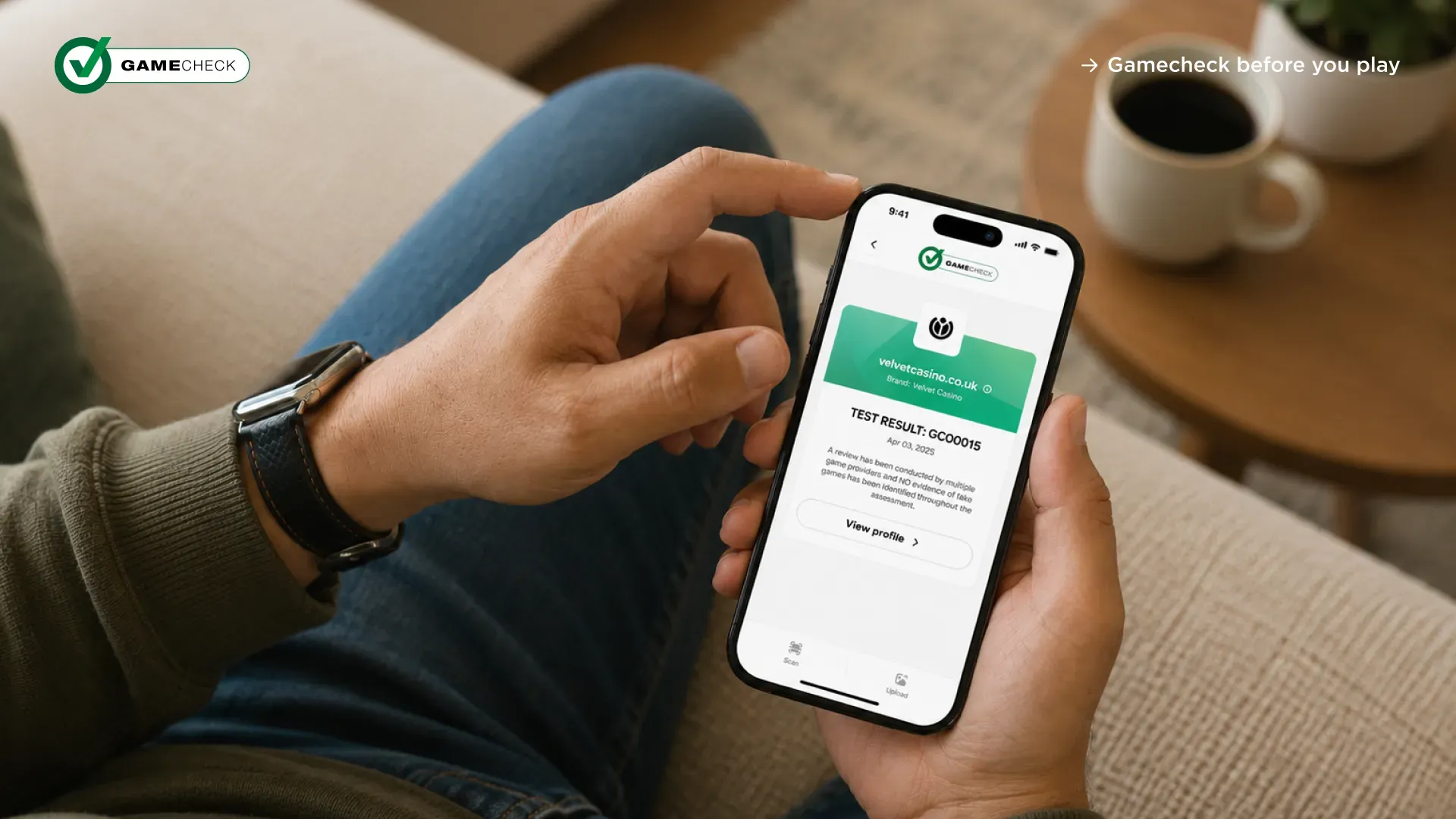
Gamecheck takes the same position. The Gamecheck app is free to download on iOS and Android and puts verification directly in the player's hands. Before depositing or playing, a player can check whether the games on an online casino are real. The process takes seconds. There is no subscription, and no technical knowledge required. Fair play should be accessible to everyone: not only to those willing or able to pay for the information.
Access to information changes behaviour. When players know they can check, they do check. And when they find that an online casino's games have been verified as real, they can play with a level of confidence that was simply not possible before.
The Gamecheck SEAL reinforces this further. When an operator displays the SEAL on their site, it signals that a selection of their games has been checked and found to be real by the game providers. For players, it is a clear indicator that this operator is committed to fair play.
The global online gambling market is growing quickly. With that growth comes a corresponding rise in rogue operators, sites that offer fake games, make promises they cannot keep, and disappear before players can seek any recourse. The scale of the problem is no longer niche. It affects millions of players across every major market.
Operators who hold the Gamecheck SEAL are making a public statement about the standard they hold themselves to. Game providers who work with Gamecheck are protecting their intellectual property and the players who trust their titles. And players themselves are becoming more informed, increasingly aware that not every game is what it appears to be.
Player protection is now driven by platforms wanting to prove their games are real, separating operators who take their responsibilities seriously from those who do not.
Player protection begins with access to information. The more a player knows about where they are playing, the better equipped they are to make decisions that are right for them.
The Gamecheck app is free on iOS and Android. It allows players to check any online casino game before they play, a simple step that takes seconds and provides clarity. Online casinos displaying the Gamecheck SEAL in their website footer have had a selection of their games checked with the game providers. Scan the SEAL with the app to verify it.
The conversations happening across the industry right now: about verification, about transparency, about what fair play actually looks like in practice, are conversations that matter. Gamecheck is part of that discussion, and so are the players who choose to use the tools available to them.
Knowing an online casino is offering real games is the starting point. A fair experience cannot exist without it, and now, for the first time, players have a straightforward way to check.
Visit Gamecheck to check your online casino before you play.