The 2026 Integrity Framework for Operators
6 min read
In early 2026, the global iGaming industry finds itself at a pivotal moment. After months of conversations across Europe, from the halls of SiGMA Central Europe in Rome to preparations for ICE Barcelona 2026, one truth has become impossible to ignore: trust has become infrastructure. It now determines whether players participate, and whether platforms grow.
This shift is reshaping how integrity is defined and raising the standards every operator must meet. At the centre of this evolution is one requirement that has moved from optional to essential: verification.
Why ICE Barcelona 2026 is the ideal moment for this conversation
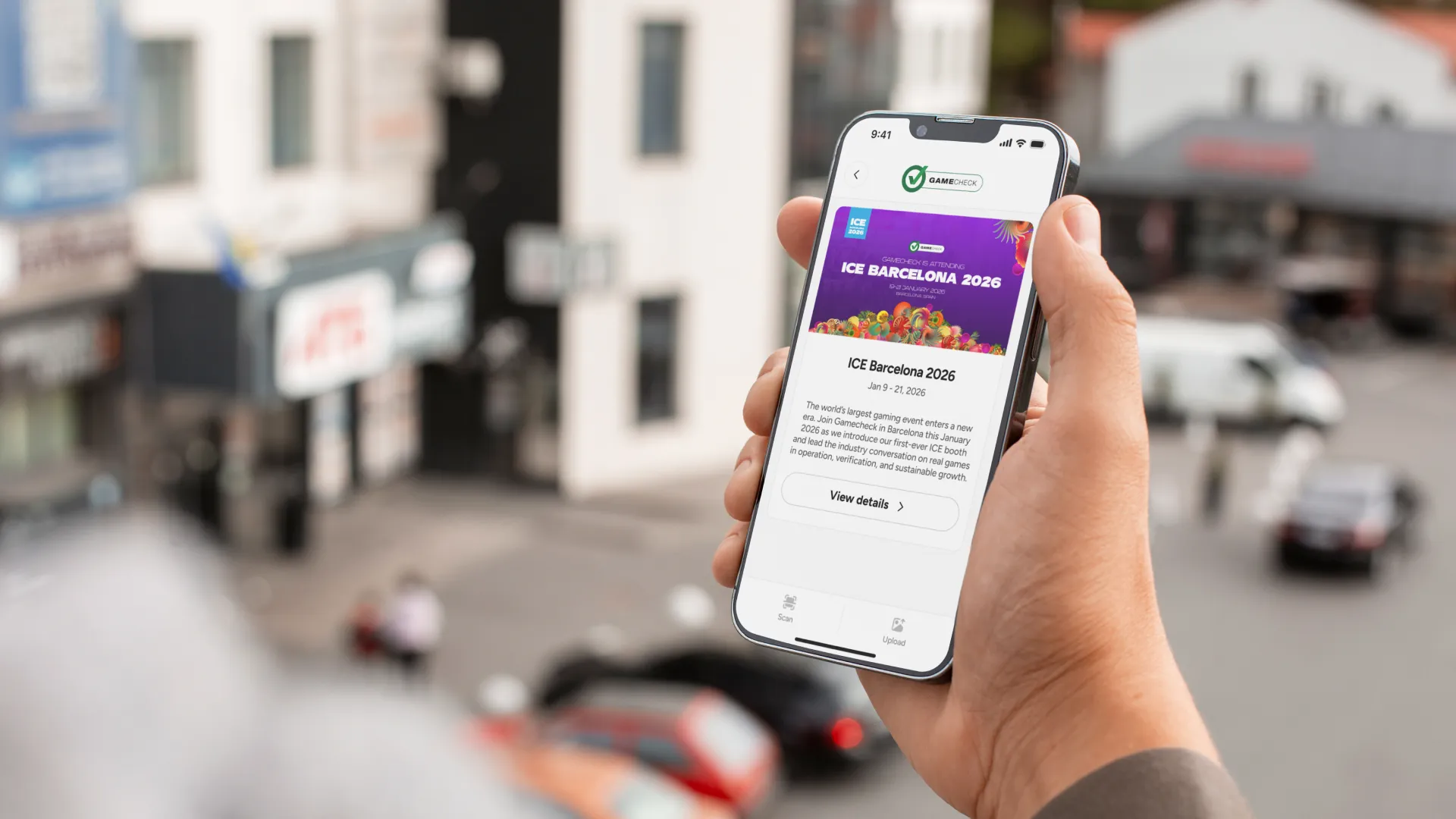
ICE Barcelona 2026 is not only the world’s largest B2B gaming technology exhibition. It is also the year when integrity, verification, and player protection move to the centre of the global conversation. Much of this shift is driven by the 2026 World Gaming Forum, whose headline theme, Combating the Black Market, anchors the opening day under the keynote “The Black-Market Challenge.”
The World Gaming Forum is asking a crucial question: how can the industry stop the black market? Gamecheck brings the answer. Through independent verification and clear Real Games in operation status, Gamecheck is setting a new integrity standard for player protection and transparency.
This theme will shape the focus of regulators, providers, and operators throughout the event. During Monday’s Grand Opening and World Regulatory Briefing, industry leaders will debate how to protect players from black-market risks such as fake casinos, misleading platforms, and fake games. These issues align directly with Gamecheck’s mission: verifying games with providers and giving players clarity before they play.
The three days of ICE Barcelona mirror the industry’s most urgent priorities.
January 19 sets the tone with anti-black-market strategies. As the keynote unfolds, discussions shift toward how verification can strengthen platform integrity more effectively than reactive enforcement.
January 20 highlights innovation and sports. The Sports Leaders Conference and Esports Betting programme examine fairness, and competitive integrity. The Gamecheck team will contribute with demonstrations on Fair Play in Sports, showing how verification reinforces integrity and credibility in fast-growth environments.
January 21 turns toward the future, exploring trends in digital infrastructure, and closing-day commercial agreements. As the exhibition concludes at 16:00, operators leave with a clearer understanding of how verification will shape global strategies in the years ahead.
ICE Barcelona 2026 is the perfect moment to redefine integrity. And verification is the foundation on which that definition is built.
A new era of operator accountability
Responsible gaming tools and security have long formed the backbone of operator integrity. These elements still matter, but the market now expects more.
Integrity in 2026 begins with a single question:
Can an operator prove that the games on their platform are real games?
Players no longer accept claims at face value. Providers no longer assume their creations appear online exactly as intended. Verification has become the defining factor in trust. Operators must demonstrate that they host real games on their platform, and continue to do so consistently over time.
What the 2026 Integrity Framework requires
The trust landscape of 2026 is built on ten core integrity pillars. Together, they define how operators must conduct themselves to earn the confidence of players, providers, and regulators in a global, competitive market.
1. Real Games
Operators must provide real games that match the provider-approved versions. Integrity now begins with the ability to prove that every game players interact with is genuine, unaltered, and verified.
2. Fair Play
Fair outcomes are essential. Operators must ensure their setup never interferes with the intended game mathematics or performance. Independent verification strengthens this by confirming game fairness directly with providers.
3. High Quality Design
Players expect stable, seamless experiences. Operators who implement games correctly, without disruption or unauthorised modification, uphold the design integrity intended by the providers and meet rising user expectations for innovation.
4. Secure Platforms
Platform security protects players from tampering, manipulation, and data risk. A secure environment ensures that real games function as intended and gives regulators confidence in the operator’s technical standards.
5. Secure and Timely Pay-outs
Fast, reliable pay-outs remain one of the clearest signals of operator integrity. When players receive their winnings consistently and without issue, it reinforces long-term trust across all regions.
6. Excellent Customer Support
Responsive, knowledgeable support shows that an operator values its players. Effective communication reduces confusion, resolves concerns quickly, and offers reassurance in markets where fake casinos often rely on silence or misinformation.
7. Transparency
Transparency has become the backbone of the integrity framework. Operators must communicate clearly about game providers, terms, verification processes, and platform behaviour. Ambiguity erodes trust instantly.
8. Trust
Trust must be proven through evidence, not claimed through marketing. Operators who show verification results, protect player funds, and communicate openly create a trust-based environment that differentiates them from fake casinos.
9. Player Protection
Player protection includes shielding users from fake games and misleading claims. Operators must create an environment where safety is visible and proactive.
10. Responsible Gambling
Responsible gambling remains an essential part of operator integrity. Clear tools and accessible support enable players to manage their activity safely and reinforce the platform’s overall credibility.
How Gamecheck supports this framework
Gamecheck strengthens these integrity pillars by providing confirmation of game authenticity. Operators can demonstrate Real Games in operation, helping players instantly distinguish safe platforms from fake casinos offering fake games. Verification enhances transparency, improves player protection, and ensures operators meet the rising integrity expectations of 2026.
What players expect in 2026: transparency before trust
Players have become more informed and more cautious. Fake casinos offering fake games have intensified scepticism across both mature and emerging markets. As a result, players expect operators to prove game authenticity, not simply claim it.
The Gamecheck SEAL has become one of the clearest ways for players to gain reassurance. When they see the Gamecheck SEAL displayed on an online casino’s platform, they know that a selection of games have been independently verified, confirmed by the providers, and monitored continuously.
Trust begins with transparency. Verification provides exactly that.
Why integrity standards are rising now
Market expansion and the presence of fake casinos have converged to make 2026 the year of stricter integrity expectations. New regions such as LATAM have seen rapid increases in Verification Requests, revealing widespread concern around platform legitimacy. Operators must earn trust from the moment they enter these markets.
Providers have strengthened their controls to prevent modified versions of their games from circulating online. Regulators increasingly view verification as a core consumer protection requirement. And independent, provider-backed verification has become the industry’s most reliable defence against fake games and misleading platforms.

How Gamecheck supports the integrity framework
Gamecheck provides the infrastructure operators need to meet the rising expectations of 2026. The verification lifecycle ensures that each game undergoes investigation, confirmation with the provider, and ongoing monitoring. This level of clarity aligns with modern regulatory standards and player expectations.
The Gamecheck SEAL gives operators a public way to demonstrate transparency, showing players clear verification results and proof of Real Games in operation. As operators expand globally, the Gamecheck SEAL provides a consistent standard of integrity across all markets, giving players and providers a single trusted point of proof.
From Rome to Barcelona: the year of verification
SiGMA Central Europe made one thing clear: the industry is aligning behind a shared expectation. As we approach ICE Barcelona 2026, this expectation only intensifies. Operators who cannot demonstrate game authenticity will lose ground to those who can. Providers want clarity. Regulators want evidence. Players want reassurance. Verification satisfies all three.
Final thoughts: integrity as the new global standard
Operators who succeed in 2026 will be the ones who recognise that transparency is the core of modern iGaming. Trust is built through verification, and verification is built through evidence that players can rely on without question.
The Gamecheck SEAL gives operators a direct way to demonstrate this evidence. It shows players and providers that the games on a platform are real, confirmed, and continually monitored. It transforms integrity from a claim into a visible commitment.
As the industry enters a new era shaped by global regulation, cross-market expansion, and rising player expectations, integrity is no longer a differentiator. It is the baseline for participation in a trust-first marketplace. The operators who act now will lead the next phase of growth with confidence.
Gamecheck stands ready to support every operator who chooses transparency, protects their players from fake casinos and fake games, and commits to the real games ecosystem that defines the future of 2026 and beyond.