Game integrity has always mattered in online casino gaming. Legitimate operators have always understood that fair play is the basis on which player relationships are built and sustained. What has changed is something more specific: the scale and visibility of the fake game problem, and how many operators are now waking up to it.
In 2026, the presence of fake games: titles that imitate the look and feel of real slots and table games without operating as those games actually should, is no longer a fringe concern. It is a live issue affecting how players choose where to play, how regulators approach oversight, and how legitimate operators position themselves in an increasingly competitive market.
Operators who can demonstrate that their games are real, their platforms are transparent, and their monitoring is ongoing are not just protecting their reputation. They are gaining a meaningful edge over operators who cannot make the same case. That is what has shifted - not the importance of integrity itself, but the industry's awareness of what is at stake.
The numbers are striking. The global iGaming market was valued at over $88 billion in 2024, with projections reaching $153 billion by 2030, and more than 180 million players participating in online casino gaming globally. That is an industry at significant scale and one that has attracted significant attention from operators who are not playing fairly.
Between 2022 and 2023, mobile casinos and betting platforms lost $1.2 billion to fraud. Across the sector, iGaming fraud surged an average of 64% year-over-year between 2022 and 2024, and roughly 83% of operators say it is getting worse.
The problem is not contained to financial fraud alone. Fake online casino games are an expanding part of this picture. Players who fall victim to fake games often hold the operator responsible, regardless of whether the deception was intentional or not. Negative reviews, social media backlash, and word-of-mouth criticism can quickly damage a brand's reputation, leading to a decline in player retention and acquisition.
For legitimate operators, this creates a real business problem. The conduct of rogue operators harms the reputation of the sector as a whole. Players who have a bad experience do not always distinguish between platforms - they can lose confidence in online casino gaming in general. The operators who address this, and can show they have done so, gain ground.
The iGaming industry is converging around a clear principle: the companies that thrive in the next decade will be those that players can trust. That observation reflects something the industry is increasingly acknowledging across the board. Trust is the lifeblood of iGaming. Without it, no amount of bonuses, new games, or marketing can keep players loyal.
What does trust actually require in practice? It starts with game integrity: the ability to demonstrate that the games on a platform are real, and that players are not being offered an imitation of the experience they should be getting.
In iGaming, compliance is the foundation of trust. Operators who treat game integrity as a minimum standard will meet expectations. Those who invest in it as a visible, demonstrable commitment will exceed them, and that gap is where competitive advantage is built.

Here is something that does not always get enough attention in industry conversations: integrity that players cannot see does not build trust.
A platform can operate with complete integrity internally, but if players have no way of knowing that, the operator receives no credit for it. In a market where players are increasingly aware of the risks of fake games, and where the tools to check those risks are becoming more accessible, operators who make their integrity visible are the ones who benefit.
This is where the Gamecheck SEAL changes the conversation for legitimate operators.
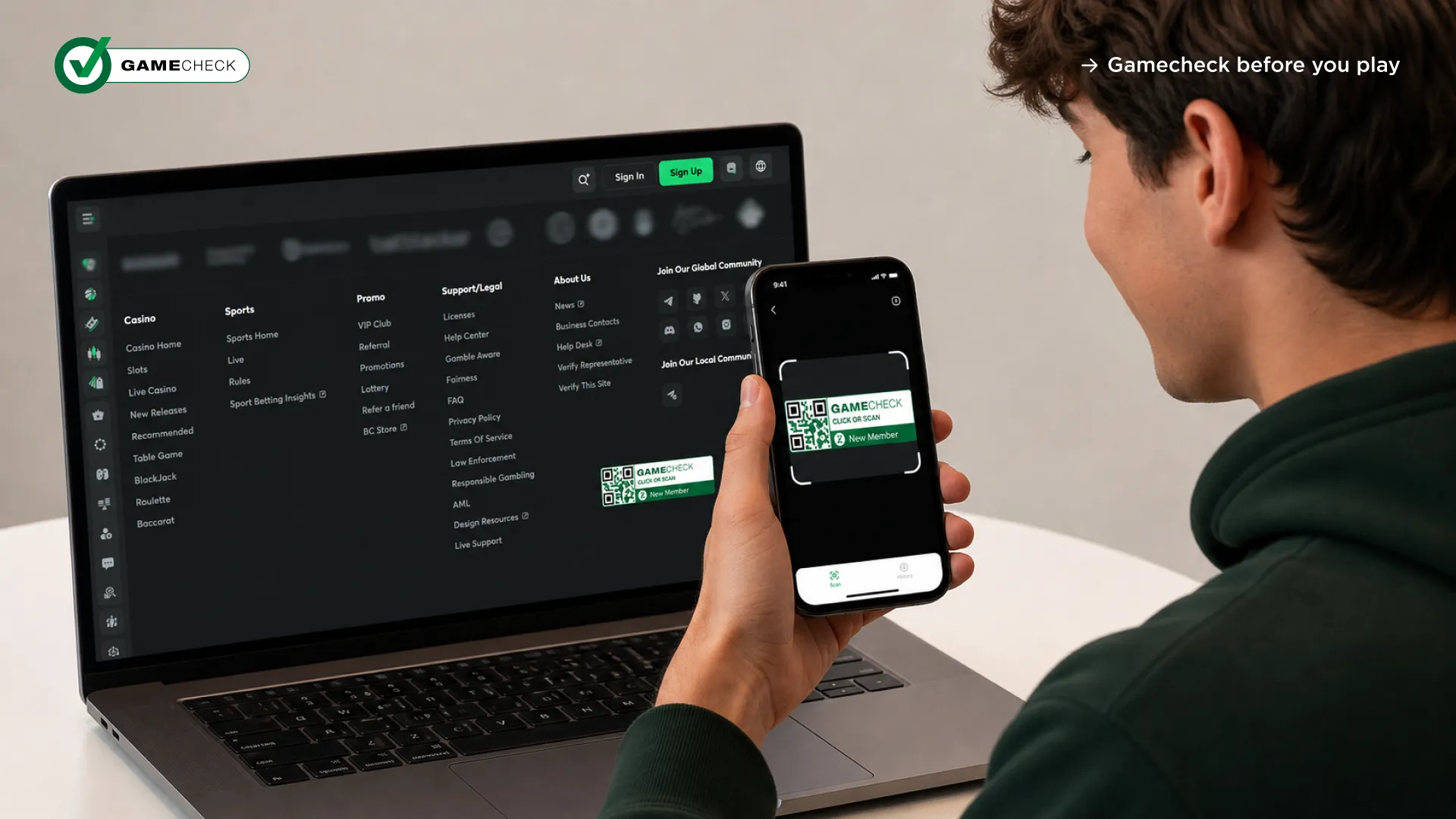
The Gamecheck SEAL is a live trust badge displayed on an operator's website. It signals that a selection of games on that platform has been checked, with findings confirmed by the original game providers themselves. It is not a static endorsement, it is subject to continuous monitoring. If fake games are ever detected after a Gamecheck SEAL has been issued, it is removed immediately, and reapplication is blocked for 12 months.
That structure matters. It means the Gamecheck SEAL is a live, ongoing signal that players can verify in real time by scanning the QR code using the Gamecheck app.
For an operator displaying the Gamecheck SEAL, the message to players is clear: these games have been checked, the providers confirmed they are real, and this platform is monitored continuously. That is a meaningful statement that rogue operators simply cannot make.
The business case for investing in game integrity is straightforward when the full picture is considered. An operator's reputation is its lifeline. Public incidents of fraud can severely damage a brand, leading to diminished player trust, reduced engagement, challenges in acquiring new players, and difficulties in retaining a loyal base.
Player acquisition in online casino gaming is expensive. Retaining a player who already trusts a platform is significantly more cost-effective than replacing one who has left.
Operators who build a reputation for game integrity reduce churn, increase lifetime value, and generate organic, word-of-mouth credibility that marketing budgets cannot replicate.
Operators who have embedded game integrity into their operations by earning the Gamecheck SEAL and displaying it in their website footer, are better positioned as markets mature, and find it far more commercially valuable than those who treat it as an afterthought.
Players are paying attention. Online gambling fraud doubled in the last two years from 0.70% in 2023 to 1.39% in Q1 2025. As awareness of fraud grows, so does player caution. Players are increasingly likely to check a platform before they deposit their money, to share experiences in online communities, and to walk away from a site that raises concerns.
Tools like the Gamecheck Chrome Extension retrieve live information from the Gamecheck database for any site a player visits, making the checking process straightforward. Players do not need technical knowledge, they need access to reliable information, and the tools that provide it are becoming part of how informed players behave.
For operators, this is both a challenge and an opportunity. The challenge: players are scrutinising platforms more carefully than before. The opportunity: operators with a clean record and visible trust signals are the ones those players choose.
Maintaining a reputable brand in a space where some operators are not playing fairly requires more than good intentions. It requires visible, verifiable commitment. The Gamecheck SEAL is the clearest way to communicate that commitment to players at the moment of decision.
One thing worth understanding about game integrity is that it is not a solo exercise. The process involves Gamecheck working in collaboration with original game providers to gather evidence and confirm whether games are real. That collaboration is what gives the results their credibility and it reflects a model that the broader industry is moving towards.
The operators and providers gaining ground are not managing integrity questions behind closed doors. They are transparent about the process and make their findings accessible.
All Gamecheck SEAL activity is logged on the blockchain and accessible to players. That openness is itself a trust signal. Operators who participate in transparent, verifiable systems are making a statement about how they operate, and players are paying attention.
The operators who stand to gain from a visible commitment to game integrity are the legitimate ones: the platforms running real games and building for the long term.
For those operators, the Gamecheck SEAL does something important. It takes the integrity they already have and makes it clear to players who would not otherwise know how to distinguish them from operators who are not playing fairly. In a market where the appearance of legitimacy can be manufactured, a live, monitored trust signal is a real differentiator.
The Gamecheck SEAL is awarded to operators who pass four backend verification checks confirming game integrity. It is earned by the operator, and because it can be removed if problems are detected, it carries weight that a static certification cannot.
Game integrity is moving up the agenda. Every indicator - player awareness, regulatory direction, market consolidation, and fraud growth, points towards integrity becoming more central to how operators compete.
The operators who invest now in making their game integrity visible and verifiable, are positioning themselves ahead of a shift that the rest of the industry is still approaching. The Gamecheck SEAL is one of the clearest ways to do that: a live, player-facing signal that what a platform offers is a real online gaming experience with real games.
For operators interested in applying for the Gamecheck SEAL: SEAL Pricing | Gamecheck.
For players, the Gamecheck app is free on iOS and Android: Gamecheck App.