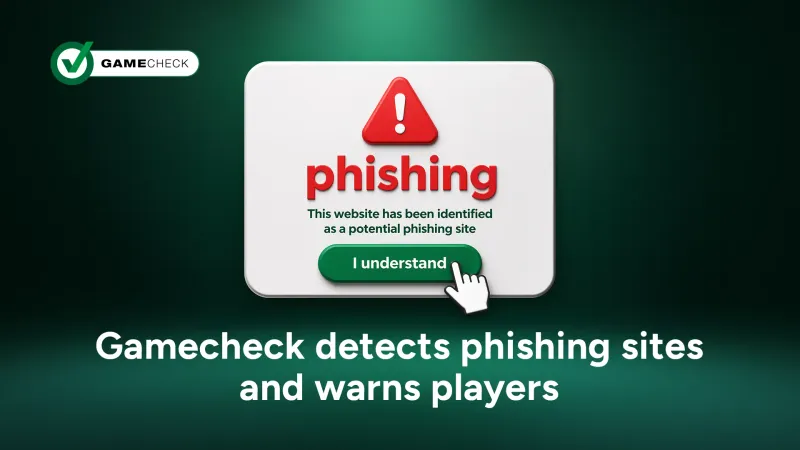
A new anti-phishing feature for players is now live on gamecheck.com
Identity theft is one of the most underreported risks in online casino gaming. Players ask whether the games on a site are real, but there's a question that comes even earlier: is the site itself what it claims to be?
Gamecheck's free search tool now includes phishing detection. When a player checks a URL that has been identified as a phishing site, a warning appears, whether they're using the Gamecheck platform or the Gamecheck Chrome Extension. The protection sits inside the tools players already use.
The feature is now live at gamecheck.com and available to players in all countries.
Phishing is a form of identity theft. The term comes from the idea of baiting someone into handing over information they would not otherwise share. In online casino gaming, phishing typically works like this.
A rogue operator builds a site that looks identical to a real, established online casino. The design, the logo, the game library and even the URL are copied or closely imitated. The player, believing they are on a site they recognise, creates an account. They enter their name, email address, password and payment details. That information goes directly to the rogue operator.
The player may never know it happened. There may be no obvious sign that something is wrong until their account credentials are used elsewhere, or their financial details are compromised.
Phishing sites do not need to run fake games to cause harm. The damage happens before a single game is played. This is why checking the URL of an online casino before registering or depositing is as important as checking whether its games are real. Gamecheck now covers both.
Gamecheck has added phishing detection to its Search Tool. When a player searches a URL identified as a phishing site, a warning is displayed. The process is straightforward, and the protection is immediate.
Here is how it works in practice.
A real online casino operator provides Gamecheck with a list of known phishing sites associated with their domain. Gamecheck adds those URLs to the database, linked to the genuine operator's verified URL. From that point forward, any player who searches a flagged phishing URL on Gamecheck receives a clear warning before they proceed.
The system is built to handle the way phishing sites operate. Rogue operators frequently generate multiple variants of a fake site including numbered prefixes, suffixes, and slight character substitutions designed to catch players who follow a fraudulent link. The Gamecheck phishing detection feature accounts for this, so an entire cluster of phishing variants can be caught within the same detection framework.
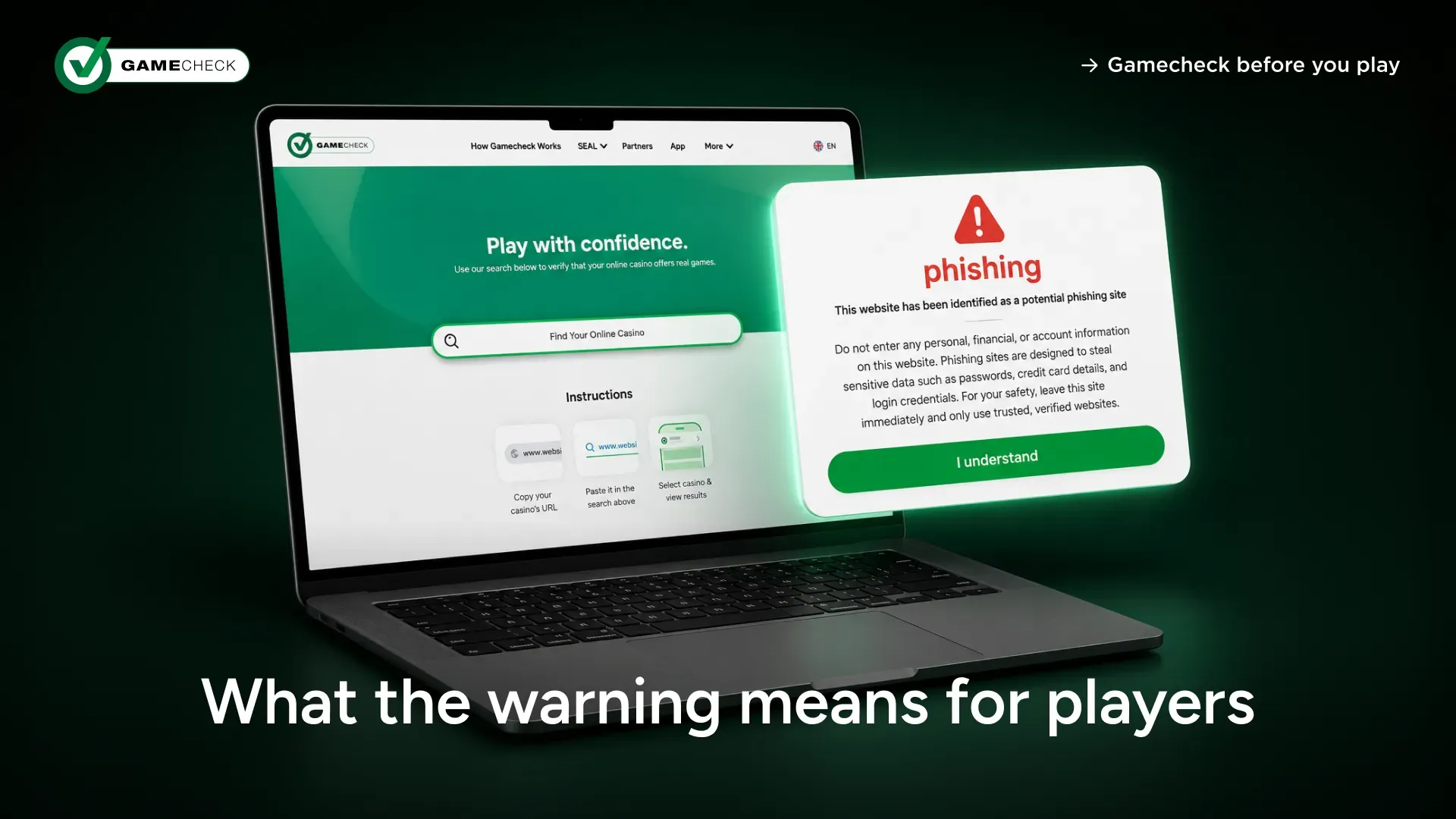
When a player searches a URL on Gamecheck that has been identified as a phishing site, a warning pop-up appears immediately on screen. The warning confirms the site has been identified as a potential phishing site and names the real platform it is impersonating. Players are advised not to enter any personal, financial, or account information on the site and to leave immediately. A clear on-screen prompt allows players to acknowledge the warning before continuing.
If a player searches a real, verified URL, the result is returned as normal. There is no disruption to the standard search experience for sites that are not flagged. This matters because the margin between a real URL and a phishing URL can be as small as one character. Players should not be expected to spot that difference by eye. A systematic, database-backed check removes that burden.
Gamecheck's tools focus on a specific and well-defined problem: whether the games on an online casino are real. That remains the foundation. The Gamecheck Search Tool, Chrome Extension, and Gamecheck app each approach that problem from different angles, giving players multiple ways to check before they play.
Phishing detection addresses the layer beneath that. Before a player can even assess the games on a site, they need to know the site itself is real. The data on phishing is unambiguous. Attacks are increasing in frequency and sophistication. The online casino sector, with its combination of financial transactions, identity data, and high player volumes, is a natural target.
Players who are careful about game integrity are just as exposed to phishing risk as those who are not. The threat does not discriminate by how informed a player is; it relies on a moment of inattention.
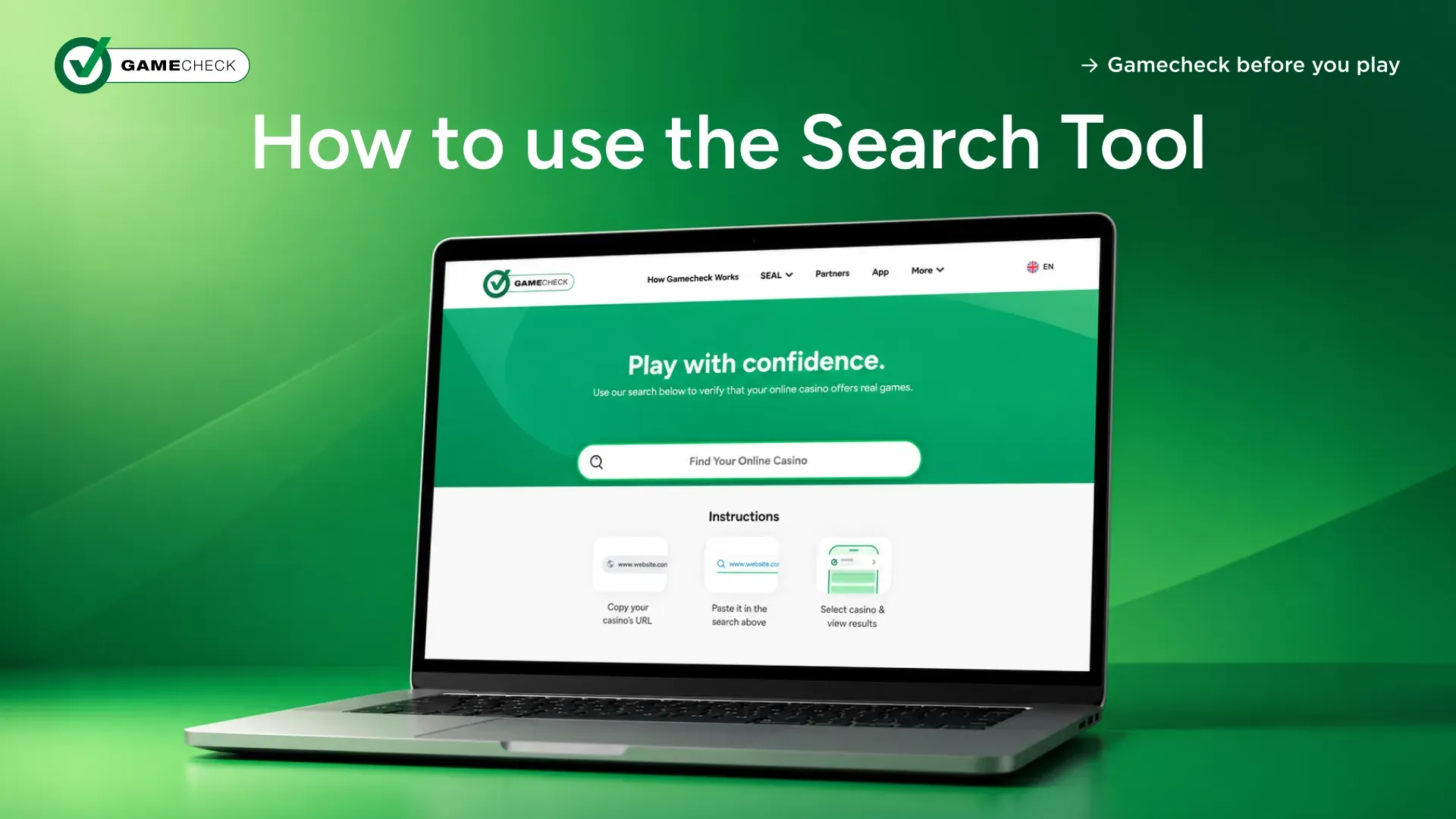
Using Gamecheck's phishing detection requires nothing additional from players. The check happens automatically when a URL is searched in the Gamecheck platform or Chrome Extension.
Go to gamecheck.com as usual, enter the URL of the online casino you want to check, and review the result. If the site appears in the Gamecheck database as a phishing site, a warning will be displayed. If it is a verified site, the standard game integrity result is returned. If the site has not yet been checked, players can submit a verification request directly through the page Request Casino Verification.
The Chrome Extension provides the same database access while browsing. It reads the URL of the site currently open in a player's browser and returns the result without the player needing to navigate away.
Phishing sits at the intersection of two measurable trends: the growth of the online casino market and the growth in fraud targeting that market. As the sector expands, the incentive to exploit it grows alongside it. Gamecheck's phishing detection feature is a direct response to that data. The Search Tool now checks not just whether games are real, but whether the site offering those games is genuine in the first place.
There is one more reason to Gamecheck before you play.
Gamecheck now protects players from phishing sites. For operators who hold the Gamecheck SEAL, players can check their links directly on Gamecheck. If the link is genuine, the result is returned as normal. If the site is a phishing copy, a warning is displayed before any harm is done.
Check the site. Keep your identity safe. One search. No phishing. Gamecheck before you play.
Phishing is a form of identity theft where a rogue operator copies a real online casino's design, logo and URL. Players believe they recognise the site and enter personal details which go straight to the rogue operator.
A real online casino operator provides Gamecheck with a list of known phishing sites linked to their domain. Gamecheck adds these to its database, and any player who searches a flagged URL through the Search Tool or Chrome Extension receives an on-screen warning before proceeding.
No. The check happens automatically whenever a URL is searched on gamecheck.com or through the Chrome Extension. If a site is flagged, a warning appears naming the real platform it is impersonating.