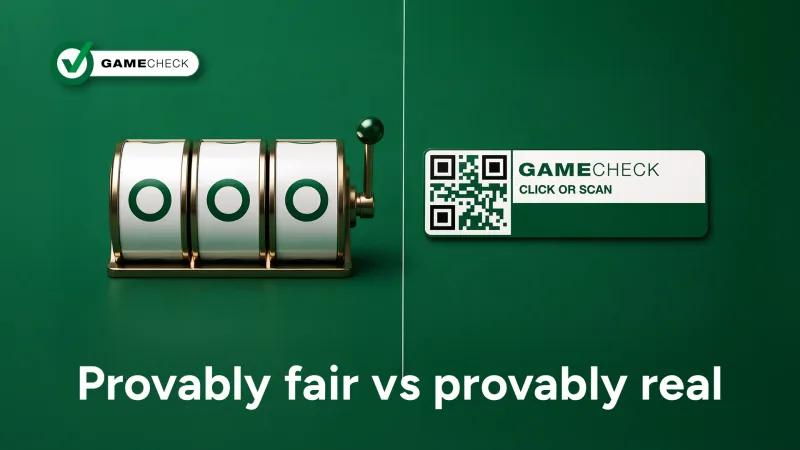
Provably fair technology answers one question with mathematical certainty: was this specific round of a game determined by chance. It is a meaningful piece of engineering, and it has done real work in building confidence around how individual game outcomes are calculated. But fairness only means anything once a more basic condition is met: the game itself has to be real.
A round can be checked and verified as untampered with, and still be running on a game that was never supplied by the provider it claims to come from. That is why, before a player even thinks about questioning whether a game is provably fair, the first and far more important question is whether the online casino and its games are real in the first place.
Provably fair systems rely on cryptographic hashing to let a player check, after the fact, that a game's result wasn't altered once a bet was placed. The mechanics follow a consistent pattern across the games that use this system. Before a round begins, a server seed is generated and converted into a hash, a fixed-length string produced by a one-way cryptographic function. That hash is shown to the player before betting, acting as a locked-in commitment to a result the player cannot yet see and the operator cannot later change.
This confirms that the random number generation behind a specific round wasn't tampered with between commitment and result. What it does not confirm, and isn't designed to, is whether the game running that calculation was built and licensed by the provider it claims to come from.
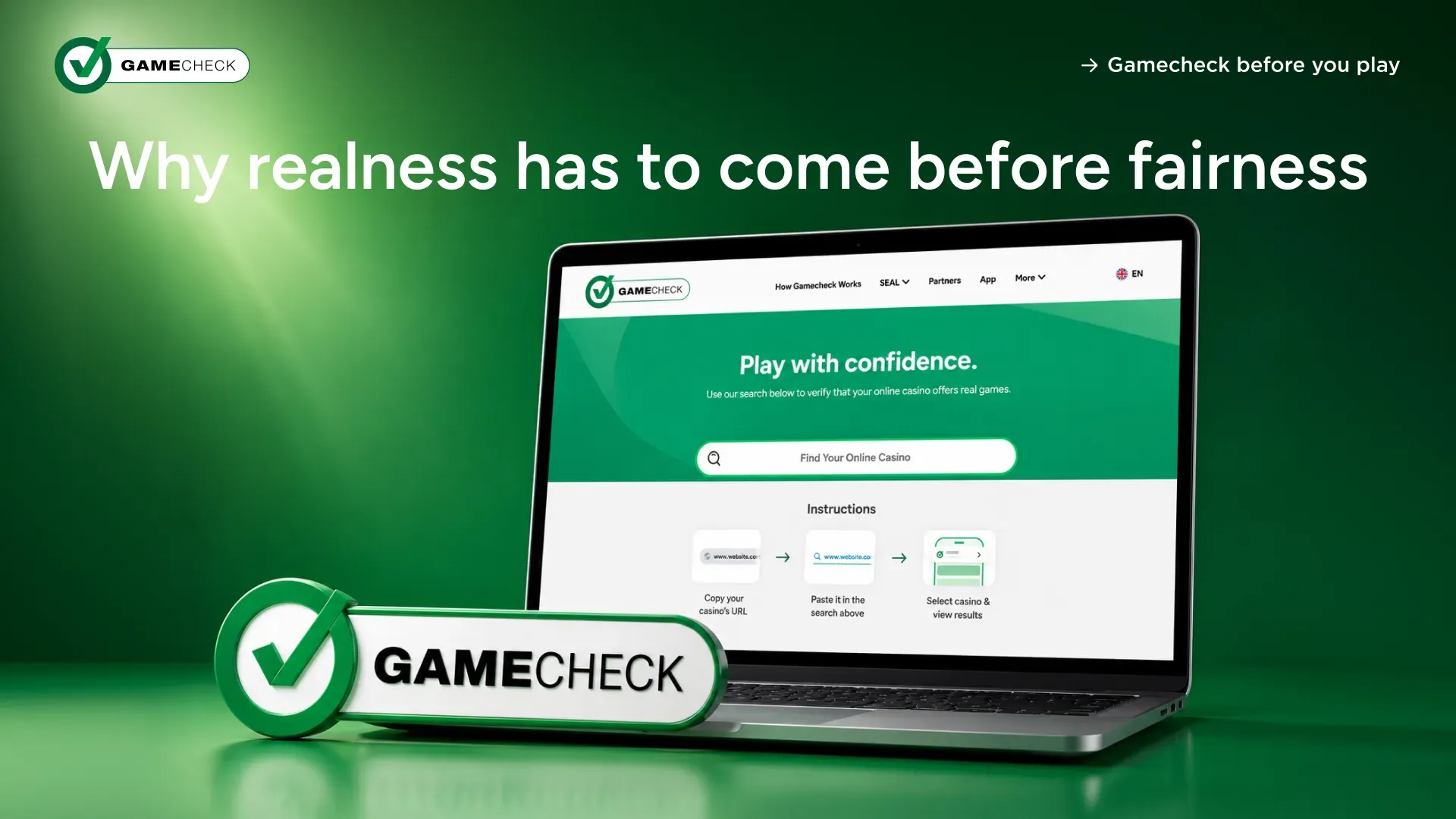
Fairness is a property of how a round is calculated. Realness is a property of where the game came from. The first cannot exist meaningfully without the second, because a fair calculation running inside a fake game is still producing outcomes on something that was never licensed or supplied by its claimed provider. A matching hash does not change that. It simply confirms that whatever process was running, fake or not, wasn't altered after the bet was placed.
This is why realness needs to be the first check a player makes, not a fairness claim. Confirming a round's randomness wasn't tampered with gives no confidence at all about whether the game generating those rounds is the one it claims to be. Only once a game is confirmed as real does a fairness check actually mean something, because only then is there a genuine game behind the calculation in the first place. Questioning whether a game is provably fair before confirming it's real is asking the second question before the first.
Provably fair operates entirely inside a single round of a single game. It assumes the game itself is what it says it is, and checks only that the mechanics inside that game weren't rigged after the fact. A fake version of a real game, copied branding, copied artwork, code built without the original provider's involvement, could still run this same hashing system on top of it. The hash would verify correctly. The seed comparison would match. None of that says anything about where the underlying game actually came from.
This is the gap that matters for players checking an online casino before they play. A site could run hashing checks correctly and still be operating games that were never supplied by the providers whose branding they carry. The cryptography proves the maths inside the round. It says nothing about the game's origin, which is the question players need answered first.
Provably real verification, which is the principle behind the Gamecheck SEAL, operates at a different layer entirely. Rather than checking the randomness inside a single round, it checks whether a selection of games on an operator's site were actually supplied by the original game providers they claim to come from.
Gamecheck tests a selection of games on an online casino's site and gathers evidence on how they behave. That evidence is shared with the relevant game providers, who confirm whether the games in question were supplied by them. Once that confirmation is received, an operator can apply for the Gamecheck SEAL by passing a set of backend verification checks tied to that authenticity confirmation.
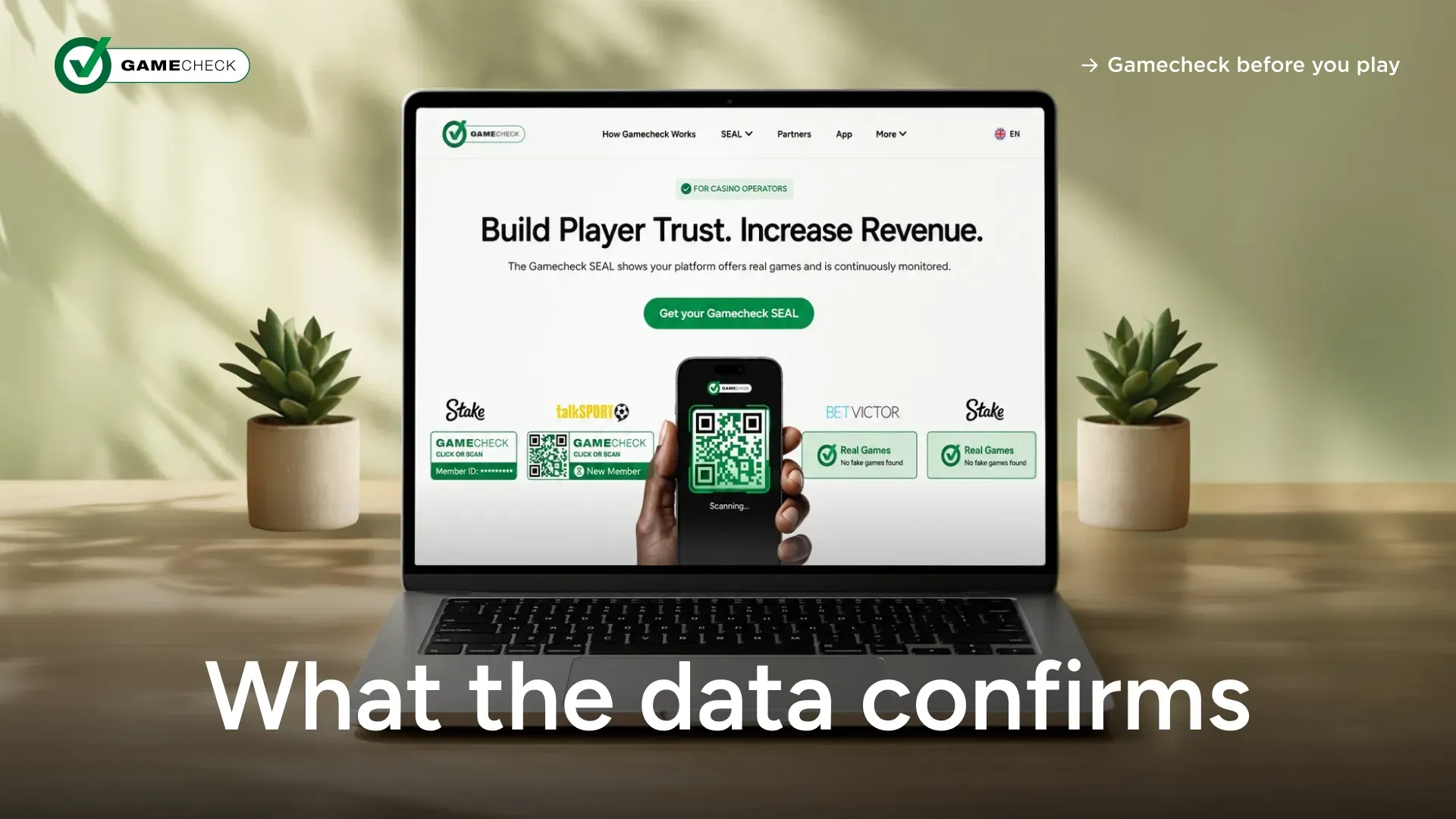
Approved sites display a dynamic Gamecheck SEAL containing a unique QR code, scannable through the Gamecheck app, and connected to that specific domain. The activity behind each SEAL is logged on the blockchain, giving the verification a permanent, auditable record.
If fake games are later detected on a site displaying the Gamecheck SEAL, the SEAL is removed immediately, and the operator is blocked from reapplying for 12 months of clean, verified operation. That enforcement is public and irreversible. The result is a check that answers the question that actually matters first: not whether a round's randomness was tampered with, but whether the game is the real thing in the first place.
For a player, there is a simple, direct way to check this. Pasting an online casino's URL into Gamecheck's free search tool shows immediately whether its games have been checked and confirmed with the original providers. For an operator, there is an equally direct way to prove it. Displaying the Gamecheck SEAL is how an online casino shows, with a live and verifiable signal, that its games have passed that check. It is not a claim the operator makes about itself. It is a result confirmed by the original game providers and made visible through a badge that is monitored continuously and removed the moment that confirmation no longer holds.
Provably real is the check that matters most, and it has to come first. A player can spend time considering whether a game's randomness has been tampered with, but that question only means something once the game itself has been confirmed as real. Before anything else, look for the Gamecheck SEAL, and check your online casino with Gamecheck. That answers the question every other check depends on.
Prove your games are real with the Gamecheck SEAL.
Fairness describes how a round is calculated. Realness describes whether the game producing that calculation is the one it claims to be. A fair calculation running inside a fake game still isn't a real game, which is why checking realness has to come first.
Gamecheck's free search tool lets a player paste in a casino's URL and see immediately whether its games have been checked and confirmed with the original providers.
By displaying the Gamecheck SEAL. The Gamecheck SEAL is only issued once Gamecheck has tested a selection of an operator's games and the original providers have confirmed they are real games.