There is a particular kind of disappointment that comes from realising you have been cheated. It is not the sharp sting of a minor inconvenience or the quiet devastation of misplaced trust. It is something slower and more financially painful. This is what playing a fake online casino game feels like, and according to Sumsub's 2024 iGaming Fraud Report, fraud in the online gaming sector has increased 64% year-over-year, with losses totalling $1.2 billion between 2022 and 2023.
For most players, the online casino experience should be straightforward. You find a platform, choose a game, and accept that the universe will determine whether you win or lose according to fair mathematical principles. Unfortunately, not everyone received the memo about playing fair. Fake games have become a significant problem within the industry, and understanding the difference between real and fake games is one of the most important steps any player can take to protect themselves.
A real online casino game is one that has been created and distributed by a legitimate game provider. Real game provider companies with real teams invest significant resources into developing games that meet strict industry standards.
The UK Gambling Commission's testing strategy for compliance with remote gambling requires all new products be tested by approved test houses prior to release, with test reports submitted before launch and annual games testing audits. Approved test houses include GLI, BMM Testlabs, iTech Labs, Gaming Associates, and TriSigma.
According to eCOGRA, one of the industry's leading testing agencies founded in 2003, their certification process includes source code review, statistical analysis using Marsaglia's 'diehard' tests, and verification of seeding and background cycling. eCOGRA holds ISO/IEC 17025:2017 accreditation and is approved in over 47 jurisdictions including Great Britain, Malta, and Sweden.
When you play a real game, the software connects to the game provider's servers. Outcomes are generated using certified Random Number Generators (RNGs), which the UK Gambling Commission mandates must be 'acceptably random' with output demonstrable 'through statistical analysis using generally accepted tests and methods.' The game provider stands behind the integrity of every spin, every hand, and every result.
In essence, a real game offers you a fair chance. You might win, you might lose, but the odds are what they claim to be, and above all, free from human input.
A fake game is a counterfeit version of an authentic title. From the outside, it may look identical to the real thing. The graphics, sounds, interface, and even the gameplay might appear exactly the same. However, beneath this convincing exterior lies software that has been altered or created by bad actors with one purpose: to guarantee player losses.
According to SoftGamings, fake games are typically created by small IT companies consisting of several programmers and designers who copy popular titles from leading manufacturers and transfer them to operators for a fraction of the legitimate cost. The pirated software costs approximately €5,000 compared to legitimate white-label packages at the considerably larger sum of €100,000.
The critical difference lies in outcome manipulation. Bigwinboard.com reports that ‘with pirated software, the RTP can be set to 10% or whatever the operator feels like.’ Legitimate games typically offer Return to Player rates between 95% and 97%. A fake game operating at 10% RTP means players lose nine times more money than they would on the genuine version. The outcomes are not random. They are programmed to ensure players lose.
These fraudulent games are distributed through rogue online casino platforms that exist specifically to exploit players. The operators behind these sites know the games are fake and use them deliberately to maximise profits at the expense of unsuspecting players.
Why people do illegitimate things? The answer is, more often than not, money. The online gambling industry generates staggering profits, and legitimate game providers earn their share by licensing games to online casinos. This arrangement works well when everyone involved possesses basic ethical standards.
The CasinoReviews 'Fake Contagion' report, covered by Gambling Insider in October 2024, found multiple unverified vendors distributing fake versions of popular games powered by 'unregulated, untested engines that manipulate results in favour of the house.' Duncan Garvie of CasinoReviews stated that 'the spread of fake casino games represents a real and significant threat to the integrity of the online gambling industry.'
There is also a secondary motivation behind many fake game operations: data harvesting. When players sign up and deposit funds on fraudulent platforms, they provide personal and financial information.
Group-IB's November 2024 report identified over 500 deceptive ads and 1,377 malicious gambling websites, noting that 'through these fraudulent apps and websites, scammers would steal both personal and financial information from users during the registration process. Victims can suffer significant financial losses, with some reporting losses of more than US$10,000.'
Understanding how these operations work is educational, if somewhat nauseating. The rogue operator begins by creating a website that resembles a professional online casino with unsettling accuracy. They invest in polished designs, prominent branding, and aggressive promotional offers that should set off alarm bells but often do not, because of very attractive signup bonuses.
These welcome bonuses are typically so generous they border on absurdity. The urgency is manufactured: deposit now, claim your bonus immediately, do not bother researching whether this platform has ever actually paid anyone.
The games themselves are either directly stolen from legitimate providers or recreated using pirated assets. The games are hosted on suspicious domains rather than the game provider's official servers. Players who deposit funds soon discover that winning has become mysteriously difficult. And on the rare occasions when they do appear to win, withdrawing those funds proves impossible.
Game providers have very obvious reasons to combat fake games.
Every fake game represents unauthorised distribution of their intellectual property. Worse still, fake games damage their reputation. When a player has a terrible experience with what they believe is a genuine title, they blame the game provider, not realising that they were playing a fake.
This is why reputable game providers actively collaborate with verification services to identify and flag fake games. They confirm which online casinos are authorised to host their games and which are operating fakes. Only the original game provider can definitively confirm whether a game on a particular online casino is real or fake.
Players are often advised to look for licensing information, research an online casino's reputation, and choose platforms hosting games from established providers. This is sensible guidance. However there is a very real problem: there is not sufficient protection against determined fraudsters.
Licensing information can be fabricated. The Malta Gaming Authority issued warnings in November 2025 about sites falsely claiming MGA licences, cautioning that 'dealing with unlicensed operators involves increased risks, as these entities are not bound by the safeguards and legal requirements set out in Malta's regulatory system.'
Effective game verification follows a methodical process. Investigators visit an online casino and test a selection of the games on offer. They examine technical details, including the web addresses from which games are launched. Fake games often operate from suspicious domains rather than the game provider's official servers.
Once this initial testing is complete, the findings are presented to the relevant game providers. Because providers maintain records of their authorised distribution partners, they can confirm whether a particular online casino is legitimately hosting their games or running fake games.
Only after game providers have validated or disputed findings is a verification status assigned. This approach ensures that the ultimate authority on whether a game is real or fake rests with the only party who can truly know: the people who created it.
The Gamecheck SEAL is a trusted symbol indicating that a selection of games on an online casino have been verified as real by the original game providers. This verification is based on direct confirmation from the providers themselves and supported by regular monthly checks.
The Gamecheck SEAL represents more than a one-time verification. Online casinos displaying the seal are subject to ongoing monitoring, with random, unscheduled tests ensuring that operators cannot present real games during audits only to switch back to fakes afterwards.
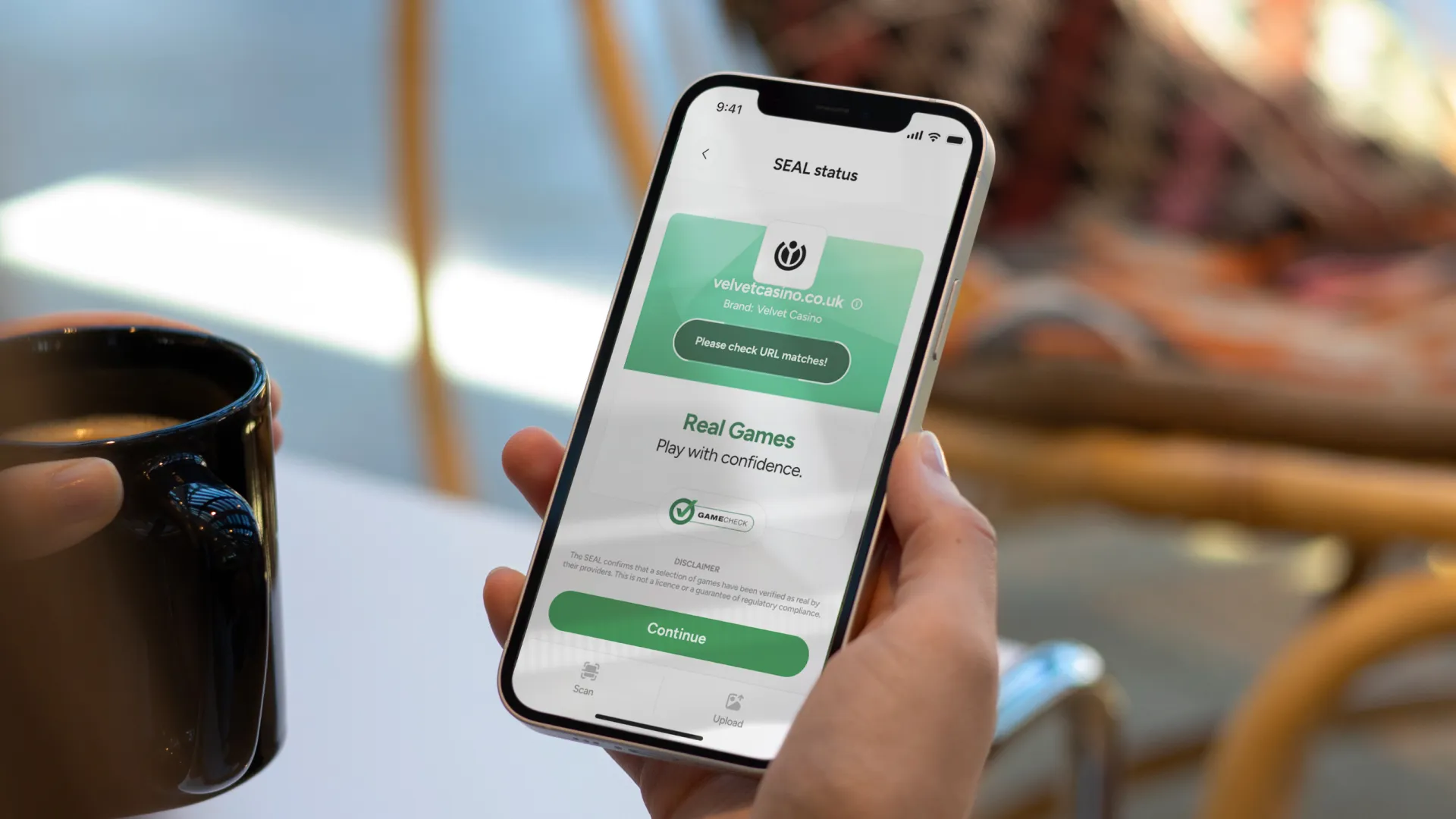
The Gamecheck SEAL can only be authenticated through the Gamecheck app. This design prevents rogue operators from copying the Gamecheck SEAL badge and displaying it fraudulently. By scanning the seal with the app, players receive real-time confirmation that the verification is genuine and current. If fake games are detected on an online casino that previously held the seal, it is immediately revoked.

Understanding the difference between real and fake games is the first step, but knowledge without action is merely interesting conversation. The goal is to ACTUALLY protect yourself. Before depositing funds with any online casino, take a short moment to verify the platform through the Gamecheck website. Enter the online casino's URL to see whether it has been verified and what its current status is. This check takes seconds.
If you see the Gamecheck SEAL displayed on an online casino's website, use the Gamecheck app to scan it and confirm its authenticity. The Gamecheck SEAL logo on a website alone proves nothing. Only scanning it through the app provides verification.
Pay attention to warning signs. Unusually generous promotions, pressure to deposit quickly, and limited or unusual payment options can all indicate platforms that may not be trustworthy. These factors alone do not confirm fake games, but they warrant additional caution.
Finally, trust your instincts, but verify the online casino anyway. If something about an online casino feels wrong, take the time to check before playing. The few seconds spent verifying could prevent considerable regret.
The fight against fake games extends beyond individual player protection.
Fake games undermine the entire online gambling industry by eroding trust. When players have negative experiences, they may abandon online gambling altogether or view all operators with suspicion, including the many legitimate platforms working diligently to provide fair gaming.
The UK Gambling Commission estimates £2.7 billion is staked annually on the UK online black market. The Commission issued 2,032 cease-and-desist orders by Q3 2024. In January 2025, CEO Andrew Rhodes stated that 'the Gambling Commission's strategy on combatting illegal gambling is to cause as much up-stream disruption as we can.'
The difference between real and fake games comes down to one fundamental question: is the game you are playing the authentic product created and authorised by its original game provider, or is it a fake game designed to deceive you?
By understanding what fake games are, why they exist, and how verification works, you can make informed decisions about where to play. The tools to protect yourself exist and are remarkably easy to use. Taking a moment to use them before you play is the simplest and most effective way to ensure that every game you enjoy is a real one, with genuine chances and fair outcomes.
After all, gambling involves quite enough uncertainty already. There is no reason to add 'wondering whether the game is real' to the list.