On the first morning at Fiera Roma, an operator stopped at our stand with a simple question: “If a copy of a popular game were running on our site, how would we know?” It was the question we had come to Rome to ask, and it arrived before we had the chance to raise it ourselves.
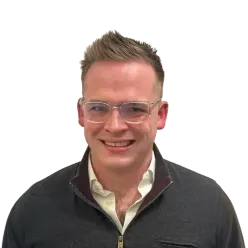
Four days, nine halls, more than 30,000 delegates. At an event that size, the questions people ask are a form of data. From Hall 1, Stand 1024, Jack Crabtree, Head of Sales, Elizabeth McDermott, Partnerships Manager, and Umur Ozan, Creative Strategist, spent those four days talking with operators, game providers, and others across the industry.
Before the event, we set out our argument for why fake games belong on the agenda in Rome. This piece reports the evidence we encountered at the event.
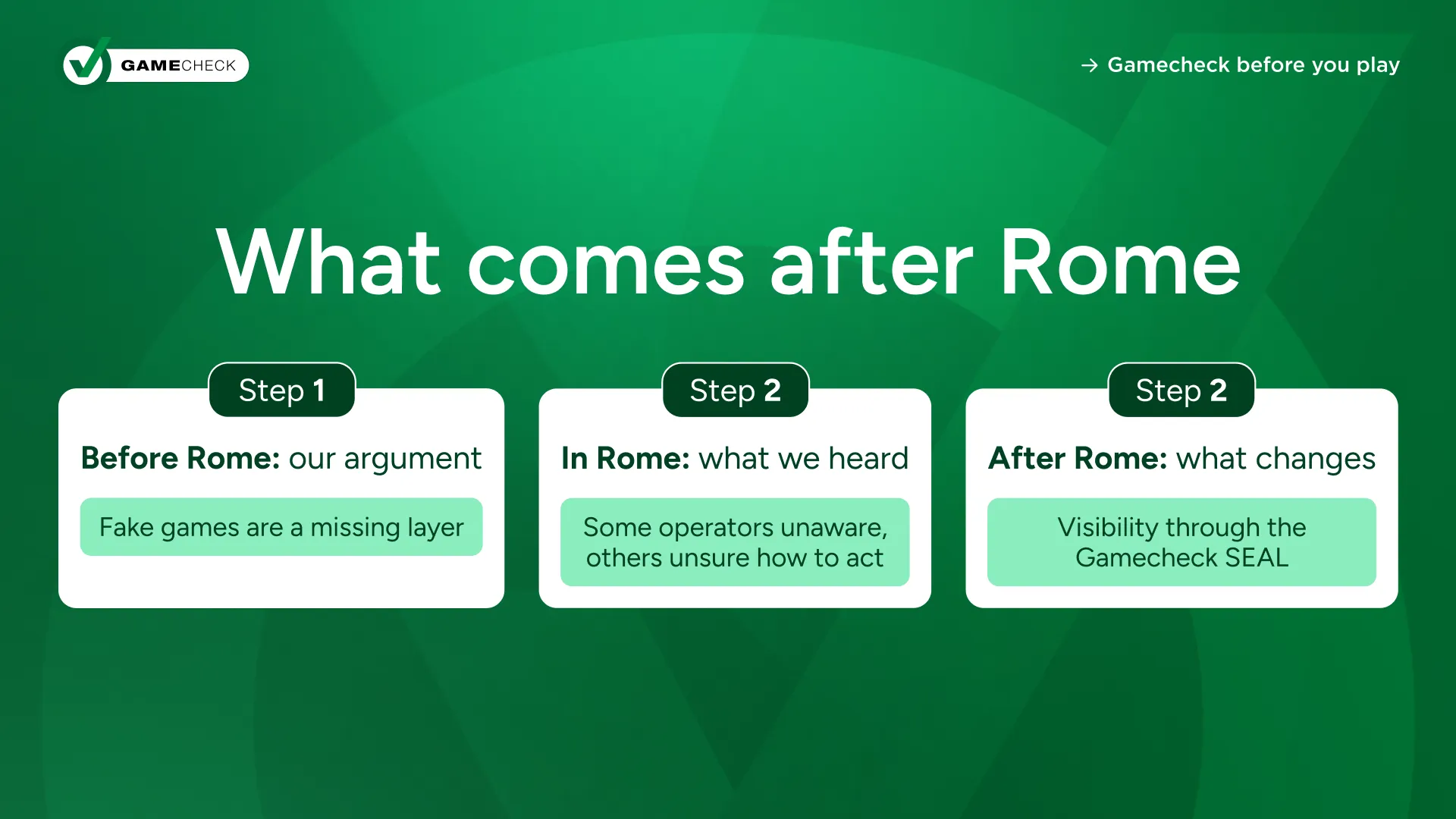
Before SiGMA World 2026, we argued that the industry’s conversation about player harm is largely behavioural. Operators watch deposit patterns, session length, and late-night play, and respond with limits and cooling-off periods. All that work assumes the game producing the session data is real. A player on a fake game can set sensible limits, play for 20 minutes, and log off on time, and still be harmed, because the harm sits in the product rather than their behaviour.
That was our argument. An argument made before an event still has to be tested, so we went to Fiera Roma to put it to the people who build, host, and protect the games.
Visitors to the stand came from every part of the industry: operators, game providers, affiliates, and regulators. Most came to find out about the Gamecheck SEAL or to talk about player protection more broadly, and reached fake games once the conversation went deeper.
That pattern is itself a finding. If fake games were already part of how the industry thinks about player protection, we would expect the topic to arrive fully formed. Instead, it surfaced as the question underneath other questions, which is exactly where our argument placed it.
When we asked operators directly how they know the games on their sites are real, their answers fell into two broad groups.
The first group had not considered the risk. Many assumed that the games on their sites were the games they had agreed to host. The idea that a copy could look identical to the original, down to the artwork, sound, and bonus rounds, while having nothing to do with the game provider that made it, was new to them.
The second group knew the problem well. Some had come across it through a player raising concerns, others through a game provider getting in touch. What they lacked was not awareness but a clear way forward. They wanted to tackle it in a way that protected both the integrity of their games and the players on their sites, and they were not sure where to start.
Across four days, we did not meet an operator who thought fake games were acceptable.
The gap we found was one of visibility, not intent.
For game providers, the conversation was more direct. Their titles are the ones being copied, and several described the frustration of seeing their work appear in places they had never agreed to supply. Many were interested in how Gamecheck works alongside them, since game providers are best placed to confirm whether a game is real or fake. The ability to check the same operator multiple times a month on behalf of multiple game providers, rather than relying on a single snapshot, came up again and again.
The Italian Pavilion and the new Italian-language stage gave the local market a strong presence on the floor. Italian delegates who visited the stand asked practical questions: how a player can tell whether a game is real, and how an operator can show its players that its games have been checked. In other words, the conversation in Italy was the same one we have in every market. It comes down to trust in the product.
Conversations are one kind of evidence. Numbers are another, and they answer the question that matters most after an event: was what we heard representative, or just loud?
Since launching in October 2024, Gamecheck has:
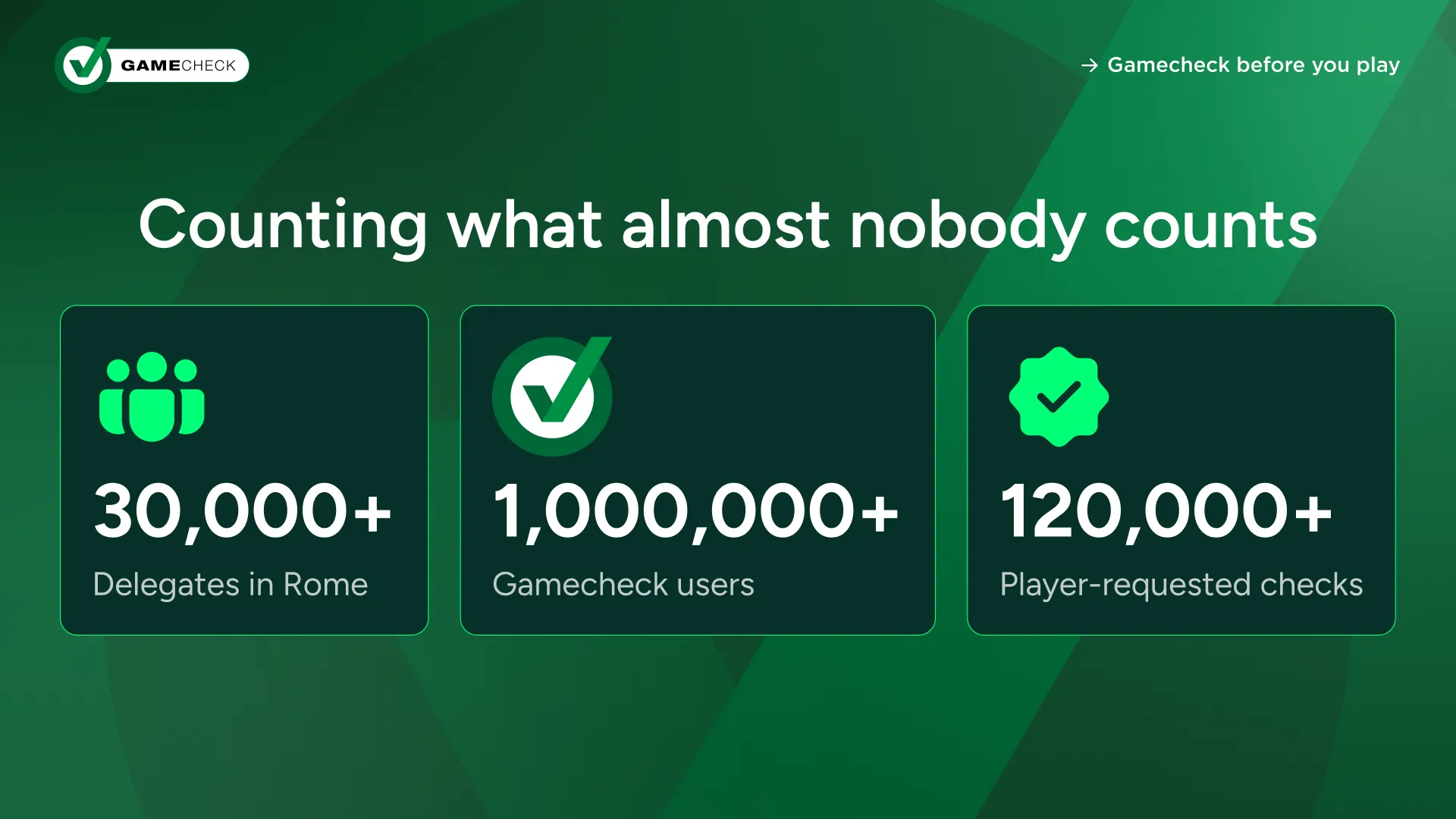
To put those figures in the context of Rome: SiGMA World 2026 drew more than 30,000 delegates. Gamecheck has more than 1,000,000 users, enough to fill Fiera Roma more than 30 times over. Players have requested more than 120,000 checks themselves, roughly four for every delegate who walked through the doors. Players are already asking the question we brought to Rome, at scale and without being prompted.
Every finding comes from the same process. We check a selection of games in collaboration with the original game providers, who are best placed to confirm whether a game is real.
The figure we kept returning to in Rome was the last one. More than 1,000 online casinos changed course once the evidence was in front of them. That matched what we heard from the second group of operators: once they could see the problem, their first question was what to do next. Fake games are a measurement problem as much as a willingness problem, and harm that nobody counts rarely reaches a board report.
For the operators who had not considered the risk, the starting point was simple. The team explained what a fake game is, how it reaches an online casino, and why it can harm a player whose session data looks perfectly healthy. For many, that was the first time the two layers of player protection, the game and the behaviour, had been set out side by side.
For the operators who already knew the problem, the conversation moved quickly to solutions. The team walked them through the Gamecheck SEAL, from the checks carried out with the original game providers to what players see on screen. Continuous monitoring answered the concern we heard most often, that a one-off check would only ever be a snapshot.
For game providers, the solution was collaboration. Every check depends on their input, and every fake game exposed protects their titles as well as the players who trust them.
So did our argument survive Rome? It came back refined rather than simply confirmed. The industry is not ignoring fake games. In many cases it simply has not yet had the tools to check the games on its sites or to act. This is a great finding, as visibility is a problem that can be solved.
The behavioural layer of player protection is mature and improving. The layer beneath it, whether the game is real, still has very few people measuring it. The practical question after SiGMA World 2026 is how operators and players start answering it.
For operators, the Gamecheck SEAL answers it in public. It shows players that a selection of the online casino’s games has been checked with the original game providers. Monitoring is continuous, not a one-off audit. If even one fake game is found, the Gamecheck SEAL is removed and the operator cannot reapply until 12 months have passed. Players can check any Gamecheck SEAL by scanning it with the Gamecheck app.
For players, Gamecheck’s free tools put the same question in their own hands. The Gamecheck app, Search Tool, and Chrome Extension let anyone check an online casino’s games before they play.
Many of the conversations that started in Rome are already continuing.
To every operator, game provider, and regulator who stopped by Hall 1, Stand 1024: thank you. Your questions about the Gamecheck SEAL, and how it can help build trust across the community, made this a week of real conversations with real answers. We look forward to continuing them.
Rome confirmed something the data already suggested. When operators can see fake games, many want to act. The hard part has been seeing them. The industry has become very good at spotting harm in the way people play, but fewer people are yet checking what they are playing. Until that changes, the simplest protection available to a player is to ask the question themselves before they play.
Published On: Nov 05, 2026
Updated On: Nov 06, 2026
Where was Gamecheck at SiGMA World 2026?
Gamecheck was at Hall 1, Stand 1024, at Fiera Roma. Jack Crabtree, Head of Sales, Elizabeth McDermott, Partnerships Manager, and Umur Ozan, Creative Strategist, spent the four days talking with operators, game providers, affiliates, and regulators.
What is a fake game?
A fake game is a copy of a popular online casino game running without the involvement of the game provider that made it. It looks the same as the original to players, but the original game provider has no part in how it works.
Why is a fake game a player protection issue?
The harm sits in the product rather than in the player’s behaviour. A player can play responsibly by every behavioural measure and still be harmed if the game in front of them is fake.
How does Gamecheck find fake games?
Gamecheck gathers evidence and checks a selection of games in collaboration with the original game providers, who are best placed to confirm whether a game is real or fake.
How can players check an online casino’s games?
Players can use the Gamecheck app, Search Tool, or Chrome Extension to check an online casino’s games before they play. They can also scan a Gamecheck SEAL with the Gamecheck app to confirm it is real.
Join operators using Gamecheck SEAL to protect players and grow credibility.