
Bangladesh’s online casino landscape is large, growing, and entirely offshore. Analytics firm Blask counted the top 20 brands serving the market, and all of them were offshore, with demand for online gambling up 11x in four years. Its revenue-based monthly estimate for the sector fell by 3.6%, from $123.5 million to $119 million, in early 2026. This dip coincided with a government enforcement push. Online casino gaming is now prohibited under the Gambling Prevention Act, 2026.
Where demand is high, scammers follow.
Fake online casino games are built to look exactly like real ones, which makes them appear legitimate to players. This article unravels how Bangladeshi players are targeted, what fake online casino games are, how the scam unfolds, the red flags to watch for, and how to protect yourself.
Fake online casinos go where the audience is, and in Bangladesh that audience is on mobile.
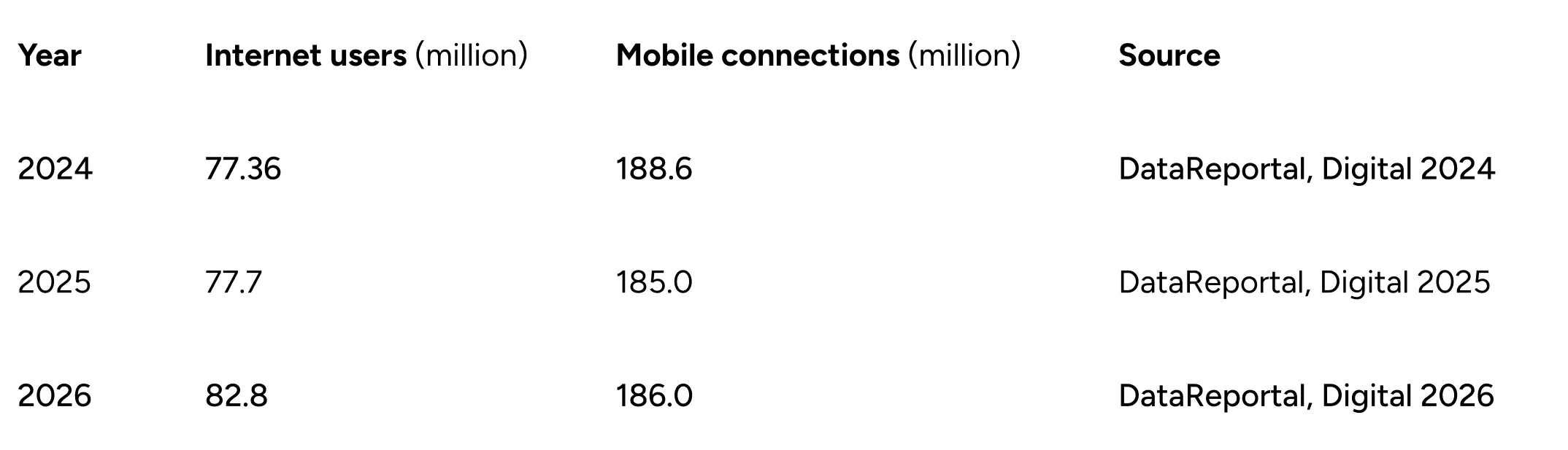
An estimated 82.8 million people were using the internet by the end of 2025, according to DataReportal. Mobile connections are higher than the number of internet users because many use more than one SIM card.
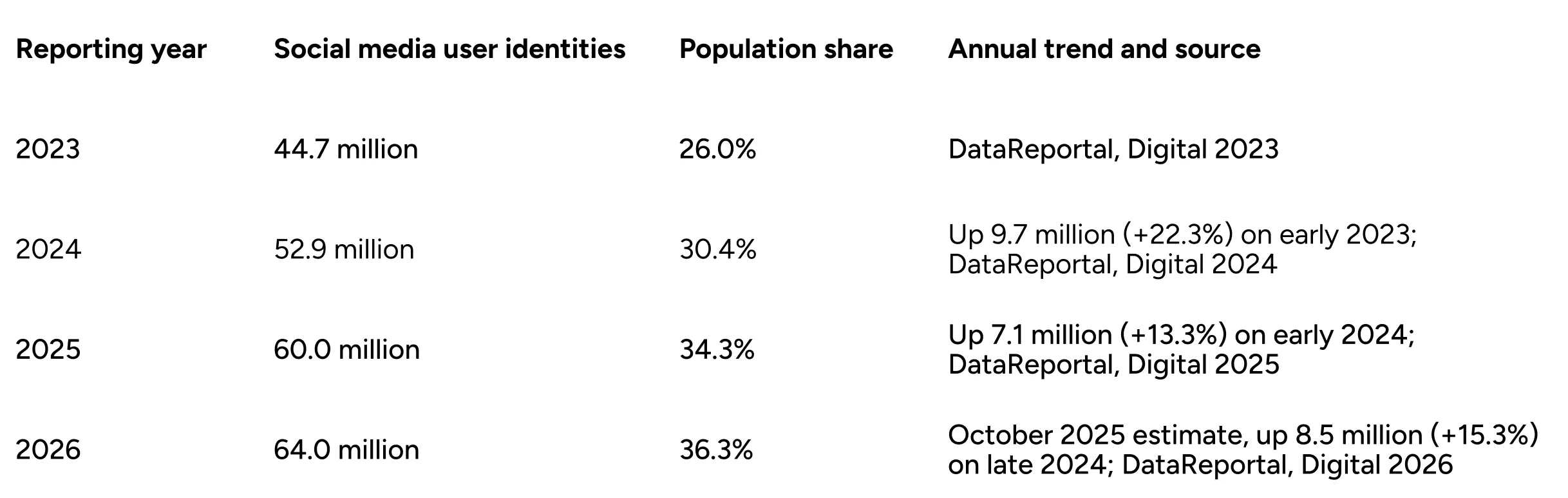
Social media is part of daily life too. DataReportal counted 64.0 million social media user identities in October 2025, up 15.3% in 12 months. Facebook is the largest platform by far, with 72.0 million users in September 2026, equal to 39.7% of the population, according to analytics firm NapoleonCat.
Payments are just as easy. Many Bangladeshis use mobile wallets for everyday payments, and there are now more registered accounts than people in the country. These wallets move nearly Tk 60 billion a day. Two lead the market: bKash reports 42 million active users and Nagad about 28 million.
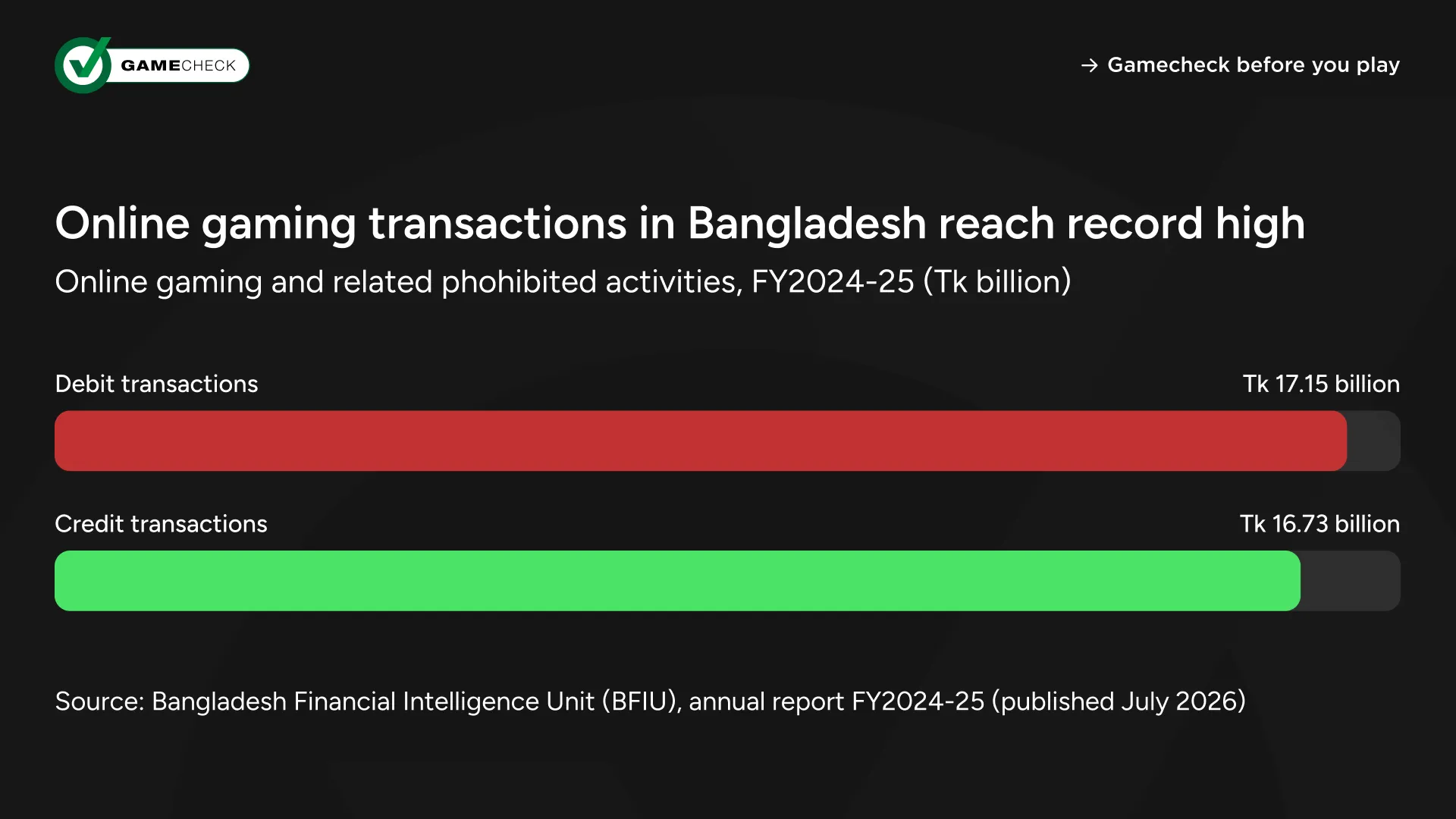
Bangladesh’s Financial Intelligence Unit (BFIU), which tracks suspicious money flows, received 30,199 reports of suspicious activity in the 2024-25 financial year. Online gaming and related prohibited activities accounted for Tk 17.15 billion in debit and Tk 16.73 billion in credit transactions in FY2024-25, the highest on record. Most of this money moved through bank accounts and mobile wallets.
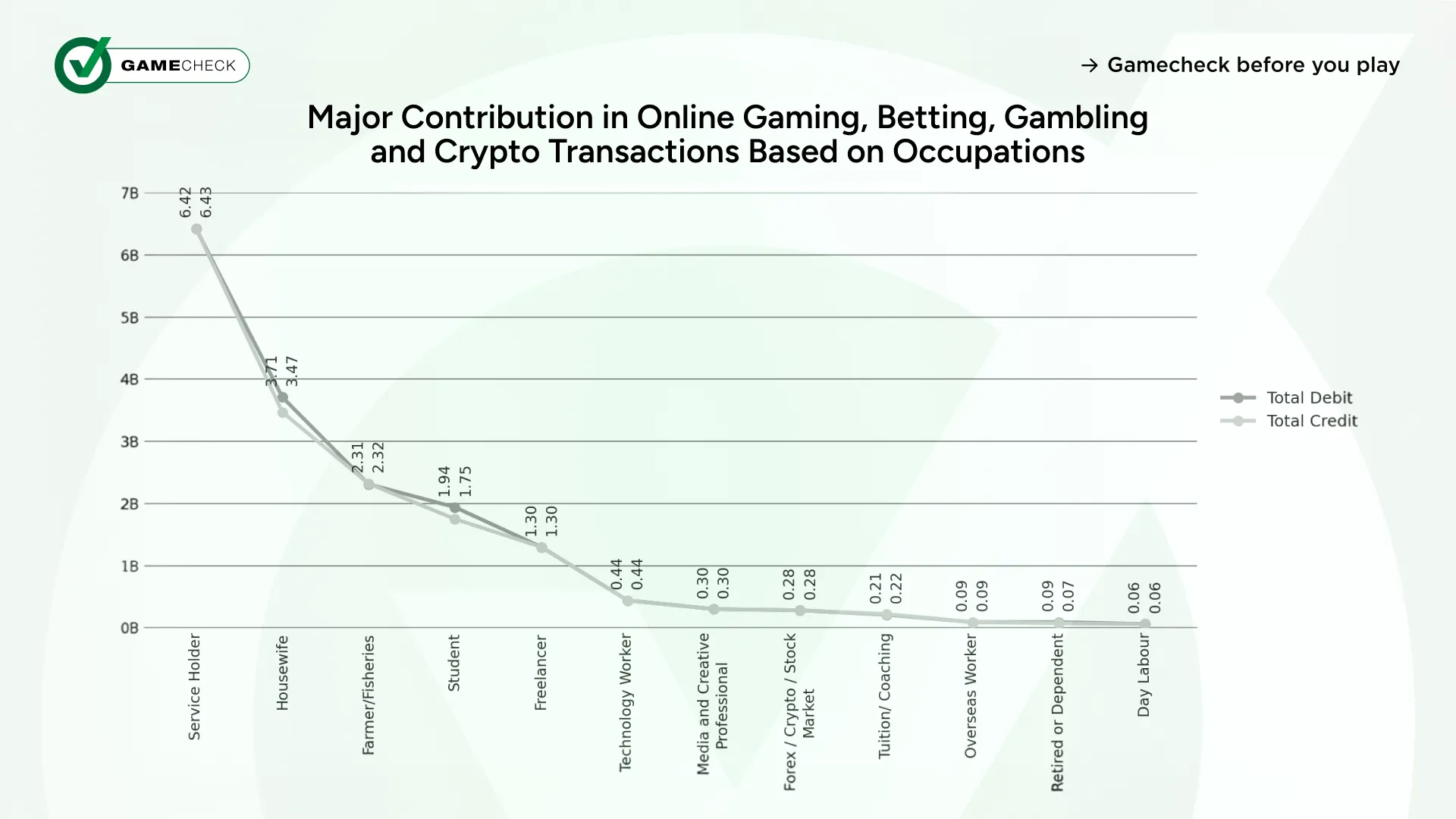
The same report shows who is involved. Salaried workers top the list, with more than Tk 6.4 billion in debits and Tk 6.4 billion in credits, which suggests people with steady incomes are increasingly being drawn in. Housewives, farmers, fishermen and students together account for more than Tk 7.9 billion. This activity is no longer limited to city office workers. It has reached homes, villages, and young people, often funded by personal savings, money sent home by relatives working abroad, and mobile wallets.
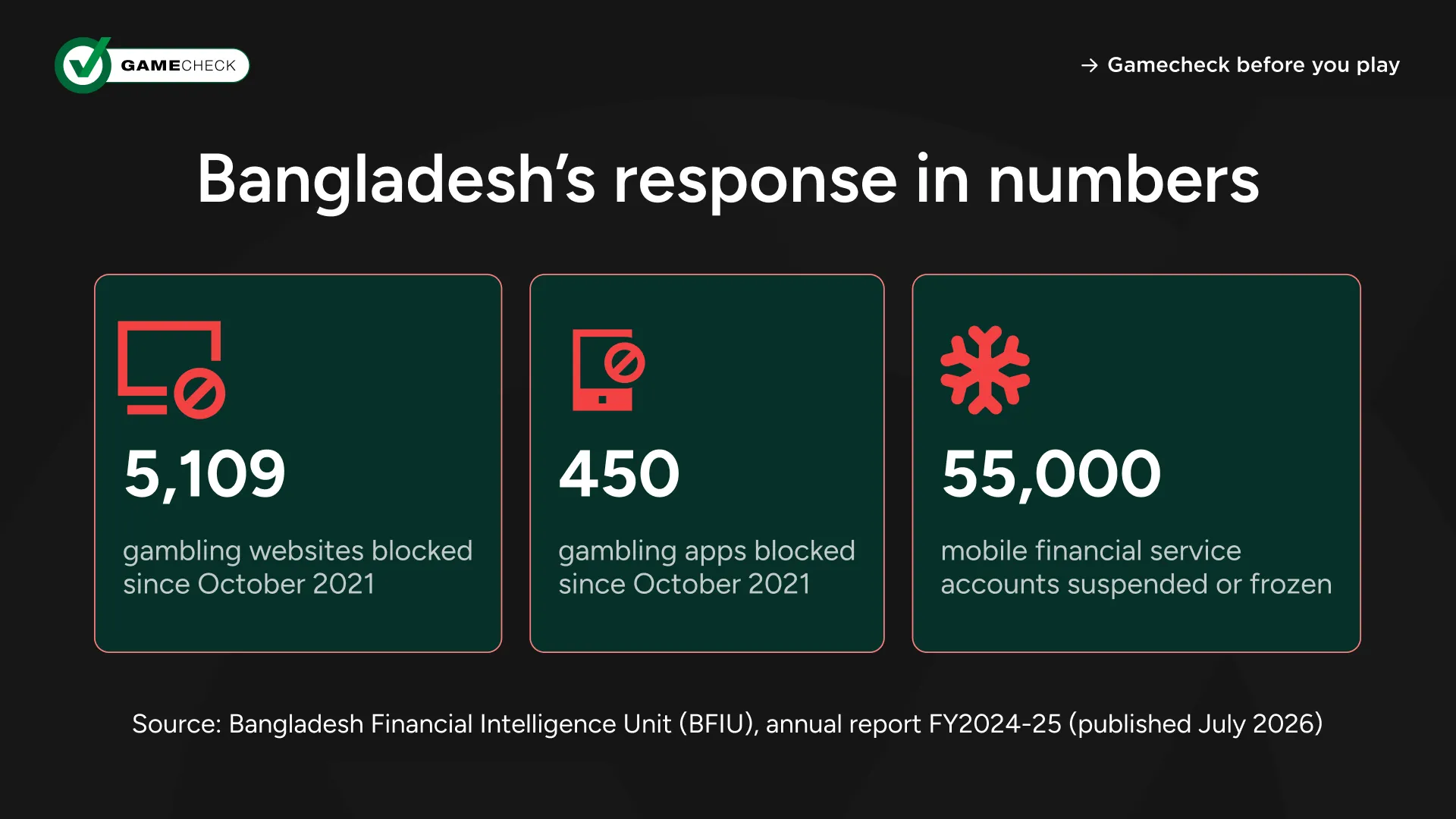
The Bangladesh Telecommunication Regulatory Commission (BTRC) has blocked at least 5,109 gambling websites and 450 apps since October 2021.
The Bangladesh Financial Intelligence Unit has also suspended or frozen around 55,000 MFS accounts linked to online gambling. Local reporting shows that blocked sites often reappear under new names. For players, a site's name tells them very little about whether its games are real.
For a fake online casino, this is an ideal set-up.
A player can see an ad, open a site, and deposit from the same phone within minutes, long before asking whether the games are real. On a small screen, a fake online slot is even harder to spot.
That is the gap Gamecheck was built to close. Gamecheck tests games to gather evidence and checks its findings with the original game providers, who are best placed to determine whether games are real or fake.
Here are a few fake sites offering fake games in Bangladesh, identified by Gamecheck:
Each name links to its Gamecheck profile, where players can see the site’s current status.
A fake game is a copy of a real game that never came from the original game provider. It imitates the branding, graphics, and sound of a real title. Behind the surface, it runs on unknown infrastructure, with no certified random number generator (the system that decides each game’s outcome) and no audited return-to-player rate.
Fake games tend to appear in three ways:
Gamecheck’s investigation into the Gambler Panel network found a shared system behind more than 2,000 fake online casino websites. An online casino being prohibited in a country does not make its games fake. A fake game is simply one that isn’t real, whatever the status of the site hosting it.
The Bangladesh Financial Intelligence Unit’s (BFIU) breakdown of suspicious transactions by occupation shows that money linked to online gaming, betting, gambling and crypto is no longer confined to a niche group of users. Salaried workers top the list, with more than 6.41 billion Bangladeshi taka (BDT) leaving their accounts and BDT 6.42 billion flowing in.
That suggests people with steady pay-checks are turning to these banned platforms in growing numbers. Housewives, farmers, fishermen and students are far from absent either: between them, they account for over BDT 7.9 billion in related transactions. The pattern suggests the activity has moved out of the urban salaried class and into homes, villages and younger age groups, with personal savings, remittances and mobile financial services being used to feed it.
The lure. It usually starts with a social media ad, a Facebook page, or a Telegram group.
In September 2026, Bangladesh’s Criminal Investigation Department (CID) reported that an organised group allegedly promoted betting websites through social media ads and shared account details with site operators over Telegram.
The hook. Large welcome bonuses and early wins build trust. Local reporting describes apps that offer a small win at first to draw players in. Gamecheck’s research found that fake games can be set to pay out unusually often at the start, so players feel they have found a fair site.
The look. Fake games copy the branding, graphics, and sound of real titles, so nothing on screen signals the problem. The balance looks real, and so do the games.
The pressure. Once trust is built, players are encouraged to keep playing and depositing, often through new offers or messages from support agents. In the Gambler Panel network, Gamecheck found that players were told to make a “verification deposit” before any winnings could be released. With no real game provider behind the game, there is nothing independent behind the results.
This is why players can’t reliably identify fake games by sight alone.
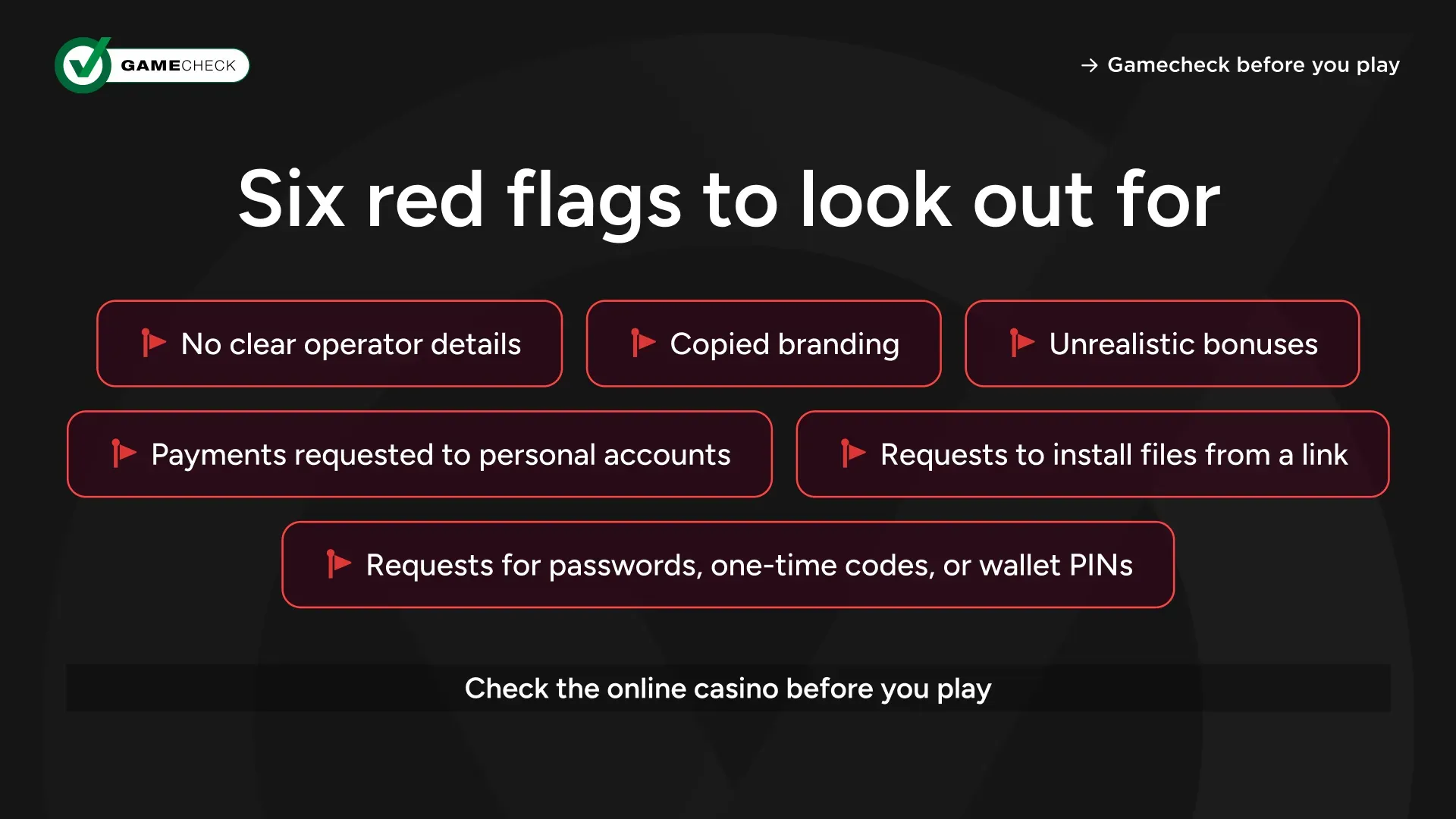
No single sign means a game is fake, but several together are a clear reason to check before going any further. Gamecheck’s guide on how to spot a scam before you deposit covers more.
Gamecheck also detects phishing sites and warns players, because identity theft is one of the most underreported risks in online casino gaming.
Since launching, Gamecheck has checked more than 77,000 online casinos and identified more than 11,000 fake games. Gamecheck’s free tools make the same checks available to players:
The Gamecheck app lets players scan a Gamecheck SEAL to confirm it is genuine and follow up to six online casinos from their phone, where most online casino sessions begin.
The Gamecheck SEAL shows that a selection of games has been identified as real by the original game providers. Operators displaying it are monitored continuously, and copied Gamecheck SEALs are blocked.
Gamecheck does not assess whether online casino gaming is permitted where a player lives. It simply checks whether the games are real. The same checks matter to the iGaming industry. They help game providers find out when copied versions of their games are circulating and protect their titles from being copied.
Fake online casino games work because they look real. The warning signs are consistent: ads promising easy money, bonuses too generous to be true, copied branding, requests to pay personal accounts, and a polished screen that gives nothing away. Since players can’t reliably spot a fake game by sight, checking is the most reliable step they can take.
Gamecheck is an independent provider of tools, research, and education that helps online casino players determine whether online casinos offer real casino games.
Check any online casino’s games with Gamecheck before you play.
Published On: Nov 08, 2026
Updated On: Nov 09, 2026
What is a fake online casino game?
A fake online casino game is a copy of a real game that never came from the original game provider. It looks and sounds like the real title, but there is no real game provider behind it.
Can players spot a fake game by looking at it?
Not reliably. Fake games copy the branding, graphics, and sound of real titles, so they can look identical on screen. Checking an online casino with Gamecheck’s free tools is more reliable than judging by sight.
Does an unlicensed online casino mean its games are fake?
No. An online casino being unlicensed or prohibited in a country does not make its games fake. A fake game is one that isn’t real, whatever the status of the site hosting it.
Why would an online casino ask for a one-time code or wallet PIN?
A real online casino never needs either. A one-time password or wallet PIN gives someone direct access to your money, so a request for one is a strong sign of a fake or phishing site.
What does the Gamecheck SEAL show?
The Gamecheck SEAL shows that a selection of games has been identified as real by the original game providers. It does not mean every game on the site is real. Operators displaying it are monitored continuously. If even one fake game is found, the Gamecheck SEAL is removed and the operator cannot reapply for 12 months.
Join operators using Gamecheck SEAL to protect players and grow credibility.