

When a player searches for an online casino by name, the instinct is to trust whichever result appears first. Search position can make a result appear more credible, but ranking highly does not by itself show that a page or game is real.
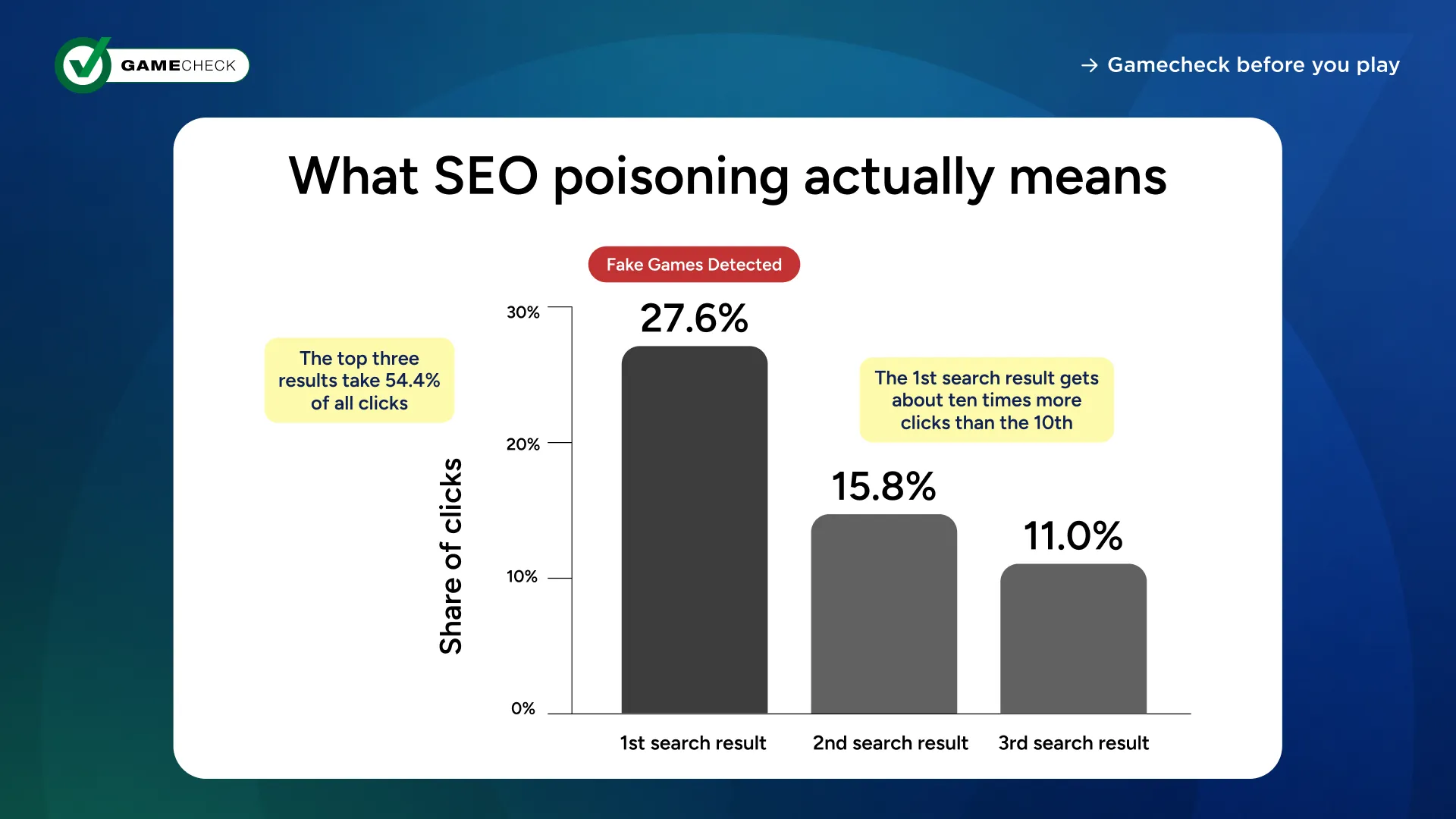
Increasingly, though, fraudsters use a technique called SEO poisoning to push fake pages into search results, sometimes placing them right beside, or even above, the real site. That top position carries real weight: Backlinko's analysis of four million search results found the first organic result takes 27.6% of clicks, roughly ten times more than the result in tenth place. The second result takes 15.8%, and together the top three results take more than half of all clicks at 54.4%.
Gamecheck's own checks have already identified more than 10,000 fake online casinos, which gives a sense of how often this tactic succeeds before it's caught. For online casino players, this means a result's position in search is no longer enough on its own to go by. Understanding how SEO poisoning works is the first step towards spotting it.
SEO poisoning is a method of manipulating search engine rankings so that a fraudulent page appears more prominently than it should. Rather than building a brand new website and slowly earning a search engine's trust over time, the people behind these pages usually take a shortcut: they borrow trust that already belongs to somewhere else.
This is different from simply setting up a fake online casino website. SEO poisoning is about visibility, making sure that fake page is actually seen by the people searching for the real operator or game.
There's no single method, but a few approaches come up again and again:
The common thread is attackers try to exploit factors that help pages appear prominently in search results, rather than relying solely on building a website from scratch. The tactic turns up especially around online casino gaming keywords, since these searches are some of the most commercially valuable on the web.
Online casino operators already spend heavily to appear for their own brand name, which means the potential reward for hijacking that same search space is high. Published keyword analyses put a paid search term such as "online casino real money" at up to $90 per click, which gives a sense of what a single visitor is worth in this market. A single hidden page can quietly funnel a steady stream of players toward a fake game before anyone notices.
Picture a well-known online casino operator with strong brand recognition among players. Someone adds a hidden page to an unrelated website that already ranks reasonably well, for topics with nothing to do with online casino gaming. That page carries the operator's name, alongside common search terms like "play now" or "official site". Because the underlying website already carries some trust with search engines, the new page can climb rankings far faster than a brand new website ever could.
A player searching for the operator by name sees this page appear close to the real result. Nothing about the listing itself looks obviously wrong. It's only once the player clicks through, and lands on a website that doesn't quite match what they expected, that something starts to feel off. By then, they may have already shared personal details or started playing a fake game.
Online casino searches are competitive and commercially valuable, which makes them an attractive target for this kind of manipulation. The technique is also spreading: security firm ReliaQuest recorded SEO poisoning-related malware detections rising about 10% every month between August 2023 and January 2024, a 60% increase across the six-month period.
A player searching for a well-known operator may see a manipulated page sitting close to, or briefly outranking, the real site. On a mobile device, where the full web address is often hidden or shortened, this can be very hard to notice in the moment.
This is one reason even long-time players, who feel they know an operator well, still benefit from checking in occasionally rather than relying on familiarity alone.
Search engines do work to detect and remove these pages once someone reports them, but the process takes time. In that window, before removal, search engines may still index the page, players may share it, and a meaningful number may click through. This gap between a page appearing and a page coming down is part of what makes the tactic effective.
A manipulated page doesn't need to stay at the top for long. It only needs enough time to attract players before it's identified and removed.

Fake games and pages are designed to look convincing. These steps can give players more information before they decide whether to play.
SEO poisoning isn't only a player problem. It affects trust across the iGaming industry more broadly. Operators whose names are borrowed this way often have no idea it's happening until players report confusion, or the operator notices a drop in traffic to their real website. Game providers face a related issue: fake games built to imitate their titles can appear in search results before the provider is even aware the fake game exists.
This kind of hijacking can also be hard for an operator or game provider to spot on their own. The fake page usually sits on an unrelated website, so it rarely appears when the operator searches for their own name alongside the compromised site directly, and it can go unnoticed until a player raises the alarm.
Gamecheck works with game providers to check whether games described online are real, and monitors online casinos where fake games have previously been identified. A Gamecheck SEAL signals that the original game providers have checked a selection of games as real, and Gamecheck removes it immediately if it later identifies fake games. Gamecheck has monitored 69,846 online casino sites and completed more than 496,000 checks, identifying over 10,000 fake online casinos in the process.
Search engine rankings will keep evolving, and so will the methods used to manipulate them. For now, the most reliable protection remains straightforward: treat a search result as a starting point, not a guide on its own, and check what's actually behind a game before playing it.
Don't let a search result make the decision for you.
Use the free Gamecheck Search Tool to check any online casino before you play, and see instantly whether it's running real games, fake games, or is still pending checks.
Published On: Oct 13, 2026
Updated On: Oct 14, 2026
What is SEO poisoning?
SEO poisoning is a technique fraudsters use to push fake pages higher in search results, sometimes right beside, or even above, the real site. Rather than building trust slowly, they borrow it: adding hidden pages to poorly secured websites, registering lookalike domain names or buying expired domains that still carry search engine trust.
How can I tell if a search result might be fake?
Check the web address before you click. It may be similar to, but not exactly the same as, the operator's usual address, or use an unfamiliar domain ending. Other warning signs include a copied page design, an immediate redirect to a different address, or no sign of independent checking, such as a Gamecheck SEAL.
How can I check if an online casino offers real games?
The free Gamecheck Search Tool and Chrome Extension both return a clear result in seconds: real games in operation, fake games detected, or a check still pending.
Join operators using Gamecheck SEAL to protect players and grow credibility.