
Most conversations about fake games focus on the player. That makes sense, as players are the ones who sit down and tap the play button. But if you didn't know, fake games hurt another group: the game providers who made the real versions.
A fake game showing up at an online casino doesn't just fool the player. It takes away the credibility of those who created the real thing. This leaves them with a bad reputation that's not their fault.
Below, we look at how fake games end up at online casinos and how Gamecheck's free tools can help you spot them in seconds.
A real online casino game didn't just appear out of nowhere. A talented team spent months and resources building it. Here's how the process works, from start to finish.
The idea always comes first. Artists then come in to draw the game's visuals. After that, sound designers create music and sound effects that fit the game's theme. Programmers then write code to ensure every mechanic works as it should.
After creation comes testing. Independent testing agencies like iTechLabs and eCOGRA check games to ensure they produce fair outcomes and meet quality standards. A title can only go out to online casinos if it passes both checks. If it doesn't, the production team must make tweaks to make it worthy of appearing in online casino lobbies.
All this can take months. This timeline stretches to years if there is back-and-forth with testing agencies. But providers are happy to put in all this work, so the end product is fair and fits players’ needs.
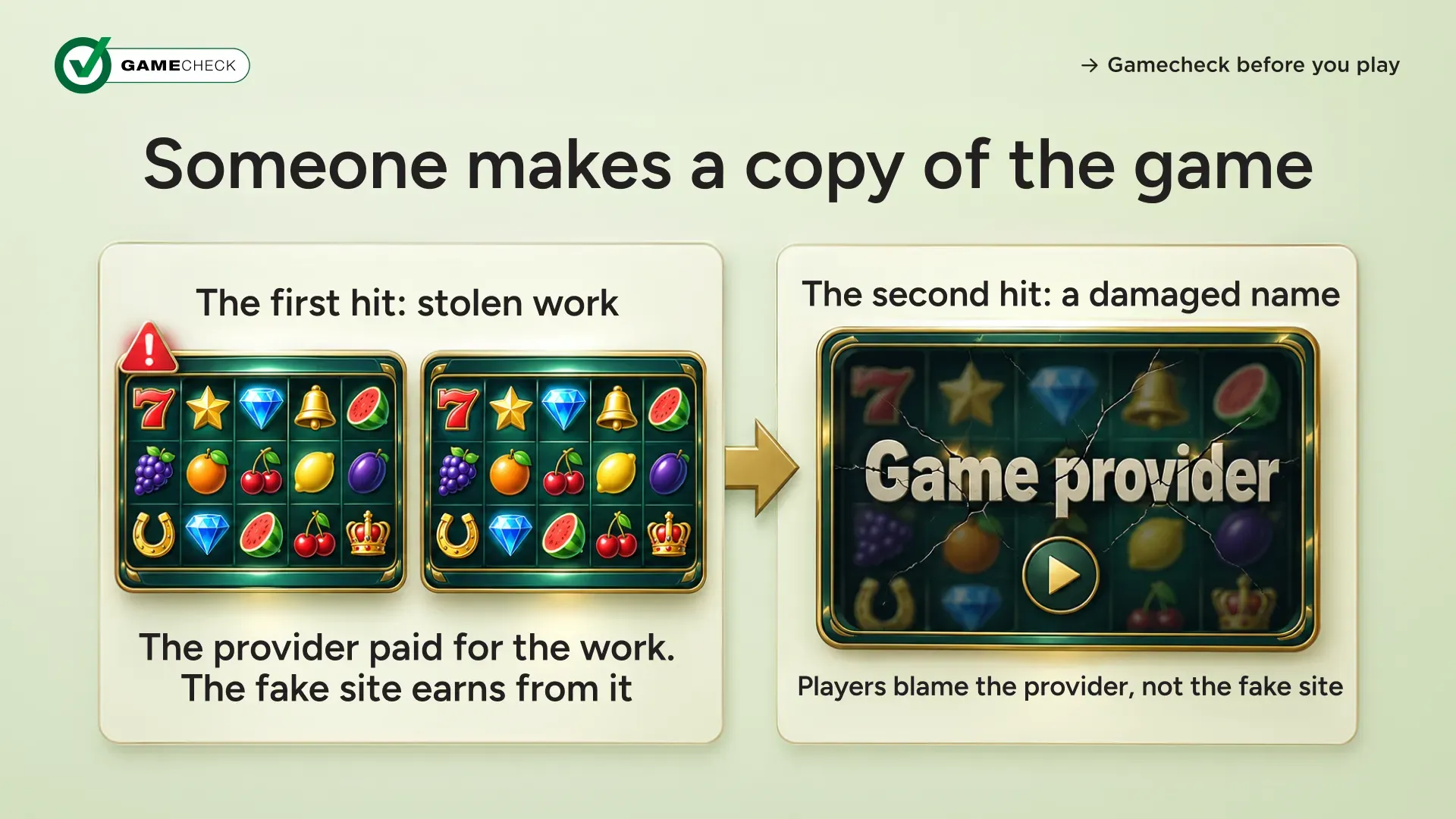
A rogue online casino operator sees a game that's popular globally. They copy it and add it to their own casino lobby. This copy looks like the real game. It uses the same visuals, sounds, bonus rounds, and gameplay. But the original game provider didn't create this game. An independent testing agency also didn't test it. The rules inside aren't the same. It's a fake dressed up to look real.
The first way a fake hurts the provider behind the original real game is straightforward. It takes their work without permission. The provider spent loads of money to bring an idea to life. They paid teams for the sound, art, and code. A rogue operator takes all of this without spending a penny. When that fake title goes live on their site, they earn money from the work the original provider paid for.
All this falls under “intellectual property theft.” Someone's using what you made as if it were theirs. In the online casino world, this happens far too often. Gamecheck has found more than 11,000 fake games across online casinos sites. Each of these sites lists fake titles under the real provider's name, and the provider earns nothing for their work.
This hit hurts most because it affects trust.
When a player opens a game at an online casino, they see the provider’s name on the launch screen. They hit the play or spin button for a while. But because fake games don't work as they should, the experience falls flat. When this happens, the player may make a mental note not to play titles from that provider. They didn't know the game was fake. All they know is the provider’s name. So, the provider shoulders the blame.
Gamecheck's founder, James Elliott, said that players tend to blame the provider, not the operator hosting the game. And this blame can spread. A player who had a bad time playing a certain title can tell their friends or post about it on Reddit.
Over time, more people hear about these experiences and start to avoid the provider's games. So, the provider's reputation can suffer, all because of a title they never produced.
If fake games looked fake, people could tell at a glance. But that isn't the case. Players can check its graphics and mechanics. But they can't examine the code, and the creator is hidden. That's why a fake game can easily pass for a real one.
Players not being able to spot fakes isn't their fault. The whole point of them is to fool people. And so far, they're delivering on that front well.
Game providers can fight back. But it isn't as easy as you might think. They first need to find the fake games. Afterward, they'd need to gather evidence and do all they can to take down these fake games.
Let's say a provider manages all of these. It's good news. But the issue will resurface sooner rather than later because rogue operators can set up another website featuring these fake games. So, those titles that were removed have a new location.
Gamecheck has covered this situation in detail in the real cost of fake games. Providers can't win this fight alone. They need players to do checks too.
Online betting and gaming across Africa is set to grow rapidly. The African market is expected to rise from $12.7 billion in 2026 to $19.4 billion by 2030, according to iGaming Business. Online casino gaming is one of the fastest-growing areas of that market.
Phones are also part of this equation. The GSMA and the Partnership for Digital Access in Africa (PDAA) are working on a plan tagged “Advancing Digital Connectivity in Africa: Charting Africa’s Path to 1 Billion Connected People by 2030.” If this plan succeeds, many more people could try out online casino games for the very first time.
New players are at the highest risk. They haven't seen or played the real versions of the games before. So, they don't know how to compare it against a fake. And if a fake title doesn't give them a good experience, the provider behind the real version could lose that player for life.
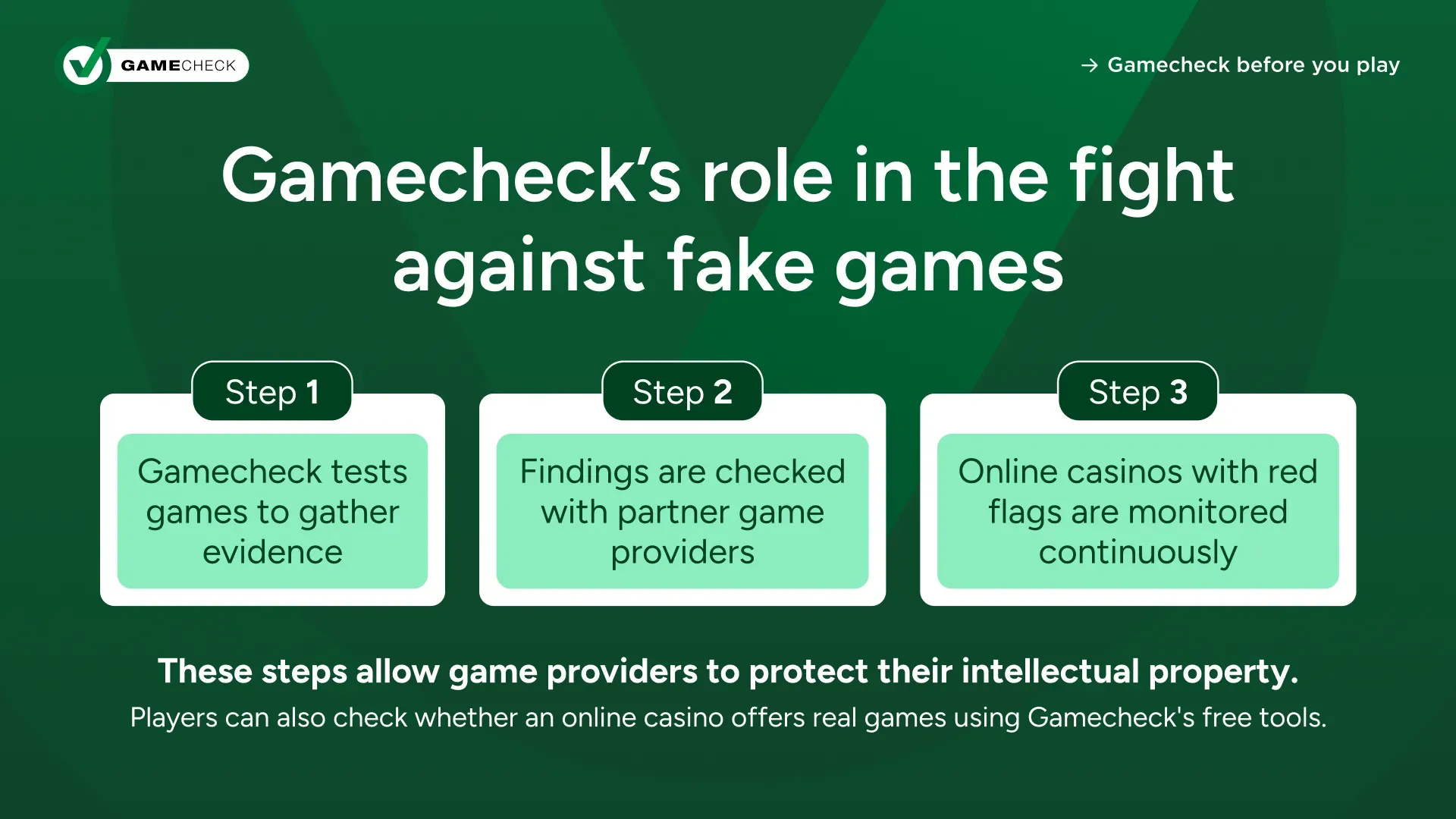
Gamecheck provides the tools, education, and research players can use to determine whether an online casino offers real casino games. It doesn't decide whether a game is real or fake on its own. Providers are responsible for that. Here's how its process works:
These steps allow game providers to protect their intellectual property. Players can also check whether an online casino offers real games using Gamecheck's free tools.
With the Gamecheck Search Tool, you can type in an online casino's name. If it's been checked, you'll see a result indicating whether it has real games or fake ones.
Checking the status of online casinos on Gamecheck is simple and takes just a few seconds. So it's no surprise players have already made more than 93,000 check requests.
If you don't want to type the Gamecheck website URL into your browser each time you want to see whether an online casino offers real titles, use the Gamecheck app on iOS and Android. With this app, you can do quick checks on the go.
Then there's the Gamecheck SEAL. Some online casinos display this badge. They didn't get it by chance, though. Instead, they earned it because providers verified a selection of their games as real.
Every Gamecheck SEAL links back to one site. It also has a QR code you can scan using the Gamecheck app. Online casinos with the SEAL undergo continuous random checks. If regulators later find fake games at any of these online casinos, they remove the SEAL right away.
Start by entering the online casino name in the Gamecheck Search Tool. Once you open its profile, you can see if it has real games, fake games, or is awaiting checks.
Each check protects you and the providers. It also makes it difficult for rogue online casino operators to fool players. If you're in Africa and would like tips on how to spot fake titles as they evolve, follow @gamecheck.afr on Instagram.
Many providers are linking up with Gamecheck to protect their work. Partnering with Gamecheck makes the fake variants of their games easier to spot. Game providers validate Gamecheck's findings. So you can be sure the final word comes from the original makers.
Real games take time, care, and money to make. They deserve to be judged on their own merits, not on fake versions that borrow their name. Fakes undo that investment, damage the provider’s reputation, and leave players with a poor experience. So when players check, and providers act on those checks, the credit goes where it belongs: to the game providers who built the real games.
Can a player spot a fake game?
Not reliably. The copies are sophisticated enough that neither an untrained nor a trained eye can tell from playing. The only sign is winning less often than expected, which costs the player money to work out.
Can a fake games status change over time?
Yes. Gamecheck continues monitoring flagged sites, and a status can change if the issues identified are addressed by the operators, and fake games are removed.
Does a licensed online casino guarantee the games are real?
No. A licence confirms that an operator has met the regulator's baseline requirements at a point in time, but it says nothing about whether individual games are real or fake. Licensing and game authenticity are separate questions, so check both rather than relying on a licence alone.
How can I check an online casino for fake games?
Paste the site's address into the Gamecheck Search Tool or the free Gamecheck app. If the site has not been checked yet, you can ask Gamecheck to check it.
Join operators using Gamecheck SEAL to protect players and grow credibility.