
-20260921-145945-800x450.webp)
Responsible play is generally a series of personal habits: set a budget, check the clock, take breaks, stop when it stops being fun. These habits matter. But they all rely on something quieter: data. A player that does not know what they are playing can not make an informed decision on it and it is hard to call an uninformed decision a responsible one.
This is where the Gamecheck SEAL comes in. The Gamecheck SEAL is a symbol displayed on an online casino's site once a selection of games has been verified as real by the original game providers. It gives players a fast, checkable signal about the games in front of them, so that their attention can stay on the parts of responsible play they actually control: time, spend and self-awareness.
Gamecheck is an impartial source of tools, research and education to allow online casino gamers to verify if online casinos are providing authentic casino games. In this article, we explain how Gamecheck SEAL helps responsible play in practice, what it covers and what it does not.
Responsible play rests on a handful of small, practical decisions. How long will the session last? How much is set aside for it? What happens when that amount runs out? Most player education focuses on these questions, and rightly so. The evidence suggests players take them seriously.
A 2025 study for the American Gaming Association found that 84% of gamblers knew of at least one responsible gaming tool, and 87% said it is critical for the industry to support responsible gaming. The same study found that 56% of online casino players set a budget before playing, and 78% of them stay within it.
A budget works when a player stays focused on it. Anything that pulls attention away from the plan, including doubts about whether the games themselves are real, makes that plan harder to follow.
Players who set a budget mostly keep to it. Uncertainty is what breaks the habit, not the habit itself.
The Gamecheck SEAL is more of a trust indicator than a rating. It tells a player one thing: that a selection of games on that site have been tested, with the results validated by the original game suppliers, and that the site is still being monitored.
Several features make the signal reliable enough to act on.
Gamecheck does not decide on its own whether a game is real. That confirmation comes from the original game providers, who are best placed to know their games. Gamecheck’s role is to monitor online casinos that show warning signs and test a selection of their games. It collects various metadata during testing, which it then checks with the game providers to determine whether the games are real. Keeping those responsibilities distinct is what gives the SEAL its credibility.
The Gamecheck SEAL links to a profile page, and that profile shows one of three statuses in plain language.
There is no scoring system to interpret and no scale to learn. A player gets a short answer in seconds, then goes back to playing or decides to look elsewhere.
Fake games are copies of real online casino games, built to look like the original. They are not always obvious. A game may carry familiar artwork and a familiar name while behaving in ways the original never would.
For responsible play, the real damage falls on the player's plan. Someone who suspects a game is behaving oddly tends to keep playing to find out. Those extra rounds are unplanned, and they push the session past the time and spending limits set at the start. Doubt extends sessions.
The scale of the issue explains why an independent check is useful. Gamecheck monitors 69,846 online casino sites, has completed more than 496,000 checks, and has identified 9,147 sites carrying fake games. Players are clearly looking for answers too: Gamecheck has received more than 93,000 requests to check a site, and its casino profile pages have been viewed more than 163,000 times.
Think about the Gamecheck SEAL as part of a responsible play routine that players already know.
Set the time and the amount first. Then look for the Gamecheck SEAL in the site footer, and check its status. The check takes seconds and happens while the player is still calm and deciding, rather than mid-session when decisions are harder.
There is one less thing for a player to think about if they have previously checked. "Is this game behaving normally?" takes mental energy away from the possibility of realising "I have been here longer than I planned." Attention is finite, and responsible play is mostly about paying attention.
Games change, and sites change. A check made once is a snapshot. This is why continuous monitoring matters more than the initial check, and why the Gamecheck SEAL is tied to ongoing unscheduled checks rather than a single event.
The Gamecheck app makes checking a habit rather than a one-off. It has been installed more than 63,000 times, with 57,400 installs on Android and 5,900 on iOS, and has around 34,700 active users.
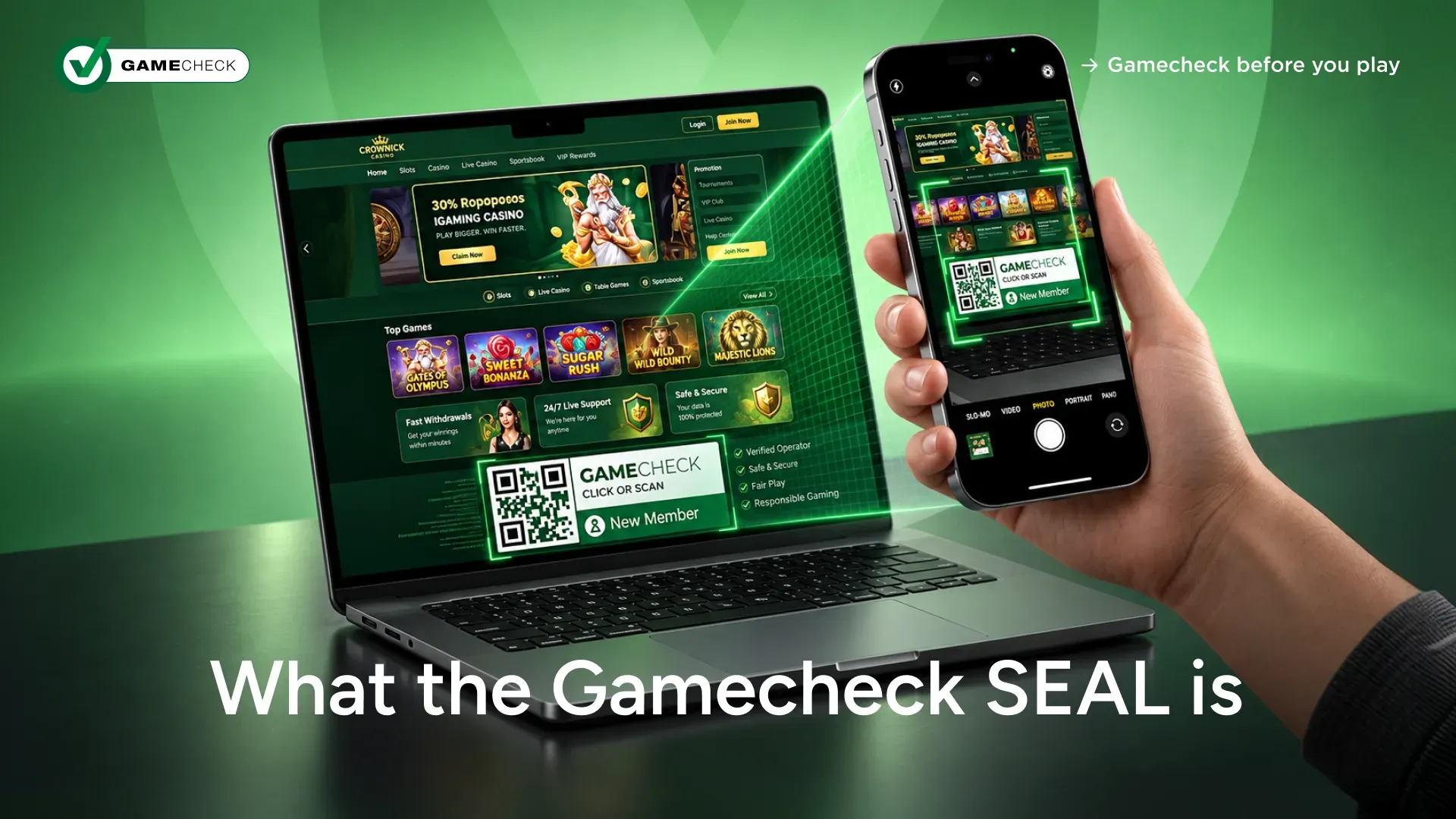
Players can scan a Gamecheck SEAL with the Gamecheck app, and the app returns its live status from Gamecheck’s database. Each Gamecheck SEAL carries a unique QR code linked to a specific domain, so a copied SEAL on another site won’t work, as it is blocked and flagged. Online casinos displaying the Gamecheck SEAL are monitored continuously, and if fake games are found, the Gamecheck SEAL is removed immediately. This is the side of responsible play that most tools overlook. Rather than players tracking whether an online casino still offers real games, Gamecheck does it for them.
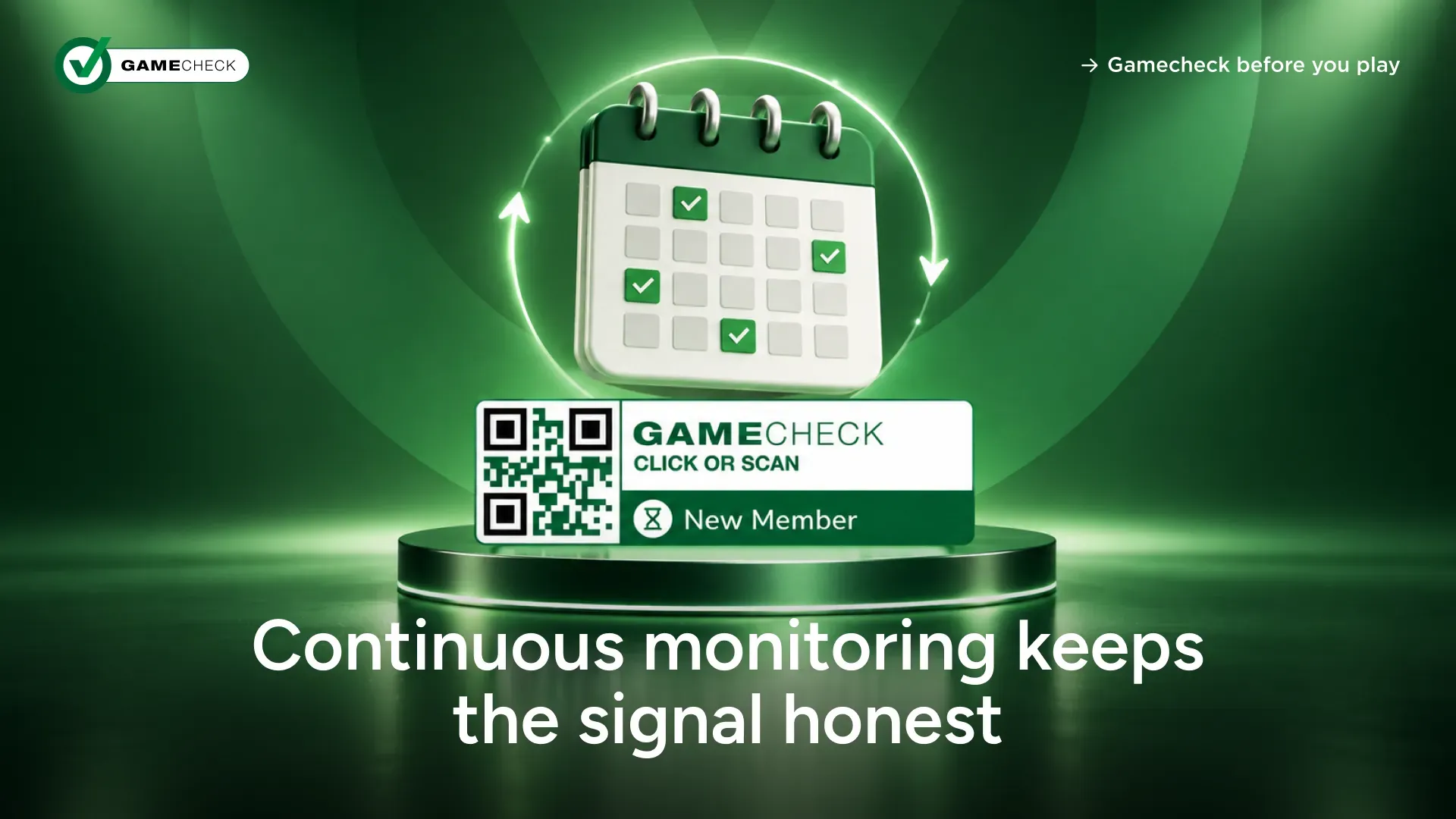
If not maintained, a trust signal is only as good as when issued. Operators with the Gamecheck SEAL endure monthly rechecks and unannounced checks.
After the Gamecheck SEAL is issued, bogus games are eliminated immediately and the profile updated to show discovered phoney games. Anyone who scans or clicks sees the change. According to traffic data, the Gamecheck SEAL has earned over 171,000 clicks to the profiles behind it.
Being clear about limits is part of supporting responsible play. Overstating a tool encourages players to lean on it in ways it cannot support.
The Gamecheck SEAL does not guarantee that every game on a site is real. It reflects a selection of games checked with the original game providers, plus ongoing monitoring. It is not a rating of an online casino overall, and it is not a substitute for the personal limits a player sets.
It does not replace safer play tools. Spending limits, time limits, session reminders and self-exclusion options serve a different purpose, and they remain the most important tools for anyone whose play is no longer comfortable. The Gamecheck SEAL supports informed decisions. It does not make decisions for anyone.
Responsible play is not only a player concern. For operators in the iGaming industry, displaying the Gamecheck SEAL is a way to show transparency in a form players can check themselves, rather than a claim they are asked to take on faith. Gamecheck works with operators through education, free tools and resources for players, and continuous monitoring of online casinos and their games.
For game providers, fake versions of online casino games damage trust in the original title and devalue the creative work behind it. Gamecheck helps identify copied games and works with established game providers to expose the sites hosting them. Because the original game providers confirm the findings, they retain control of what is said about their games.
Responsible play is built on informed decisions, and informed decisions need reliable information. The Gamecheck SEAL supplies one piece of that information quickly and in a form players can check for themselves, then keeps it current through continuous monitoring and app alerts.
Published On: Oct 09, 2026
Updated On: Oct 09, 2026
What is the Gamecheck SEAL?
The Gamecheck SEAL is a trust badge that online casino operators display to show that Gamecheck has checked a sample of their games in collaboration with the original providers and found them to be real. It carries a domain linked QR code that players can scan using the Gamecheck app to check the seal is genuine.
How do players check a Gamecheck SEAL?
Scan the QR code with the Gamecheck App, upload a screenshot of the Gamecheck SEAL, or tap it directly in a mobile browser. The app returns the live status.
How does the Gamecheck SEAL support responsible play?
It removes uncertainty about the games at the start of a session, so a player's attention stays on their own time and spending limits. It also keeps them informed afterwards through monitoring alerts.
What happens if fake games are detected later?
The Gamecheck SEAL is removed immediately and the profile shows fake games detected. Followers of that site are alerted through the app.
Does the Gamecheck SEAL replace personal limits?
No. It supports informed decisions about games. Limits, breaks and self-exclusion tools remain the player's own responsibility and are available directly from operators.
Join operators using Gamecheck SEAL to protect players and grow credibility.