2025 in numbers: how players fought fake games with Gamecheck
8 min read
In 2025, Gamecheck’s story was one of measurable change across the online casino landscape. According to our data analytics report of 2025, players around the world used our verification tools, reported suspicious platforms, avoided fake games, and helped push the industry toward greater transparency and fair play.
Every metric reflects one core idea: players deserve proof of real games. 2025 showed that transparency works when players are given the tools to check before they play.
How education helps in the fight against fake games
Fake games survive in the dark. They rely on confusion, lack of information, and players being unable to tell whether what they are playing is real. Shiny graphics and bonus claims can all be copied. How are players supposed to be able to tell the difference between what is real and what is fake?
In 2025, Gamecheck focused heavily on education as the first line of defence. By the end of last year, Gamecheck’s player education content across blogs, podcasts, and social media had reached 17.6 million people worldwide. This demonstrates the scale of Gamecheck’s global reach and confirms that awareness of fake games is now global.
Reaching players at this scale is critical. Education is what turns passive audiences into informed and vigilant players - individuals who know what to look for, question what they see, and take steps to protect themselves before they play.
Gamecheck’s educational content explains how fake games operate, and how players can check whether an online casino’s games are real. This awareness does not end with information. It leads to action - players actively verifying platforms, requesting checks, and making more informed decisions in an increasingly complex iGaming landscape.
The Gamecheck blog: when reading turns into action
Throughout 2025, the Gamecheck blog evolved into far more than an information hub. It became a place where players learned how to verify and then actually did it.
From January 2025 to January 2026, the Gamecheck blog recorded:
- 17,500 unique views globally.
- 200 conversions to verification requests.
- 100 conversions to Gamecheck SEAL pages.
Those numbers tell an important story. Players were not skimming headlines. They were reading, understanding, and acting. Investigative content exposing fake casinos exceeded 3,000 views, confirming strong demand for practical, protective information. Event-led articles generated 2,226 views, showing that when Gamecheck appeared at industry events, players wanted to understand why that mattered for them.
By the end of 2025, the blog had become a measurable driver of trust and verification, directly linking player education to practical protection.
The Gamecheck app: fair play in your pocket
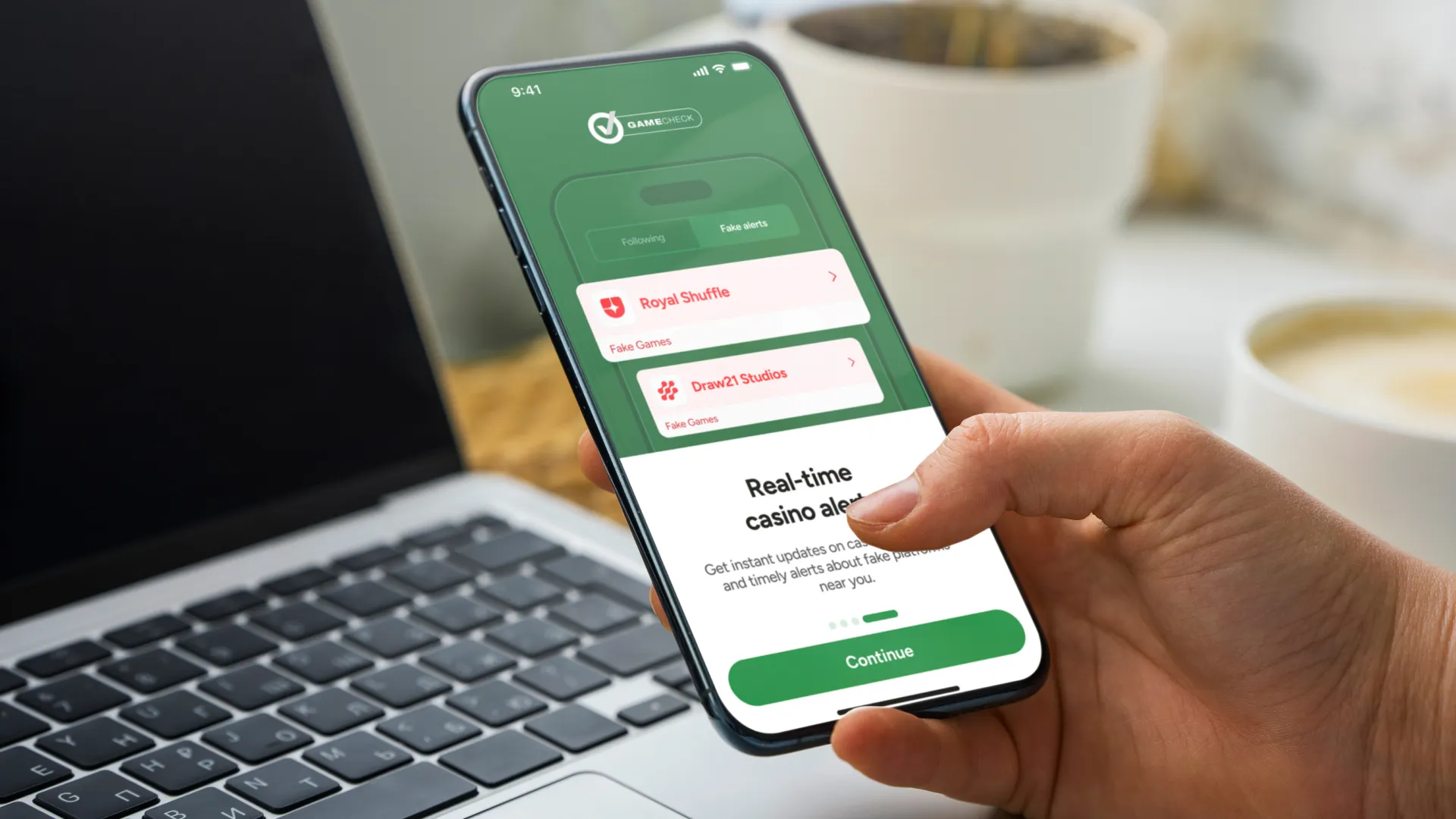
When the Gamecheck app launched in May 2025, the goal was simple: make verification easy, mobile, and instant. Six months later, the adoption curve showed that players wanted exactly that.
Gamecheck app – 2025 snapshot
- Over 16,000 downloads.
- 8,600 monthly active users.
- Top regions: Brazil, Turkey, United Kingdom.
Each download represents a decision. A player choosing not to rely on blind trust. A player choosing to check first. The app allows players to search any online casino, see whether real games are in operation, report suspicious platforms and authenticate a Gamecheck SEAL using the QR scanner.
By linking directly to blockchain-logged verification data, the app transformed trust from assumption into evidence. Players could now see a casino’s verification history, follow it, and receive updates as checks continue. That transparency changed behaviour. Players moved from guessing to knowing.
Chrome Extension: verification where it matters
While the app made verification mobile, the Chrome Extension brought protection directly into players’ browsers. Once installed, the extension automatically checks the online casino being visited and pulls its status from the Gamecheck database in real time.
Players instantly see the online casino’s verification status, number of reported cases, whether a Gamecheck SEAL is active, and if an online casino has not yet been checked, players can request verification without leaving the page they are on.
Verification became a single click instead of a complicated process. Every request feeds into Gamecheck’s investigation network, strengthening protection for everyone.
Online casinos checked: transparency at scale
In 2025, Gamecheck checked online casinos at unprecedented volume.
Online casinos checked in 2025
- 28,629 online casinos checked.
- 1,952 checks initiated by players.
- 26,677 checks initiated through Gamecheck investigations.
Every check adds to a living database that reflects the real state of the market. These numbers represent thousands of platforms examined, monitored, and documented.
Player reports and verification requests
Empowering players to act is central to Gamecheck’s mission. The Request Verification feature allows players to report suspicious online casinos directly to Gamecheck.
Each report triggers evidence collection and provider confirmation. In 2025 more than 22,000 verification requests were submitted by players. This marks a clear shift in behaviour. Verification before play is becoming normal. Players are no longer waiting to be scammed before checking an online casino.
Fake casinos exposed: accountability in action
Gamecheck's Fake Casino Exposé series became a key source of truth in 2025.
Every report is grounded in in-depth investigation by the Gamecheck team. Each exposure is built on detailed analysis of site behaviour, traffic patterns, and technical evidence. A selection of games is tested, and the findings are checked directly with the original game providers to determine whether the games in operation are real or fake.
Using this evidence-led approach, Gamecheck exposed fake casinos operating across the UK, Turkey, and LATAM. These exposures did more than warn players. By bringing visibility and accountability to rogue operators, they reduced the circulation of fake games across the industry. In some cases, exposed operators moved to real games in operation to rebuild credibility. In others, sites stopped operating altogether.
This is accountability in action - careful investigation, verified findings, and real-world outcomes that strengthen fair play for players.
Fake games detected: the heart of the mission
At the core of Gamecheck’s work is one critical task: detecting fake games.
Fake games detected in 2025
- 1,300 fake games identified.
- 300+ detections per month.
Each detection is evidence-based. Gamecheck collects launch URLs, recordings, and metadata, then confirms findings directly with official game providers. Behind every number is a player protected from fake software and manipulated gameplay.

Conversions: from fake to fair
Detection is not the end of the story. In 2025, 345 online casinos switched to real games after exposure, demonstrating that transparency does more than identify problems - it drives meaningful change. When fake games are brought into the open, platforms are forced to make a choice, and many chose to improve.
This progress is reinforced by Gamecheck’s uncompromising approach to trust. When fake games are detected, the Gamecheck SEAL is removed immediately, and affected casinos face a 12-month reapplication ban before they can seek verification again. Trust cannot be bought or negotiated. It must be earned, and it must be maintained.
The Gamecheck SEAL: trust you can verify
The Gamecheck SEAL remains the most visible symbol of fair play.
Over 20 online casinos have now earned the Gamecheck SEAL.
Behind every Gamecheck SEAL is a rigorous process:
- Evidence submission to providers.
- Confirmation that games are real.
- Public listing and monthly monitoring.
For players, the Gamecheck SEAL means proof that they are engaging with real games.
A global picture: where players are checking
Gamecheck’s reach expanded rapidly in 2025.
Blog and platform engagement came from:
- UK and the Isle of Man.
- Europe and the Balkans.
- Asia, Africa, and the Middle East.
- Australia, Canada, the United States, and LATAM.
Highest engagement was recorded in Serbia, Turkey, Brazil, Colombia, Mexico, Germany, and the UK, with the United States generating around 205 sessions per month. This mirrors wider verification activity, with Brazil and Turkey among the most active regions for checks. Fake games are a global problem and Gamecheck has positioned itself as a trusted brand globally to protect online casino players wherever they may be located.
Conclusion: from data to trust
2025 was a year of measurable progress. Gamecheck’s Domain Rating reached 58 – a level typically associated with long-established industry platforms. This growth reflects increasing trust in Gamecheck’s reporting, data, and role in helping players identify fake games. On an average month, Gamecheck supported around 20,000 players, recorded 27,000 visits, delivered 10,600 online casino profile views, and processed over 8,800 verification requests. Together, these figures represent player protection in action.
For iGaming to thrive, only real games must survive. Through every check, scan, and fake casino exposure, Gamecheck made it easier for players to know what is real, and harder for fake games to hide. As 2026 begins, one thing is clear: fair play is no longer a promise. It is a verified fact. Players now have the tools to play with the confidence they deserve.